Overview
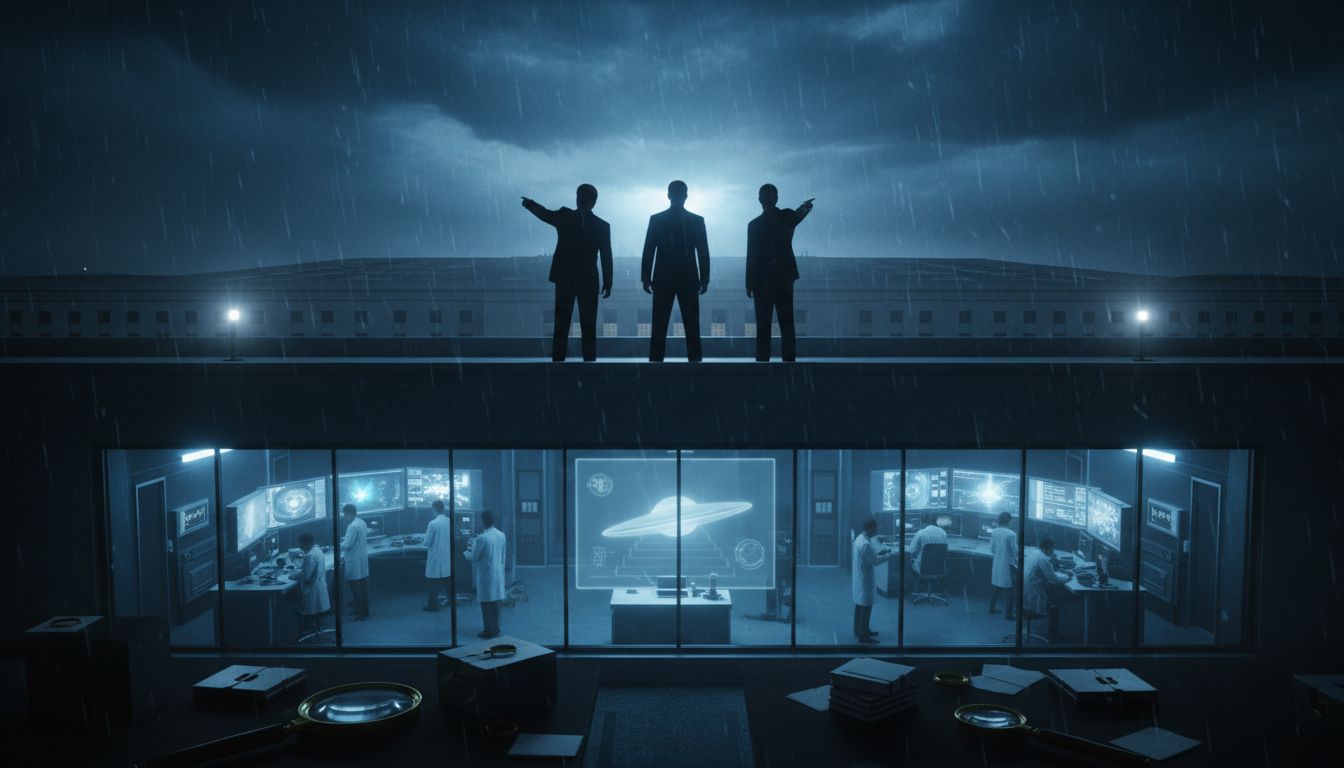
In November 2025, NewsNation reported that the Pentagon’s formal investigations into unidentified aerial phenomena (UAP) can be traced back to a 2022 congressional initiative launched by three senior senators. The lawmakers—Senators Harry Reid (D‑NV), Daniel Inouye (D‑HI) and Ted Stevens (R‑AK)—pressed the Department of Defense for greater transparency after a series of high‑profile sightings and leaked videos sparked public demand for answers. Their bipartisan effort set in motion a chain of actions that culminated in the establishment of a dedicated UAP office and a statutory requirement for regular reporting to Congress.
Legislative Push
The three senators, each a former chair of the Senate Intelligence Committee, convened a closed‑door briefing in early 2022 that brought together senior defense officials, intelligence analysts, and aerospace experts. According to the briefing transcript released to the public, Senator Reid emphasized that “the American people deserve to know whether our airspace is being compromised by unknown technologies.” Senator Inouye, speaking on behalf of the committee, called the issue “a national security imperative,” while Senator Stevens warned that “failure to investigate could leave us vulnerable to foreign adversaries.” Their joint statement urged the Pentagon to create a permanent, well‑funded entity to collect, analyze, and disseminate UAP data.
Creation of the UAP Office
Responding to the Senate’s demand, the Department of Defense announced in August 2022 the formation of the Airborne Object Identification and Management (AOIM) office, later renamed the Office of Unidentified Aerial Phenomena (UAP Office). The office was tasked with consolidating reports from pilots, radar operators, and civilian observers, and with delivering quarterly briefings to the Senate Intelligence Committee. Funding for the office was secured through the FY2023 defense appropriations bill, earmarking $45 million for personnel, advanced sensor integration, and data‑analysis tools. Pentagon spokesperson Lt. Gen. James H. Dickinson later said, “The AOIM office represents a decisive step toward systematic, science‑based evaluation of aerial anomalies.”
Ongoing Reporting and Findings
Since its inception, the UAP Office has submitted eight formal reports to Congress, each detailing the number of incidents, classification status, and investigative progress. The most recent report, released in September 2025, catalogued 173 credible sightings between 2022 and 2024, of which 12 remain unexplained after rigorous analysis. The report highlighted advances in sensor fusion technology that allowed analysts to cross‑reference radar, infrared, and visual data with unprecedented precision. While the office stopped short of confirming extraterrestrial origins, it noted that “several incidents exhibit flight characteristics that challenge current aeronautical engineering models,” prompting further collaboration with the Federal Aviation Administration and the National Aeronautics and Space Administration.
Implications for Policy and Public Trust
The bipartisan origins of the UAP investigation underscore a growing consensus that transparency on aerial anomalies is a matter of national security rather than fringe speculation. Lawmakers from both parties have cited the office’s work in recent hearings, with Senate Majority Leader Chuck Schumer stating that “the continued flow of credible data helps us safeguard our skies and maintain public confidence.” Analysts suggest that the sustained congressional oversight may pave the way for future legislative actions, such as mandatory disclosure of declassified UAP findings and the integration of UAP data into broader defense acquisition strategies. As the Pentagon refines its investigative protocols, the legacy of Reid, Inouye, and Stevens serves as a reminder that systematic, bipartisan scrutiny remains essential to navigating the unknown.