Overview
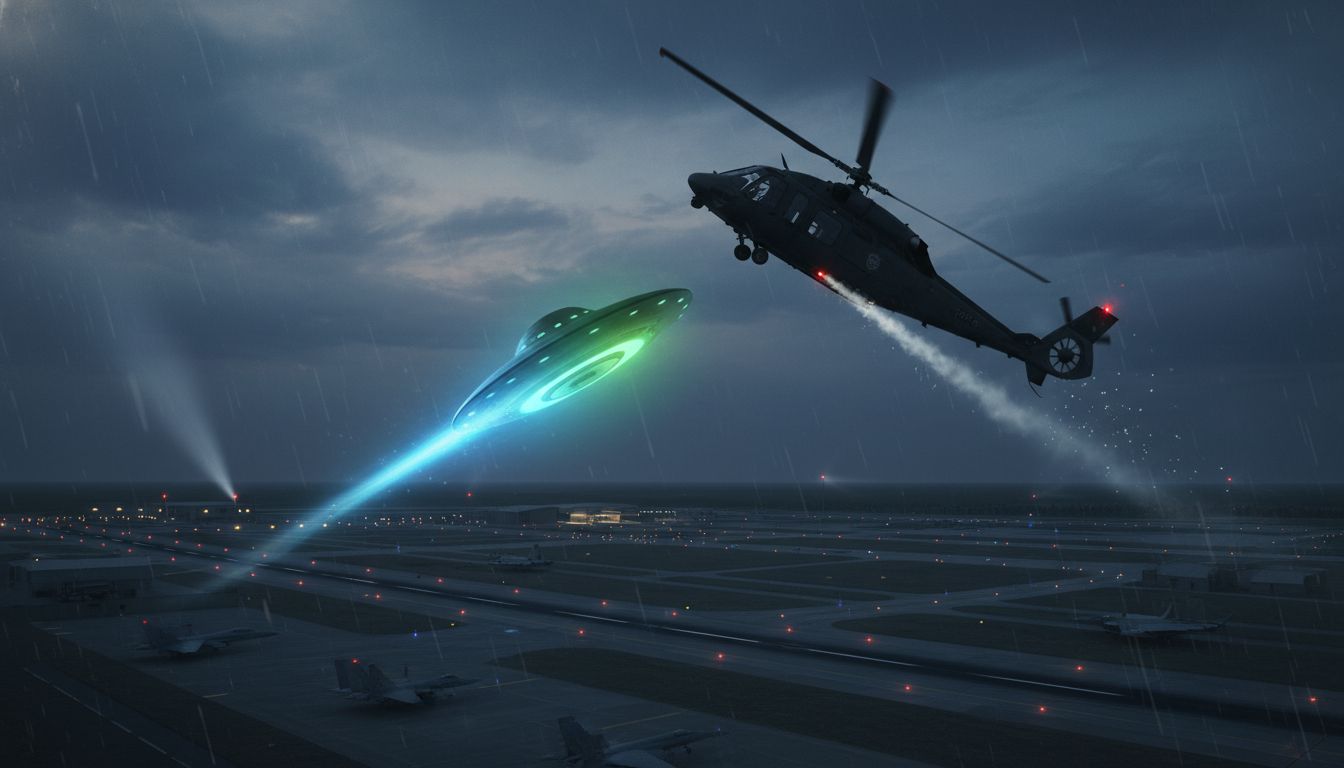
A declassified internal report obtained by the Daily Mail reveals that a police helicopter operating near Joint Base Andrews in Maryland was forced to execute an “emergency evasive maneuver” after an unidentified aerial phenomenon (UAP) appeared to lock onto the aircraft on 12 October 2024. The incident, which involved a state‑run aviation unit conducting routine patrols over the military installation, adds to a growing docket of UAP encounters that have prompted the U.S. Department of Defense to expand its investigative efforts.
Incident Details
According to the 12‑page memorandum, the police unit – a Bell 206 L‑3 model – was on a standard surveillance flight when its crew observed a luminous object hovering at approximately 2,500 feet directly ahead of the chopper. The report notes that the object “exhibited rapid, non‑conventional accelerations” and emitted a series of pulsing lights that appeared to track the helicopter’s heading.
“The flight deck officer reported a sudden loss of visual reference and an unexpected change in the aircraft’s attitude,” the document states. “Standard operating procedures dictated an immediate climb and turn to a safe altitude, which the pilot executed without injury to personnel.”
The crew logged a brief but intense maneuver lasting roughly 15 seconds before the object vanished from visual and radar detection. No damage was reported, and the helicopter completed its mission after a safety check.
Official Response
Law enforcement officials declined to comment directly on the report, citing ongoing investigations. However, a spokesperson for the Maryland State Police Aviation Unit confirmed that the flight was “conducted in accordance with all safety protocols” and that the incident is being reviewed by both state and federal authorities.
At the Pentagon, the All‑Domain Anomaly Resolution Office (AARO) – the agency tasked with cataloguing UAP encounters – acknowledged receipt of the report on 20 November 2025. AARO’s director, Dr. Sean Kirkpatrick, said in a written statement, “We are systematically evaluating all credible sightings that intersect with civilian and military airspace. This case will be examined alongside other recent reports to determine if there is a common operational pattern.”
Broader Context
The Andrews incident arrives in the wake of the U.S. intelligence community’s 2023 UAP assessment, which concluded that while most sightings could be explained, a “small number of cases remain unexplained and potentially pose a flight safety risk.” Since then, the Department of Defense has authorized additional funding for sensor upgrades and cross‑agency data sharing.
Recent high‑profile encounters, such as the “Tic Tac” incident off the Pacific coast and a series of radar‑detected objects over Nevada in early 2025, have heightened congressional scrutiny. A bipartisan UAP oversight committee held its first public hearing in March 2025, urging the Pentagon to release more detailed findings. The Andrews report underscores the expanding scope of UAP investigations beyond military pilots to include civilian law‑enforcement assets.
Next Steps
The AARO plans to integrate the Andrews flight data with its existing database, employing advanced analytics to assess trajectory, speed, and electromagnetic signatures. If corroborated, the incident could prompt revisions to standard operating procedures for law‑enforcement aircraft operating near restricted airspace.
Meanwhile, the Maryland State Police have initiated a risk‑assessment review to determine whether additional training or equipment upgrades are warranted for future patrols. As the government continues to grapple with the scientific and security implications of UAPs, incidents like the police helicopter’s evasive action serve as a reminder that unidentified aerial phenomena remain a real‑world operational concern for both civilian and military aviation stakeholders.


