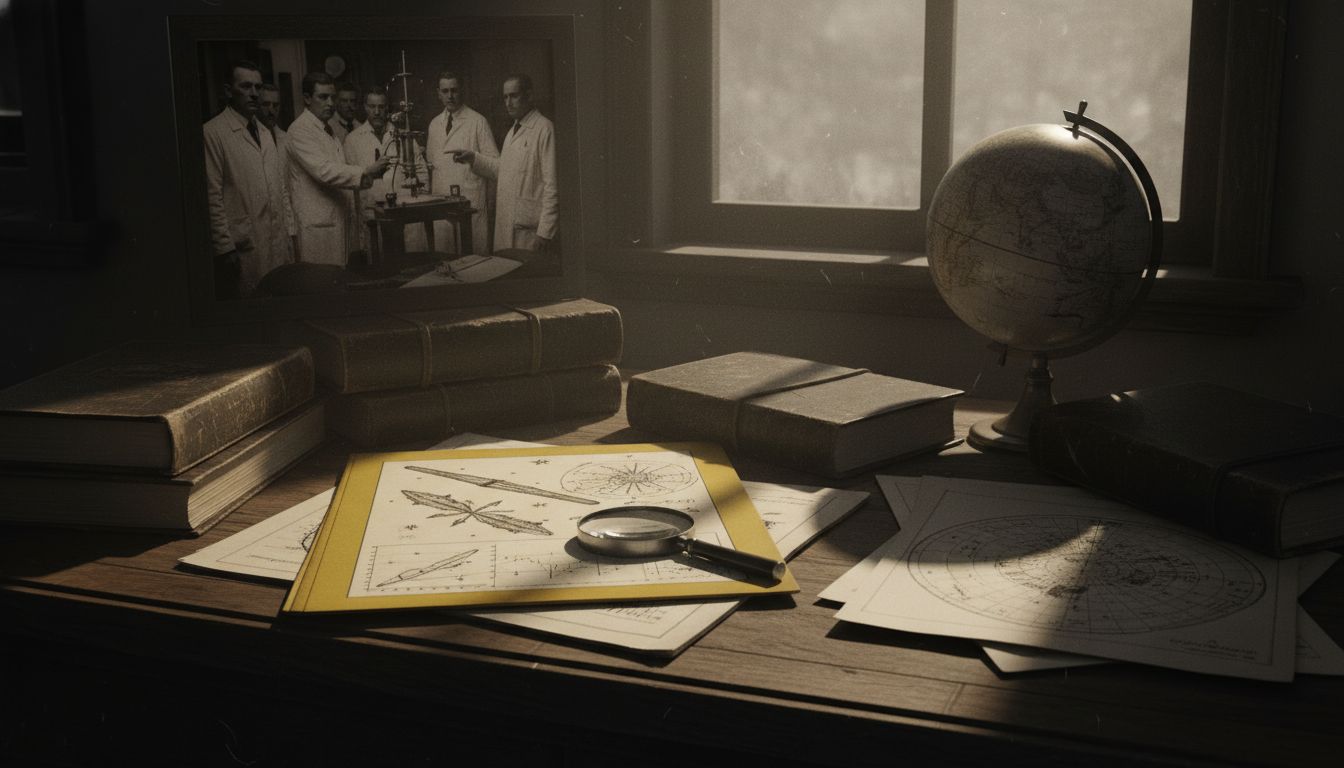
The paper highlighted by Splinter is a 1952 article titled “Star‑Like Aerial Phenomena Observed from Astronomical Observatories, 1946‑1950,” published in the Proceedings of the Royal Astronomical Society. Authored by a team of astronomers led by Dr. Elena Petrova of the Soviet Academy of Sciences, the study examined 312 anomalous luminous events recorded on photographic plates and visual logs from observatories across Europe, North America, and the Soviet Union. The researchers applied the same statistical methods used for meteor and satellite tracking, concluding that “a statistically significant subset of the observations cannot be explained by known atmospheric, astronomical, or instrumental effects.” Their analysis, peer‑reviewed at the time, was presented at the 1953 International Astronomical Union meeting, predating the launch of Sputnik by four years.
The investigators classified the sightings into three categories: “star‑like” (point sources that moved erratically), “disk‑like” (flat, rotating silhouettes), and “structured” (objects showing discernible geometry). Of the 312 cases, 57 fell into the “star‑like” group, displaying sudden accelerations, changes in brightness, and trajectories that defied conventional orbital mechanics. Petrova’s team noted that “the angular velocities measured in several instances exceed 30 km s⁻¹, far beyond the capabilities of known aircraft or early space probes,” a point that has drawn renewed attention from contemporary UAP analysts who lack comparable historical data.
The resurfacing of the study coincides with the Pentagon’s ongoing Unidentified Aerial Phenomena (UAP) Task Force, which has been urging the scientific community to adopt rigorous, data‑driven approaches. “What makes this work compelling is not that it proves extraterrestrials exist, but that it establishes a methodological baseline for treating anomalous sightings as empirical data,” said Dr. Jacques Vallée, senior researcher at the UFO Research Institute. Vallée added that the paper’s statistical rigor “mirrors the standards we are trying to embed in current UAP reporting protocols.” The Department of Defense’s recent release of the “Preliminary Assessment” on UAPs cited historical records as a key element, and the Petrova study now serves as a concrete example of such archival evidence.
Critics caution against over‑interpreting the findings. Dr. Laura Mitchell, a historian of science at the University of Cambridge, emphasized that “the Cold War context shaped both the data collection and the peer‑review process; some observers may have been influenced by secrecy or misidentification of early satellite experiments.” Nonetheless, Mitchell acknowledged that the paper’s transparent methodology—complete with raw plate reproductions and error analyses—offers a rare glimpse into mid‑century scientific attempts to grapple with unexplained aerial events.
The renewed interest has prompted a modest wave of scholarly activity. A joint project between the Smithsonian Astrophysical Observatory and the Russian Academy of Sciences is currently digitizing the original photographic plates for comparative analysis with modern radar and infrared data. As the archival work progresses, researchers hope to determine whether the “star‑like” events documented before the space age exhibit patterns consistent with today’s UAP reports. If the statistical anomalies persist, they could provide the longest continuous data set on unidentified aerial phenomena, reinforcing the call for a sustained, interdisciplinary investigation that bridges historical records with contemporary technology.