Overview
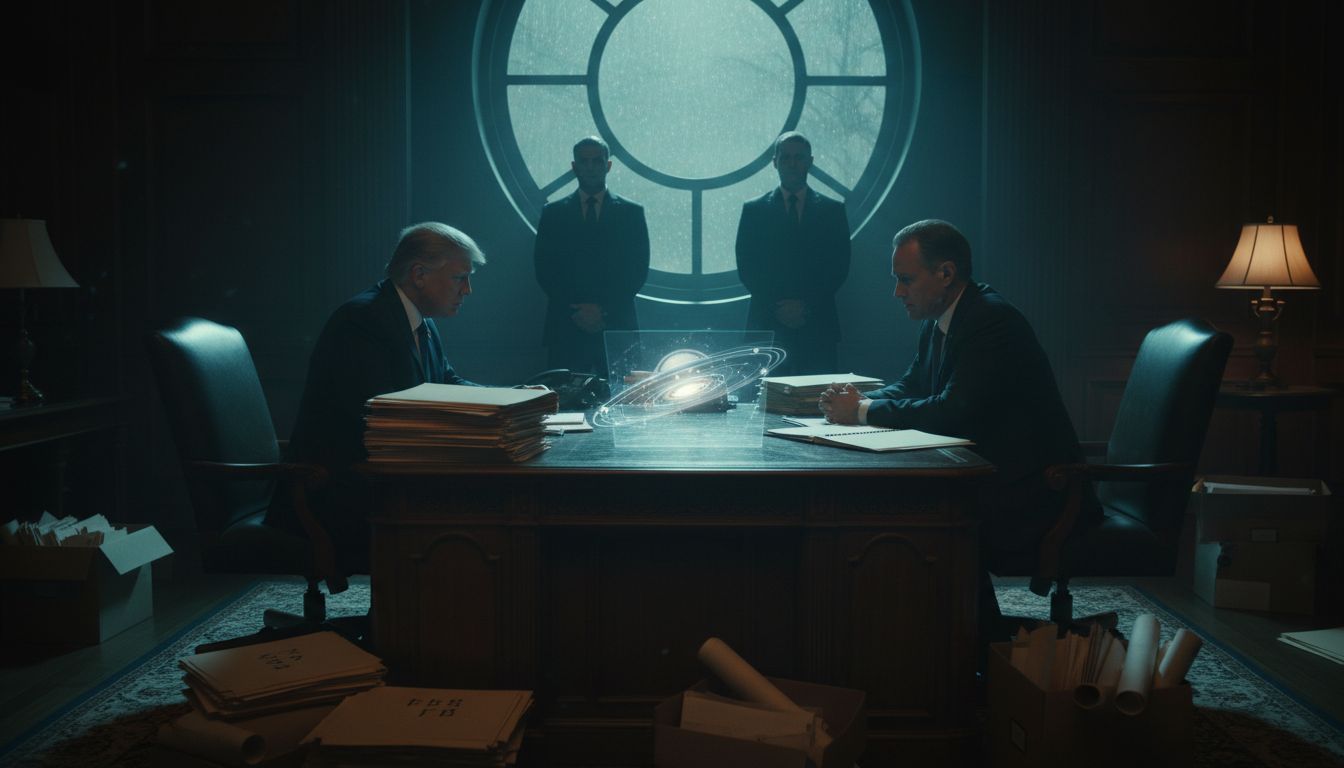
A recent episode of the Psicoactivo podcast brought renewed attention to the ongoing push for UAP (Unidentified Aerial Phenomena) disclosure in Washington. Host Pavel Ibarra highlighted Rep. Tim Burchett’s (R‑TN), co‑chair of the Congressional UAP Caucus, and his claim that former President Donald Trump was personally briefed on the matter. Burchett told journalist Matt Laslo that the conversation with Trump was “very positive” and that the former commander‑in‑chief “already knows” where relevant material is stored. While the Congressman frames the discussion as a catalyst for eventual public release, insiders and security officials warn that bureaucratic hurdles and national‑security constraints will keep any declassification effort slow and selective.
Congressional Initiative
Since the 2020 release of the Pentagon’s “UAP Task Force” report, a modest bipartisan caucus has emerged in the House, with Burchett as one of its leading voices. In the podcast, Burchett recounted urging Trump—should he return to office—to “release information if he returns to office, emphasizing that the American public needs to know.” He suggested that the executive branch possesses a “wealth of material” that could be made public, but that the decision hinges on political will rather than technical readiness. The Congressman also pointed to “five or six” deep‑sea locations where naval crews have observed high‑speed underwater objects, describing speeds “hundreds of miles per hour” that outpace the best U.S. naval craft, and lamenting the “compartmentalization” that keeps such data from congressional oversight.
Allegations of Private‑Sector Gatekeeping
Burchett’s most controversial assertion, shared in an interview with political commentator Benny Johnson, is that recovered UAP artifacts—including “craft, DNA, or life”—have been handed over to a small group of private contractors. He argued that this arrangement was deliberately designed to sidestep government oversight, congressional subpoenas, and Freedom of Information Act requests. Using a historical analogy, Burchett likened the technological gap to “bringing a modern Indian motorcycle to the settlers of the Mayflower”—the device can be started, but the underlying fuel and engineering remain incomprehensible. Critics note that no verifiable evidence has surfaced to confirm the existence of such a “quasi‑government” network, and they caution that the claim may serve more as a rhetorical device than a factual exposé.
Expert Context and Caution
UAP scholars and former intelligence officials have responded with measured skepticism. Former Deputy Assistant Secretary of Defense Christopher Mellon, who has long advocated for transparency, warned that “the bureaucracy and classification regimes in place make rapid release unlikely, even with executive encouragement.” Historian Greg Eghigian added that “political promises often outpace the practicalities of intelligence declassification,” while Harvard‑affiliated astronomer Avi Loeb emphasized that “extraordinary claims require extraordinary evidence, and so far the public record lacks the concrete data needed to substantiate the alleged private‑contractor cache.” Collectively, these experts suggest that while the political momentum may rise, the substantive release of verifiable UAP data remains a distant prospect.
Outlook
The episode underscores a shifting strategy among a subset of lawmakers: rather than relying solely on traditional intelligence channels, they are seeking high‑level political leverage to break what they describe as a “cover‑up.” Whether that approach will translate into actionable policy depends on several variables—future election outcomes, the willingness of the current administration to revisit classified programs, and the ability of congressional committees to compel disclosure without overstepping legal boundaries. For now, the narrative remains a blend of hopeful rhetoric, unverified allegations, and the entrenched reality of national‑security protocols that have historically limited public access to UAP information.
The article reflects statements made on the Psicoactivo podcast and publicly available comments from involved parties. No new classified material was obtained for this report.


