Overview
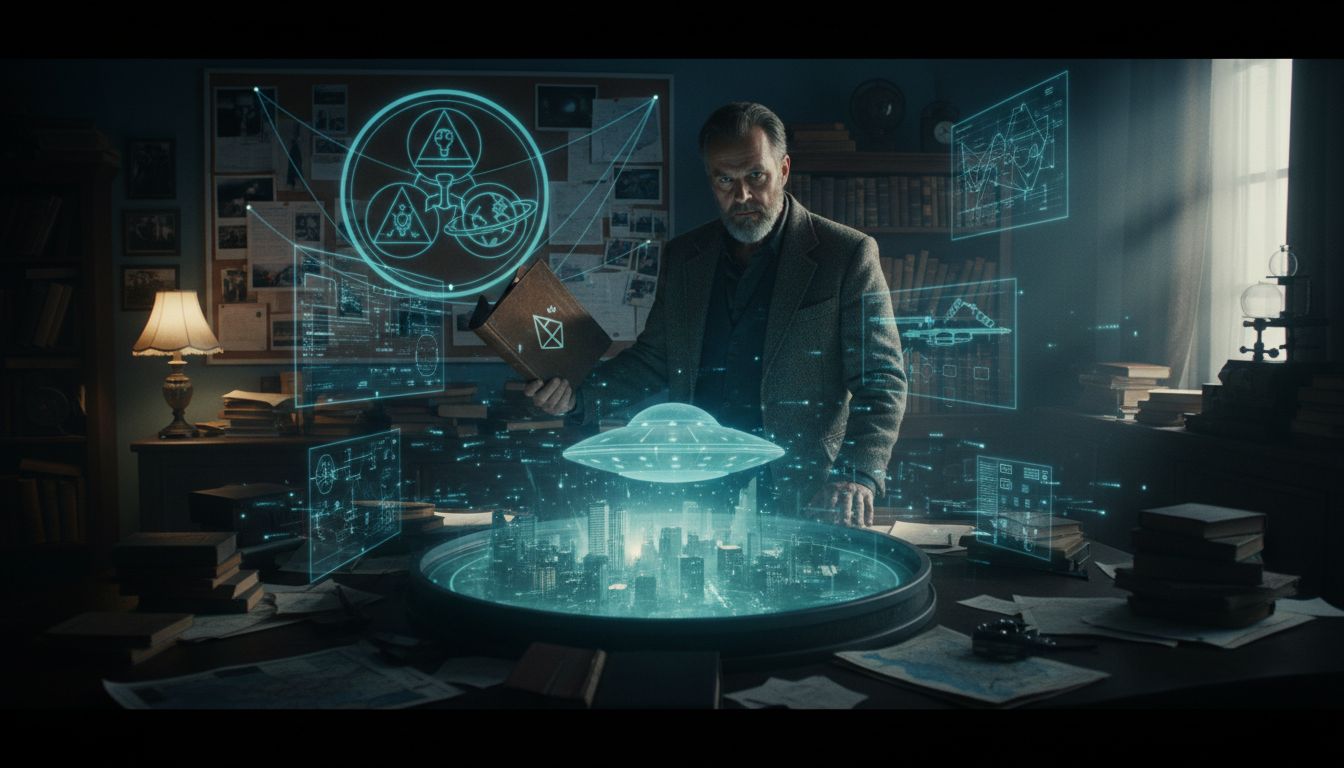
A wave of internet speculation resurfaces each time an unexplained light or aerial phenomenon is reported, and one of the most enduring narratives is the “Project Blue Beam” conspiracy. Originating in the early 1990s, the theory alleges that a covert coalition of governments, intelligence agencies and space organizations plans to stage a massive holographic alien invasion to destabilize religions, erase national borders and usher in a single world government. The claim was first articulated by Canadian writer Serge Monast, who said he had obtained secret documents outlining a staged “New World Order” that would begin with the astrological Age of Aquarius in 1983.
Monast’s Blueprint and Its Claims
Monast’s 1994 pamphlet, Project Blue Beam (NASA), laid out a four‑stage program: (1) engineered earthquakes to discredit existing religious sites, (2) a gigantic “space‑based” laser show projecting three‑dimensional images of deities or extraterrestrials, (3) telepathic “mind‑control” via low‑frequency waves, and (4) a coordinated “global event” that would convince the public to accept a new, unified belief system. Monast argued that the United Nations and a shadowy “global elite” would use this technology to replace traditional faiths with a synthetic, state‑mandated doctrine. Though the pamphlet never presented verifiable evidence, it quickly gained traction among fringe forums and later resurfaced whenever high‑profile UFO sightings occurred.
Scholarly Rebuttal: Dr. Russell Moul
In a recent article for IFLScience, astrophysicist Dr. Russell Moul systematically deconstructed the Blue Beam narrative. Moul highlighted that the technological requirements—planet‑wide holographic projection, precise seismic manipulation, and global mind‑control—exceed the capabilities of even the most advanced space agencies. “The physics of projecting a three‑dimensional image visible to the naked eye from orbit would demand energy outputs comparable to a small star,” Moul wrote, noting that no such power sources exist in public or classified programs. He also traced Monast’s alleged “secret documents” to a series of unverified leaks that have never been corroborated by independent investigators, concluding that the theory rests on speculative extrapolation rather than empirical data.
Related UFO Controversies
While Project Blue Beam remains unsubstantiated, it often intertwines with other long‑standing UFO cases that continue to fuel public curiosity. The alleged underground Dulce Base in New Mexico, first mentioned in the 1970s, describes a secret joint US‑Soviet facility where extraterrestrials and humans purportedly conduct experiments. The 1961 Barney and Betty Hill abduction—the first widely publicized claim of a civilian alien encounter—has been examined repeatedly, with psychologists attributing the experience to sleep paralysis and cultural influences rather than extraterrestrial contact. Similarly, the 1966 Westall incident in Melbourne, where over 200 students reported seeing a silver disc land in a school field, remains unresolved, though investigations have found no conclusive evidence of a hoax or foreign aircraft. These episodes, like Blue Beam, illustrate how anecdotal testimony and media coverage can perpetuate belief in hidden agendas.
Continuing Influence and Public Perception
Despite scholarly refutations, the Blue Beam myth persists, shaping how some observers interpret contemporary aerial events—from unidentified drones to satellite re‑entries. Social‑media algorithms amplify sensational claims, and the theory’s framing of a “global technocratic takeover” resonates with broader anxieties about surveillance, climate policy and geopolitical centralization. Experts caution that while conspiracies can highlight legitimate concerns about transparency, they also risk undermining public trust in scientific institutions. As Dr. Moul emphasized, “Critical thinking and evidence‑based inquiry are essential tools for separating genuine technological breakthroughs from the allure of a well‑crafted myth.”


