Discovery in the Dakhla Oasis
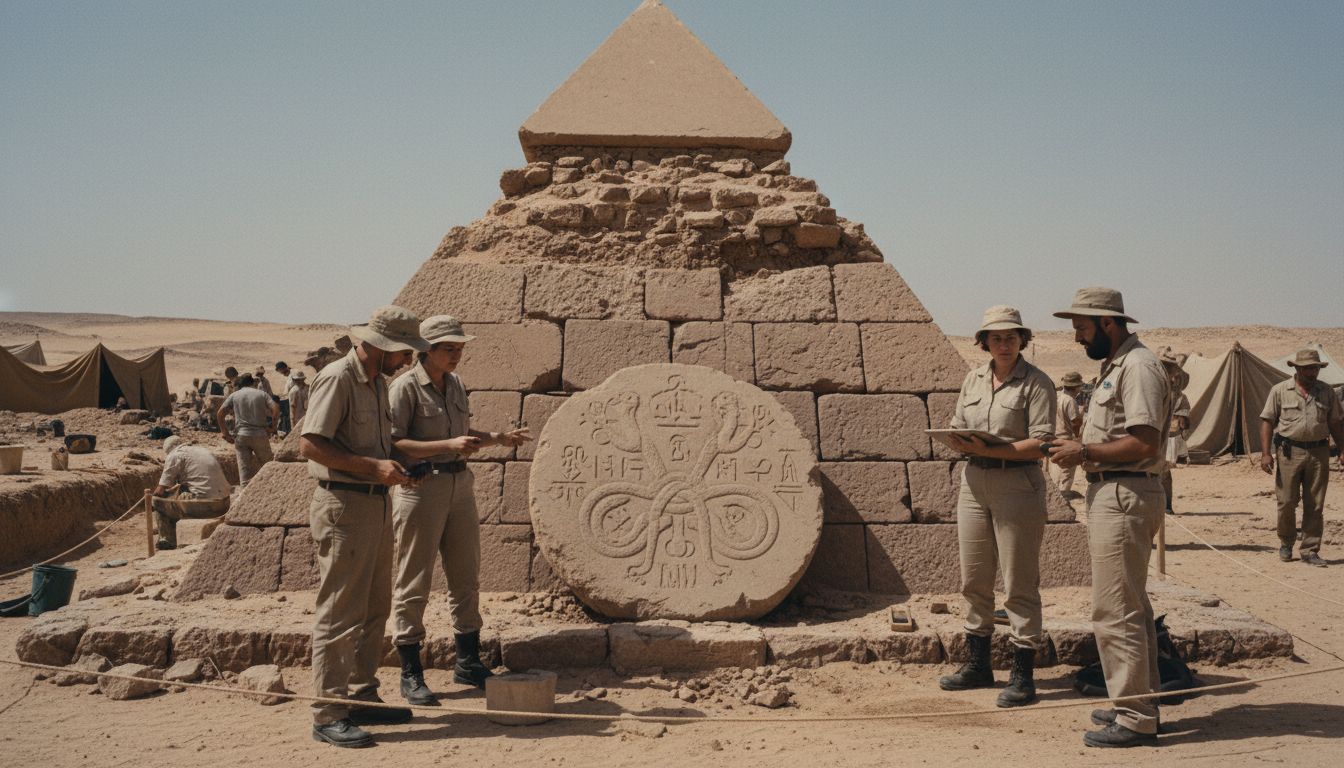
Archaeologists have reportedly uncovered a pyramid-shaped Roman-era tomb at Bir Al-Shaghala in Egypt’s Dakhla Oasis, a remote region of the Western Desert. The mud-brick structure was found by an Egyptian archaeological mission operating under the country’s Supreme Council of Antiquities. According to the available account, the tomb was built for a man and his wife and remained sealed behind a stone barrier at its entrance.
Although the burial dates to the Roman period, its decoration draws heavily on much older Egyptian religious traditions. The tomb’s design reflects continued belief in Egyptian gods, protective magic and the dangers faced by the dead during their journey through the underworld. The discovery is notable because it illustrates how ancient Egyptian funerary customs continued to influence burial practices centuries after the age of the pharaohs.
A Protected Entrance
Access to the tomb required descending a staircase of 14 steps toward a sandstone doorway constructed in a distinctly Egyptian style. Hieroglyphic inscriptions around the entrance contained funerary spells and protective recitations intended to safeguard the burial and those interred within it. Above the doorway, a winged sun disk was shown alongside two cobras, imagery commonly associated with divine protection and royal or sacred power.
The doorway itself was blocked by a stone sealing slab bearing Osirian imagery and additional funerary texts. Osiris, the god associated with death, resurrection and judgment, was among the most important deities in ancient Egyptian mortuary belief. The arrangement of inscriptions and images suggests that the threshold was deliberately conceived as a guarded boundary between the world of the living and the realm of the dead.
The Seventh Hour of the Amduat
The most significant feature identified so far appears above the doorway on the upper lintel: a depiction of the seventh hour of the Amduat, one of ancient Egypt’s major Books of the Netherworld. Egyptian authorities reportedly said that this is the first example of this specific scene documented among the tombs of Bir Al-Shaghala.
The Amduat describes the sun god Ra’s nightly passage through 12 hours of darkness after the sun disappears below the western horizon. During the seventh hour, Ra confronts Apophis, the immense serpent representing chaos and destruction. The sun god’s successful passage allows the cycle of darkness and rebirth to continue, making the scene a powerful symbol of protection, renewal and the restoration of cosmic order.
Religious Meaning and Roman-Era Continuity
For ancient Egyptians, underworld imagery served a practical religious purpose rather than functioning solely as decoration. Spells, divine figures and scenes from sacred texts were intended to guide the deceased, protect them from supernatural threats and connect their fate with the sun’s daily rebirth. Placing the seventh-hour scene above the tomb entrance may therefore have linked the buried couple’s passage into the afterlife with Ra’s own dangerous journey through the underworld.
The finding also highlights the endurance of Egyptian religious ideas under Roman rule. More than a millennium after similar underworld texts were associated with royal burials, Egyptian-inspired beliefs continued to appear in private tombs in the oasis. Beyond the sealed entrance, archaeologists identified a transverse mud-brick hall with a vaulted ceiling, part of which had collapsed on its western side. The source account ends while describing two burial chambers, and provides no further details about their condition, contents or inscriptions.