Overview
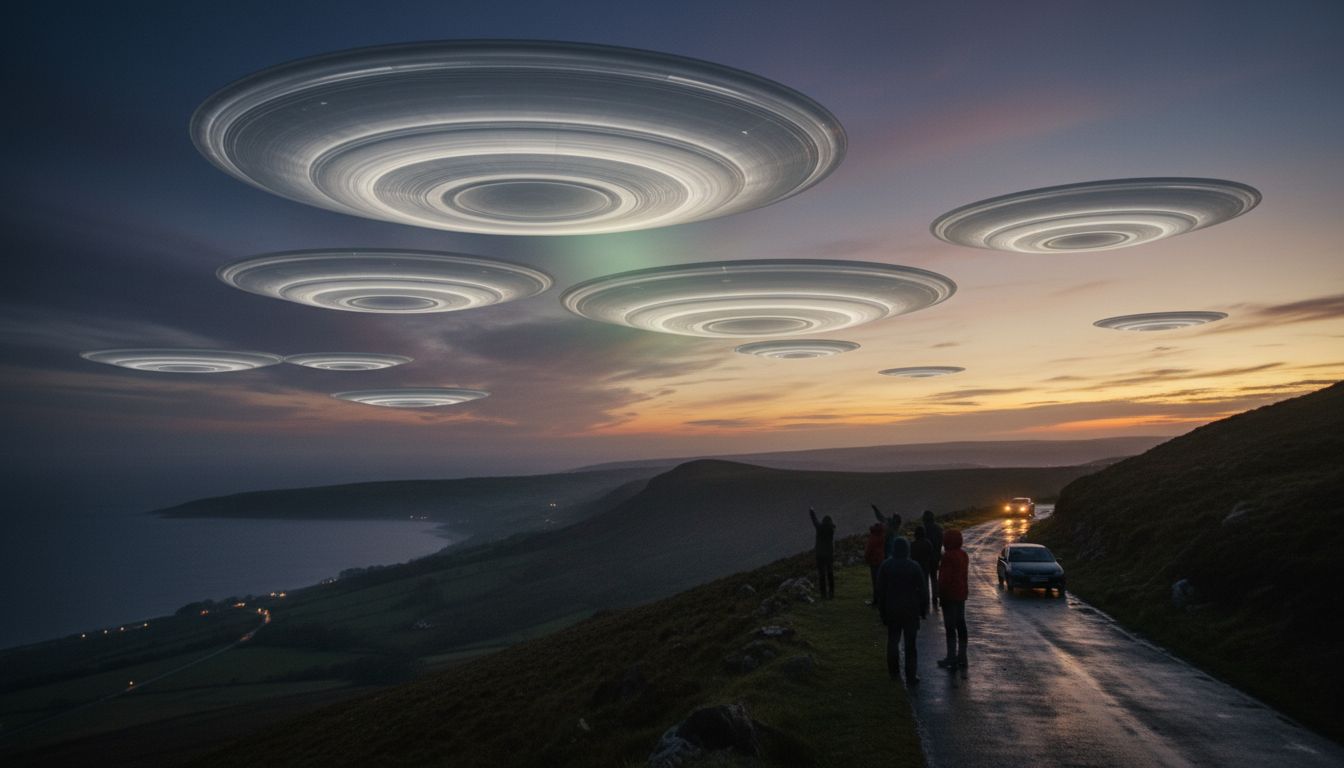
Late last week, visitors to New Borough Beach on Anglesey reported a series of disc‑shaped cloud formations that many described as resembling flying saucers. The photographs, posted on social media and later circulated by the BBC, showed three nearly perfect, flat circles hovering over the coastline. While the images sparked a wave of online speculation about extraterrestrial activity, meteorologists quickly identified the phenomenon as a rare type of lenticular cloud, a lens‑shaped formation that can appear under very specific atmospheric conditions.
Witness Accounts
Emily Camp, a local photographer who was on the beach at the time, said the clouds “looked like pancakes floating in the sky, perfectly round and completely still.” Another visitor, Gareth Morgan, told the BBC that “they were so crisp and symmetrical, I thought I was looking at a movie set.” Amelia Shone‑Adams, BBC Wales correspondent, noted that the sighting attracted a “surge of curiosity” on regional forums, with some commenters humorously dubbing the clouds “UFOs” and urging others to “look up before it’s too late.”
Scientific Explanation
Lenticular clouds form when stable, moist air flows over a mountain range and is forced upward, creating a wave pattern in the atmosphere. When the rising air reaches the dew point, moisture condenses into a smooth, lens‑like cloud that can remain stationary for minutes or even hours. Dr. Hannah Ellis, a senior meteorologist at the Met Office, explained:
“The conditions over the Snowdonia and Anglesey area last week were ideal – a strong, steady wind from the west combined with a temperature inversion created a standing wave. When that wave hits the right humidity level, you get the classic lenticular shape, which can look eerily artificial to the untrained eye.”
Ellis added that such clouds are uncommon in the UK, occurring most frequently in mountainous regions where the airflow is consistent enough to sustain the wave. The clouds’ flat underside and rounded top are a direct result of the airflow’s laminar nature, distinguishing them from typical cumulus formations.
Historical and Geographic Context
Lenticular clouds have been documented worldwide, from the Rocky Mountains of the United States to the Andes of South America. In the United Kingdom, sightings are infrequent, largely confined to the highlands of Scotland and the upland areas of Wales. Photographs of similar formations over the Glyderau range in Snowdonia have appeared sporadically in the past decade, often attracting the same mix of awe and speculation.
The term “pancake cloud” is a colloquial nickname reflecting the cloud’s flat, circular appearance; the scientific name derives from the Latin lenticularis, meaning “lens‑shaped.” Their rarity in the British Isles makes each occurrence a noteworthy event for both amateur sky‑watchers and professional meteorologists.
Public Reaction and Clarification
Following the initial flurry of social‑media posts, the Met Office issued a brief advisory on its website, clarifying that the formations posed no hazard to aviation and were simply a visual manifestation of normal atmospheric dynamics. Local tourism officials, while acknowledging the buzz, emphasized that the clouds were “a natural spectacle that adds to the region’s scenic appeal.”
The episode underscores how unfamiliar natural phenomena can quickly become viral in the digital age, especially when they intersect with popular cultural motifs such as UFOs. By providing clear scientific context, experts hope to balance public fascination with accurate information, ensuring that future sightings are appreciated for their meteorological significance rather than misinterpreted as evidence of the extraordinary.


