Overview
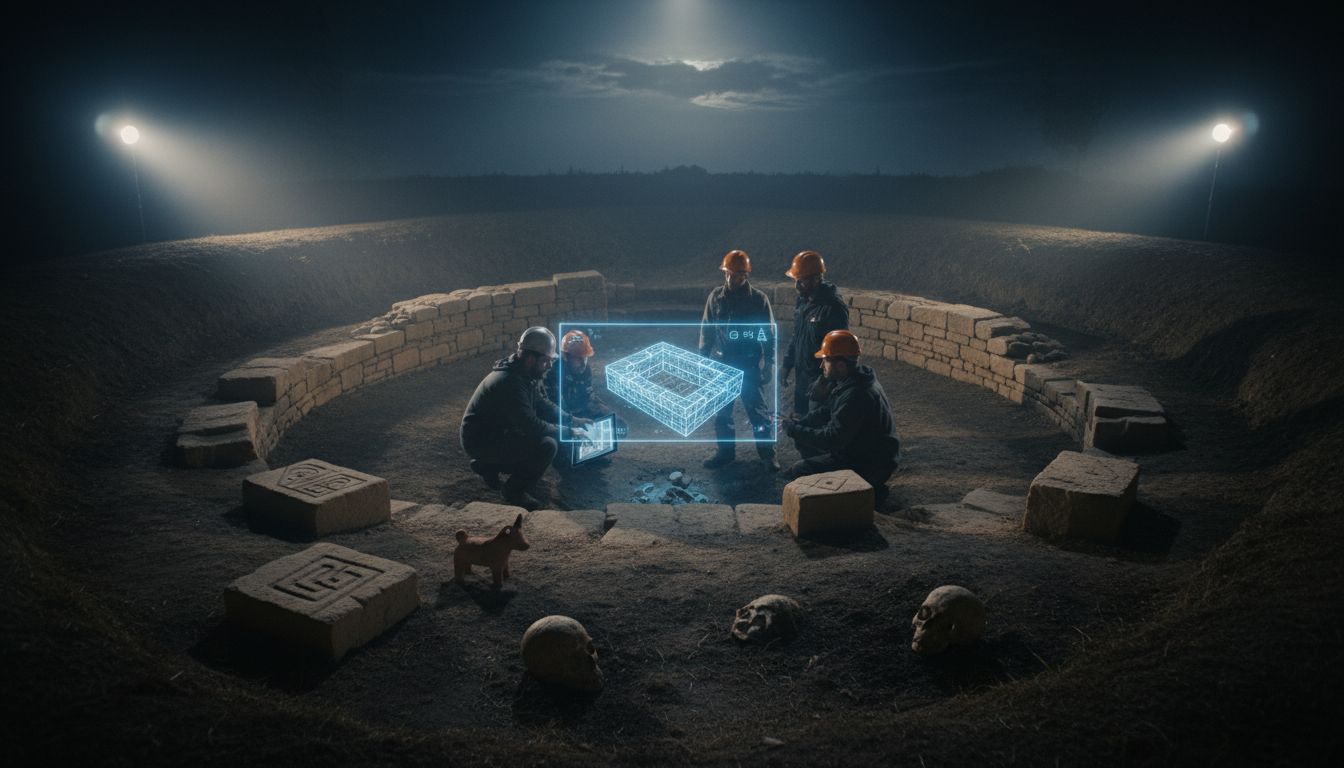
During a 1988 construction project in the western Slovak town of Holíč, workers uncovered a cluster of unusually large stones buried three metres underground. The discovery, initially dismissed as a natural formation, quickly attracted the attention of Slovak ethnologist Rudolf Irša, who documented a human skeleton beneath the biggest stone (6.8 m long) and a series of enigmatic engravings on its flat surface. Although the site was later moved and re‑arranged near the town’s castle, the stones remained largely untouched until a multidisciplinary team returned in 2022 to apply modern 3‑D reconstruction techniques and reassess the find.
New Analyses and Key Findings
The 2022 fieldwork combined laser‑scanning, photogrammetry, and comparative typology to generate a high‑resolution digital model of the stone arrangement, revealing that the stones were originally set in a circular “rondel”—a layout typical of Late Neolithic ceremonial sites across Central Europe. The team identified three categories of engravings: (1) conchoidal abductions, which are shallow flakes removed during stone shaping; (2) large flat‑bottomed traces about 5 cm wide; and (3) narrow V‑profiled incisions bearing zoomorphic and anthropomorphic motifs, some forming nested hoops.
Among the artefacts recovered from the deeper layers were a sandstone dagger, a Lengyel‑culture clay animal figurine, and fragments of pottery. Although the original human skulls reported by Irša have since been lost, archival photographs confirm their presence, suggesting a possible ritual deposition of human remains. The engravings and artefacts together point to a complex symbolic program that aligns Holíč with other megalithic traditions found along the Danube and in western France.
Context Within European Megalithic Traditions
The Holíč rondel adds to a growing corpus of Neolithic sites that blend architectural engineering with expressive art. Similar stone circles in the Morava River basin and the famed megalithic complexes of Brittany display comparable decorative motifs, especially the V‑profiled incisions that echo the “nested hoop” pattern identified at sites such as the Carnac alignments and the Giant’s Ring in Ireland. Researchers note that the presence of a Lengyel‑style figurine—a culture dated to roughly 5400–4500 cal BC—strengthens the argument that Holíč participated in a wide‑reaching exchange network of ideas, materials, and ritual practices across prehistoric Europe.
Limitations and Scholarly Caution
A major obstacle to definitive chronology is the absence of direct radiocarbon dates from the site; the original human remains were lost during the relocation, and no organic residues remain on the stones themselves. Consequently, the team relies on typological comparison with securely dated Lengyel contexts and on the stratigraphic information recorded by Irša in 1988. While the digital reconstruction offers compelling visual evidence of a circular layout, scholars caution that the current arrangement—presented as a sundial‑like formation—does not reflect the original configuration and may mislead casual observers.
Outlook for Future Research
The authors stress that Holíč’s rediscovery underscores the importance of revisiting “forgotten” archaeological sites with contemporary technologies. The 3‑D model is now publicly accessible, enabling researchers worldwide to conduct comparative analyses without further disturbing the fragile stones. Planned initiatives include targeted soil sampling for micro‑charcoal and portable X‑ray fluorescence (pXRF) surveys to detect trace elements that could refine the site's chronological framework. If successful, these efforts could cement Holíč’s role as a key node in the Neolithic megalithic network, offering fresh insights into the social and symbolic landscapes of early farming societies in Central Europe.


