Roswell, New Mexico—best known worldwide for the 1947 crash that sparked the modern UFO phenomenon—has become a tourist magnet for alien‑enthusiasts, souvenir shops and a steady stream of conspiracy‑theory documentaries. Yet the town’s cultural landscape tells a very different story when it comes to its Jewish community. According to the Jewish Telegraphic Agency, the only synagogue that ever served Roswell, Congregation B’nai Israel, shuttered its doors and merged with a congregation in Albuquerque five years ago, leaving the city’s Jewish population at a handful of individuals. “They didn’t have a rabbi and they only met twice a month, on Fridays,” said Leslie Lawner, who moved to Albuquerque with her husband in 2020. “There was really nothing we could do for them.” Their departure reduced an already tiny Jewish presence by two members, underscoring a demographic pattern common to much of rural New Mexico, where the overall Jewish population is less than one percent.
The story of Roswell’s extraterrestrial fame begins on a July day in 1947, when rancher W.W. “Mac” Brazen reported finding rubber strips, tin foil, and thick paper on his property. Sheriff George Wilcox forwarded the material to the Roswell Army Air Field, which issued a press release claiming the recovery of a “flying disc.” Within days, military officials retracted the statement, attributing the debris to a weather balloon. The incident might have faded into obscurity if not for the persistent advocacy of Stanton T. Friedman, an Ashkenazi‑Jewish nuclear physicist who turned his career toward what he called “ufology.” Friedman’s 1970s investigations, public lectures and best‑selling books kept the Roswell narrative alive, and he famously described the government's handling of the case as a “cosmic Watergate.” Although Friedman died in 2019, a granite plaque in downtown Roswell commemorates his work, and his legacy remains a touchstone for UFO researchers worldwide.
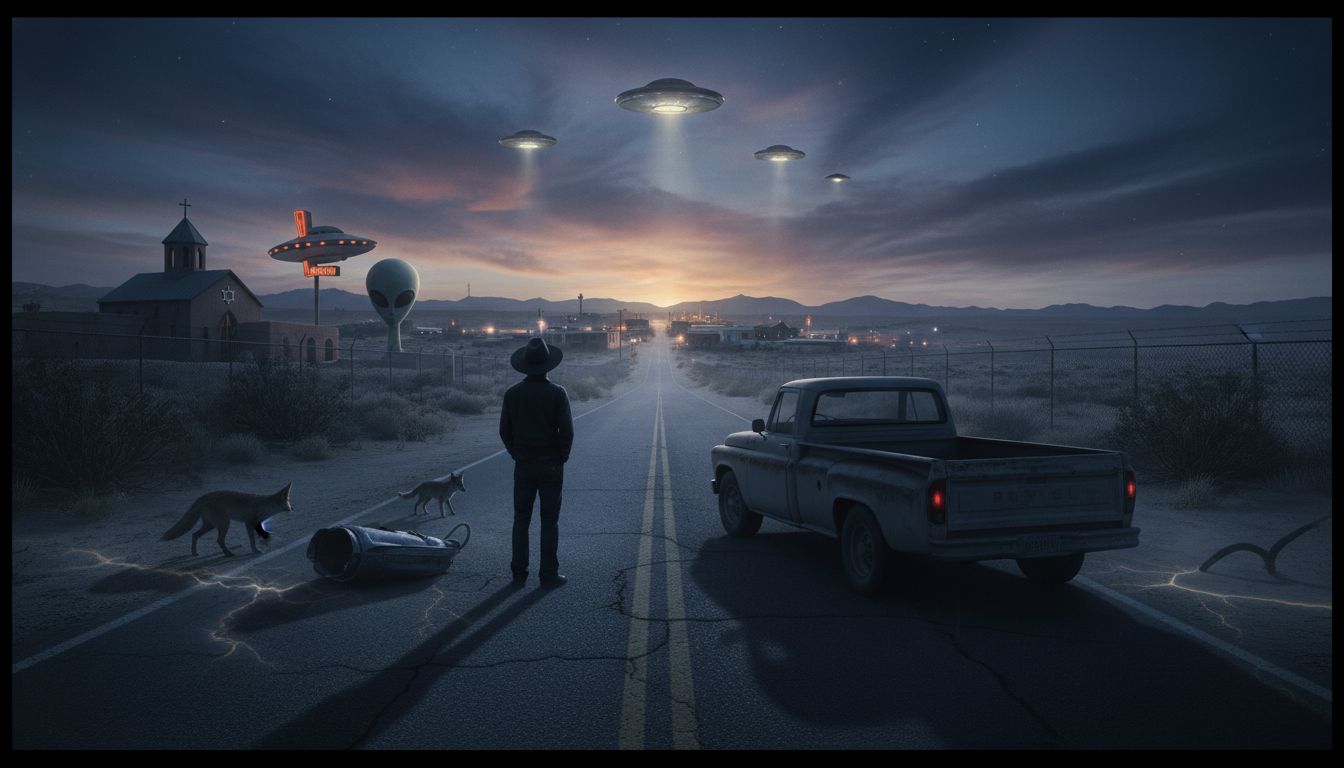
Roswell’s embrace of the alien mythos is evident in the town’s visual landscape. A stylized saucer crowns the “Welcome to Roswell” sign on U.S. 380, a UFO‑shaped McDonald’s serves meals to curious visitors, and alien figurines adorn the windows of local businesses such as White Mattress and the Western Inn. Seasonal decorations frequently feature extraterrestrials, and the city’s annual UFO festival draws thousands of attendees, bolstering the local economy. The Chaves County Courthouse even displays a granite monument that combines the Ten Commandments with a Star of David, a reminder of the brief but notable Jewish imprint on a town otherwise dominated by sci‑fi iconography.
The juxtaposition of Roswell’s UFO fame and its minimal Jewish presence reflects broader settlement trends in the Southwest. According to the U.S. Census Bureau, New Mexico’s Jewish residents number roughly 15,000 statewide, concentrated in larger urban centers such as Albuquerque and Santa Fe where community institutions, schools and kosher services are available. Rural towns like Roswell, with a population of about 47,000, lack the critical mass needed to sustain a permanent congregation, leading to closures like that of B’nai Israel. Demographers note that the region’s historic migration patterns, economic opportunities tied to agriculture and the military, and limited Jewish immigration after World War II have all contributed to the sparse distribution.
While the town continues to capitalize on the 1947 incident—most recently after the Air Force released a 231‑page report in 1997 reaffirming the weather‑balloon explanation—its cultural identity remains a paradox: a place where conspiracy theories flourish amid a near‑absence of the very community that helped launch the modern UFO discourse. As Roswell’s neon saucers glow over desert plains, the legacy of Stanton Friedman stands as a singular bridge between a once‑vibrant Jewish congregation and an enduring fascination with the unknown.