Overview
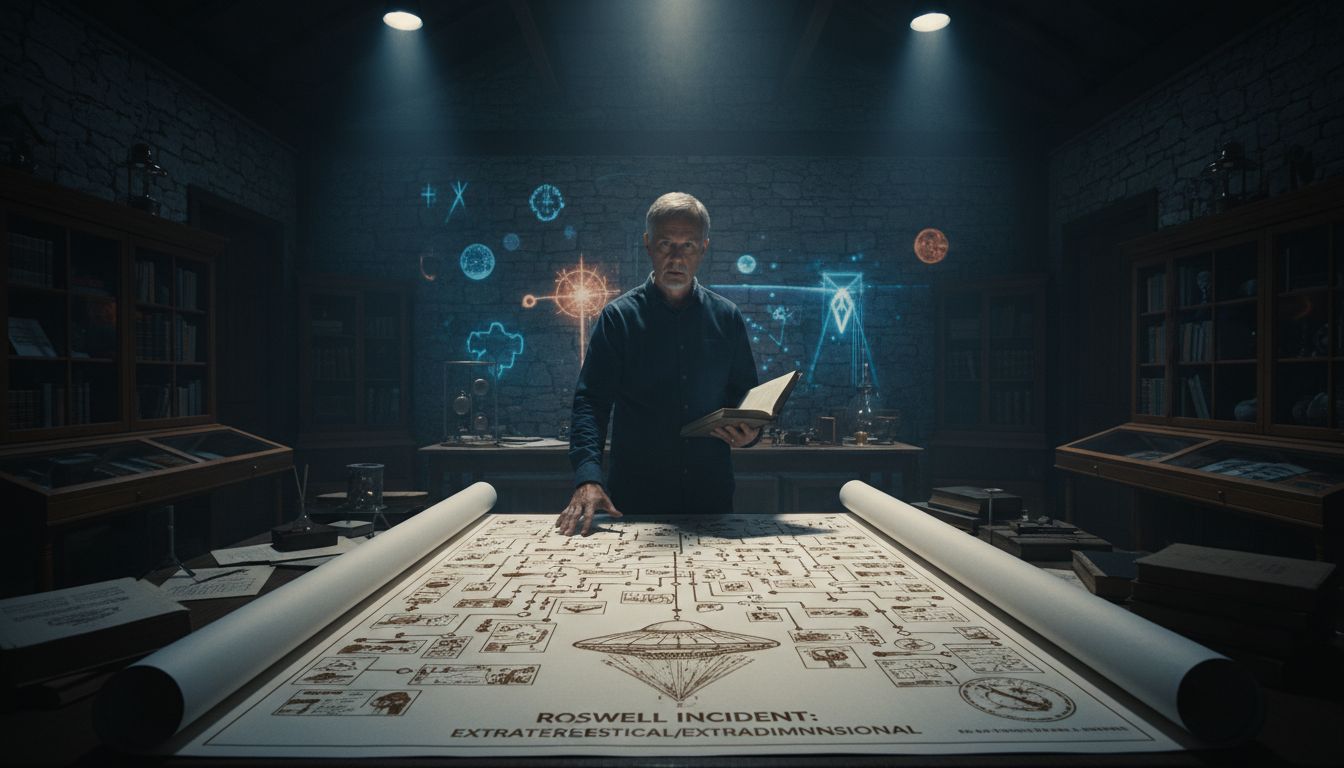
In a newly released video, independent researcher Michael Schratt presents an illustrated chronology of the 1947 Roswell incident that expands on the earlier investigations of historians Paul Schmitt and Kevin Carey. The 30‑minute presentation, titled Roswell Revisited 2026, combines newly digitised photographs, declassified documents and a series of eyewitness testimonies to construct what Schratt describes as “the most complete timeline to date.” While the mainstream narrative continues to attribute the debris to the classified Project Mogul balloon, Schratt argues that the pattern of military actions, material descriptions and subsequent testimonies point to an “extraterrestrial or extradimensional” event that has been systematically concealed.
Chronology of Key Events
Schratt’s timeline begins on July 2, 1947 at 11:59 p.m., when a lightning strike allegedly caused an “egg‑shaped” craft to explode over the Foster Ranch near Corona, New Mexico, scattering debris that included a metallic “tin‑foil” material, a memory‑metal that re‑formed after being crushed, and I‑beams bearing what he calls “purple, Asian‑like hieroglyphics.” The following day, rancher Mac Brazel and a local boy, Timothy Dee Proctor, discovered the field. Between July 4 and July 6, Brazel showed fragments at a rodeo and a bar before reporting the find to Chaves County Sheriff George Wilcox on July 6.
On July 7, Major Jesse Marcel and CIC officer Sheridan Cavitt arrived, and an “archaeologist and students” reportedly located a 13‑foot escape pod 35 miles north of Roswell, containing two deceased entities and a survivor. The next day, Colonel William Blanchard issued the famous press release announcing the capture of a “flying saucer.” By July 9, General Roger Ramey publicly re‑characterised the debris as a weather balloon, and the alleged alien bodies and pod were moved to Hangar P‑3 (Building 84) at Roswell Army Airfield. Schratt notes that the military allegedly employed industrial‑vacuum equipment to remove all trace evidence from the site.
Witnesses and Testimony
The video highlights several individuals whose statements have resurfaced in recent declassification efforts. Mac Brazel is portrayed as having been “quietly compensated” after his discovery, a claim supported by a 1952 purchase record for a new truck. Major Jesse Marcel, who handled the material, maintained that the alloys were “not of this world,” a sentiment echoed by his son, Jesse Marcel Jr., who recalled childhood memories of the hieroglyphic symbols. Former 509th Bomb Group sergeant William “Bud” Taylor described the interior of the pod as containing “fiber‑optic cables, flat‑screen monitors and humanoid corpses.”
Additional testimony cited includes pilot Oliver “Pappy” Henderson, whose wife Sappho Henderson later confirmed his private admissions of transporting the craft to Wright Field, and Colonel Philip Corso, who alleged that recovered technology was deliberately “seeded” into corporations such as IBM and Hughes Aircraft. While these accounts have not been independently verified, they form a core part of Schratt’s argument that the incident had long‑term technological ramifications.
Evidence, Counter‑Claims, and Context
Schratt confronts the official Project Mogul explanation by pointing to the “memory metal” and the hieroglyphic markings, which he argues lack any known terrestrial analogue. He also references the **full‑body cavity searches of


