Overview
In late 2024 a series of nocturnal incursions over several Royal Air Force (RAF) stations in the United Kingdom sparked a wave of speculation that the sightings might be linked to unidentified aerial phenomena (UAP) and even nuclear‑weapon security risks. A detailed analysis by Franc Milburn, published in Liberation Times and based on the paper “Russian Hybrid Operations Part One,” now concludes that the events were Russian hybrid drone operations, not mysterious UFOs. The assessment aligns with a December 2024 attribution by Britain’s MI6 and arrives as the U.S. Department of Defense issues new guidance expanding base commanders’ authority to counter a growing domestic drone threat.
Recent Overflights and the UFO Narrative
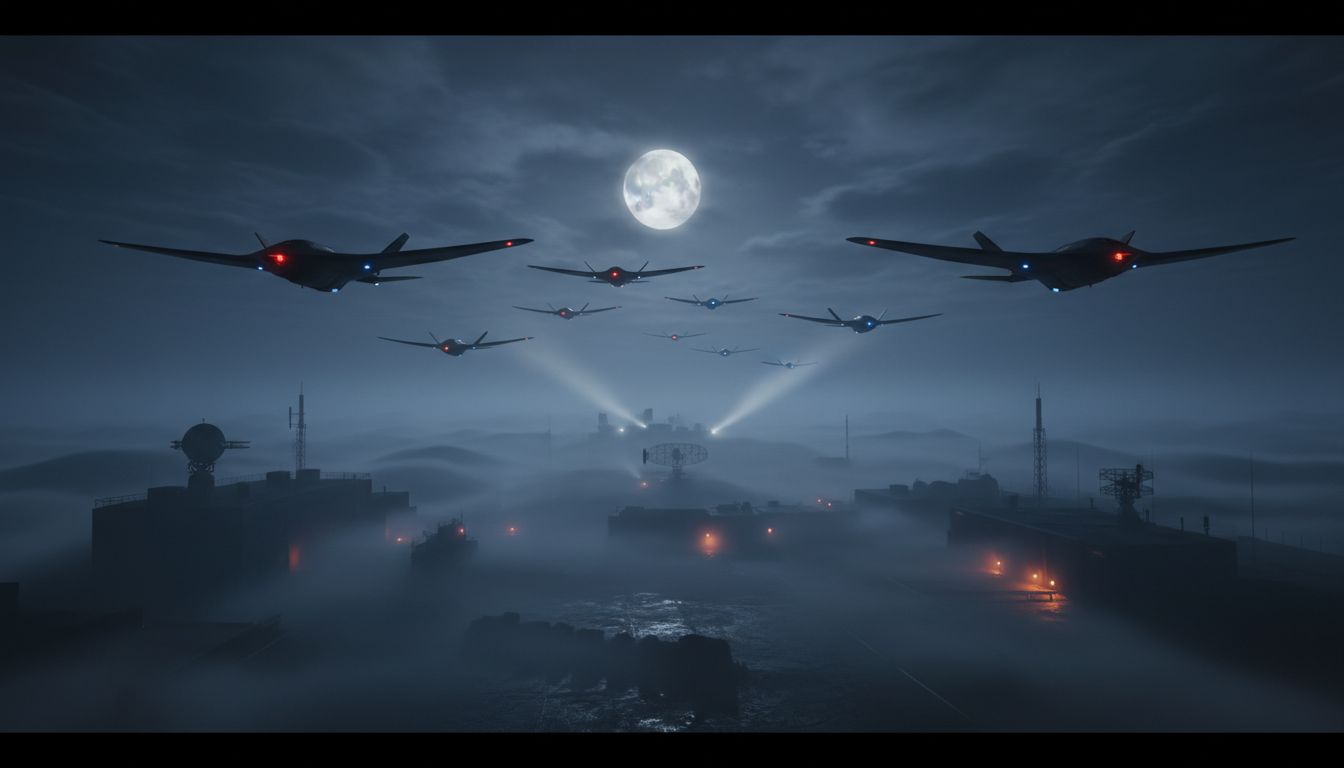
From November through December 2024, multiple RAF bases used by U.S. forces reported “strange lights” and unidentified objects hovering near sensitive installations. Video captured by a police helicopter showed an object later identified as an F‑15 fighter, yet the lack of immediate official explanations allowed social‑media speculation to flourish. Posts linked the incidents to the long‑standing “UFO‑and‑nuke” mythos that surrounds East Anglia’s nuclear‑armed airfields, prompting headlines that framed the events as potential UAP activity. As Milburn noted, “X/Twitter has been rife with misinformation and erroneous speculation, mostly due to accounts seeking to boost engagement,” underscoring the rapid spread of unverified narratives.
MI6 Attribution and Hybrid Drone Operations
In December 2024, Britain’s Secret Intelligence Service publicly attributed the overflights to Russian hybrid drone operations, describing them as part of a broader campaign to test NATO air‑defence readiness and gather intelligence on Western nuclear assets. Milburn’s report cites the same intelligence, emphasizing that the drones exhibited “prosaic” flight characteristics—standard propulsion, predictable flight paths, and identifiable radar signatures—contrary to the erratic behavior often associated with genuine UAP. “I am not ruling out the presence of more exotic technology or UAP, but rather attempting to put forward a more prosaic assessment in light of the information we do have,” Milburn wrote, reinforcing the conclusion that the incidents were conventional, albeit covert, Russian operations.
U.S. Pentagon Guidance on the Domestic Drone Threat
Concurrently, the U.S. Pentagon released updated guidance that expands the authority of base commanders to respond to unauthorized drone activity on American soil. The directive, issued in early February 2026, authorizes commanders to employ kinetic and non‑kinetic counter‑measures—including electronic jamming and, where necessary, defensive fire—without awaiting higher‑level approval. Pentagon spokesperson Lt. Col. Maria Alvarez explained, “The escalation of domestic drone incursions poses a real risk to critical infrastructure and personnel; commanders must have the tools to act swiftly and decisively.” The guidance reflects a shift from a reactive posture to a proactive, layered defense strategy, mirroring concerns raised by the UK incidents.
Implications and Expert Commentary
Analysts see the convergence of the UK attribution and the U.S. policy change as evidence that state‑backed drone threats are moving from the periphery to the mainstream of defense planning. Dr. Elena Kovacs, a senior fellow at the Center for Strategic Air Power Studies, remarked, “Hybrid drone tactics blend low‑cost platforms with sophisticated command‑and‑control, allowing adversaries to test defenses without overt escalation. The recent UK events illustrate how quickly such operations can be misread as something else, highlighting the need for clear communication and robust attribution mechanisms.” The Pentagon’s expanded authority aims to deter future incursions, but it also raises questions about rules of engagement and the potential for unintended escalation.
Outlook
While the UFO narrative captured public imagination, the emerging consensus among intelligence agencies and defense experts points to conventional, state‑sponsored drone activity as the driver behind the 2024 overflights. The episode underscores the importance of transparent attribution, disciplined media reporting, and adaptable defense policies that can address both foreign hybrid threats and the rising domestic drone challenge. As governments refine their response frameworks, the line between speculative UFO discourse and concrete security concerns is likely to become increasingly defined by evidence rather than conjecture.


