Overview
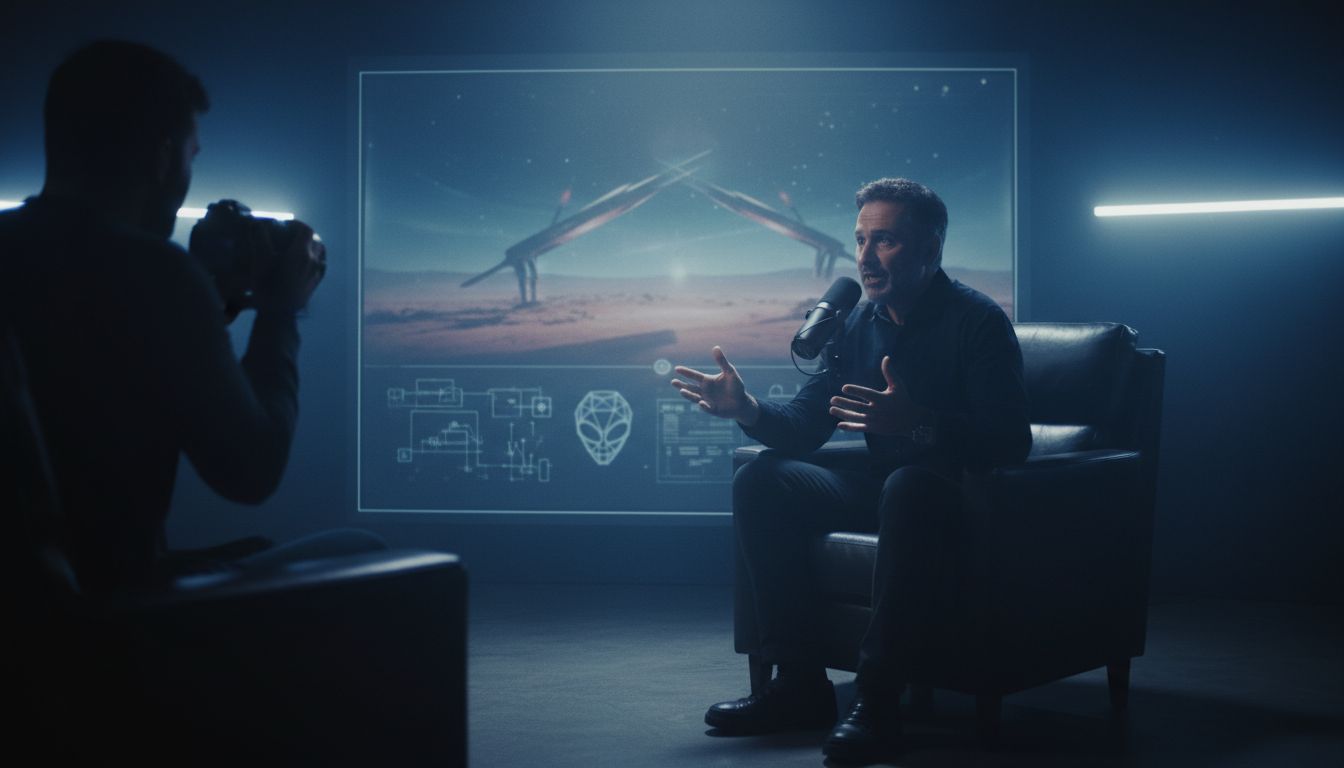
In a recent episode of the UAP Studies Podcast, filmmaker and creative director Luigi Vendittelli provided an in‑depth look at his upcoming multimedia project, “S4.” The venture combines a feature film, a virtual‑reality (VR) experience, and a detailed digital reconstruction of the secretive facility alleged by whistleblower Bob Lazar to have housed extraterrestrial technology near Papoose Lake, Nevada. Vendittelli’s discussion, which has been widely shared across the #ufotwitter community, centered on the technical methodology behind the reconstruction, the evidential weight of Lazar’s original claims, and the broader context of UAP disclosure efforts.
Reconstruction of the S4 Facility
Vendittelli disclosed that his production team has invested millions of dollars to create a full‑scale, photorealistic model of the S4 complex, drawing exclusively from Lazar’s 1989 testimony. The virtual environment replicates period‑accurate details such as 1980s‑era fire hydrants, utility poles, and the layout of hangars described in Lazar’s interviews. A key component of the project is a VR experience slated for release in late 2026, which will allow users to navigate the reconstructed hangars, hear a narrated tour by Lazar himself, and even interact with a simulated alien reactor. “We wanted to let people walk the same corridors that Lazar described, not as a speculative set but as a data‑driven reconstruction,” Vendittelli said during the interview.
Technical Evidence and the Light‑Absorption Test
One of the most compelling arguments presented by Vendittelli involved a physics‑based test of Lazar’s claim that the interior of the alien craft remained dark even when illuminated by high‑intensity halogen spotlights. By applying real‑world lighting models and material properties within the 3D engine, the team observed that the virtual metallic surfaces absorbed light in a manner consistent with Lazar’s description. “If Lazar were fabricating a story, he would have said the lights made the interior bright,” Vendittelli noted. “The fact that the counter‑intuitive darkness emerged from a physics‑accurate simulation was a turning point for us.” This finding, while not proof of extraterrestrial technology, adds a layer of empirical consistency to Lazar’s narrative.
Addressing Skepticism and Historical Claims
The podcast also tackled longstanding doubts about Lazar’s academic credentials at MIT and Caltech, which have never appeared in public records. Vendittelli suggested that Lazar may have been involved in “off‑the‑books” Department of Defense programs, a scenario that could explain the absence of documentation. He highlighted three specific Lazar assertions that have since found corroboration: (1) U.S. Navy involvement in the recovery program—a detail echoed in recent Pentagon UAP reports; (2) the existence of intact craft, contrasting with the fragmented debris narrative of Roswell; and (3) the identification of Papoose Lake/S4 before these locations entered mainstream UFO discourse. These points, Vendittelli argued, bolster Lazar’s credibility as an early whistleblower rather than a mythic figure.
Element 115 and Future Disclosure
The conversation turned to Element 115 (Moscovium), which Lazar claimed powered the alien propulsion system. When the production team attempted to model the element’s physical characteristics, they found Lazar’s description of its weight (approximately 223 g for a small sample) aligned with the properties of a heavy, stable isotope—information that would have been obscure to a layperson in 1989. Vendittelli used this to illustrate the broader pattern of technical specificity in Lazar’s testimony. Concluding the interview, he expressed frustration with what he termed the