Overview
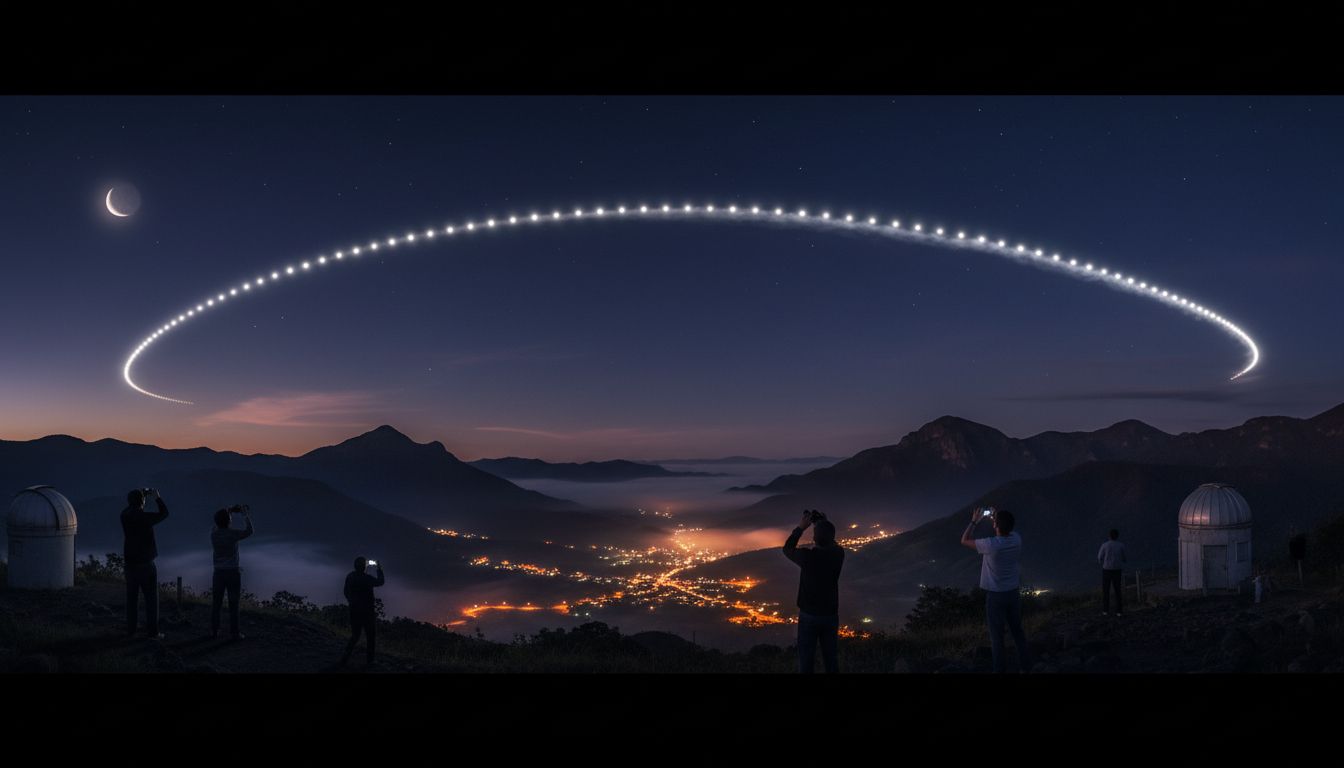
In the early hours of May 20, residents across several Brazilian states reported a striking line of bright lights moving swiftly across the night sky. Social‑media videos quickly went viral, with many users labeling the phenomenon “UFOs.” Astronomers and SpaceX officials clarified that the display was a temporary “satellite train” formed by a newly launched batch of Starlink satellites. The satellites travel in close formation for a short period after launch before spreading out into their operational orbits, creating the linear pattern that can be mistaken for an unidentified aerial object.
What the launch entailed
SpaceX conducted a Falcon 9 mission from Cape Canaveral on May 19, deploying 60 Starlink V2‑mini satellites intended to bolster the company’s broadband constellation over the Southern Hemisphere. After separation, the satellites remain clustered for roughly 30‑45 minutes while they raise their altitude and begin the orbital phasing maneuvers that will eventually distribute them across a constellation of roughly 12,000 units. During this clustering phase, the satellites reflect sunlight in unison, producing a luminous “train” that can stretch for several degrees of the sky—easily visible to the naked eye from mid‑latitude locations such as Brazil.
“The bright line you saw is simply a group of freshly launched Starlink satellites still close together,” said Megan Baker, SpaceX’s public‑affairs spokesperson, in a statement to the press. “They appear as a single, moving light source for a brief window before they disperse into their final orbital slots.”
Expert analysis
Brazilian astronomer Dr. Luís Silva of the Observatório Nacional explained why the phenomenon can be confusing. “When a cluster of satellites reflects sunlight at the same altitude, the human eye perceives it as a single, continuous object,” he told the agency INPE (Instituto Nacional de Pesquisas Espaciais). “Because the train moves quickly—covering tens of degrees in a matter of minutes—it can look unlike any conventional aircraft, prompting speculation.”
The International Astronomical Union (IAU) has issued guidelines for the public to differentiate satellite trains from other aerial sightings. Key indicators include a steady, linear formation, uniform brightness, and a speed consistent with orbital motion (approximately 7 km s⁻¹). In contrast, typical aircraft exhibit blinking navigation lights and variable trajectories.
Public reaction and official response
Videos posted on platforms such as TikTok and Twitter amassed millions of views within hours, with captions ranging from “alien fleet” to “military test.” Local authorities in the states of São Paulo, Minas Gerais, and Paraná received several inquiries, prompting the Brazilian Civil Aviation Agency (ANAC) to issue an advisory. “There is no security threat associated with these sightings,” the advisory read. “The lights are man‑made satellites, and no airspace violations have been reported.”
Community groups have also used the event as an educational opportunity. The São Paulo Astronomical Society organized a livestream on May 22, inviting viewers to watch the next scheduled Starlink launch and learn how to identify satellite trains in real time.
Looking ahead
SpaceX plans to launch additional Starlink batches throughout 2026, with a focus on expanding coverage over South America and the Antarctic region. As the constellation grows, the frequency of visible satellite trains will increase, especially during twilight hours when the sun illuminates the satellites while the ground remains dark. Astronomers warn that the cumulative brightness could pose challenges for ground‑based observations, a concern already raised by the IAU and various observatories worldwide.
For now, the recent Brazilian sighting serves as a reminder that modern satellite deployments can produce spectacular, yet perfectly explainable, visual phenomena. By fostering public understanding of these events, space agencies and commercial operators hope to reduce misinformation while preserving the wonder that such celestial displays inspire.


