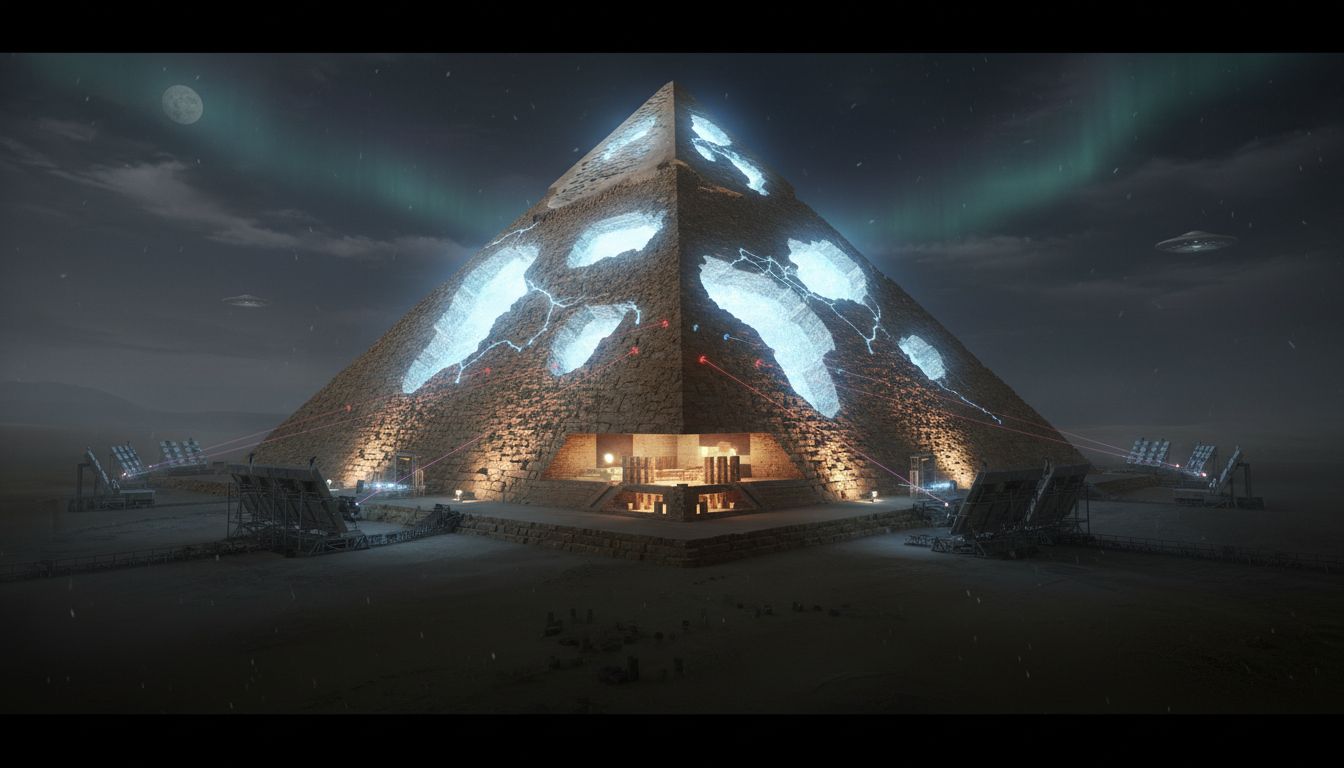
Muon‑based tomography carried out over the past 18 months has revealed a series of previously unknown low‑density regions – colloquially called “voids” – within the core of the Great Pyramid of Giza. The international team, coordinated by the Egyptian Ministry of Antiquities and involving researchers from France’s Centre de Recherche et de Restauration des Musées de France, Japan’s Institute of Space and Astronautical Science and the University of Tokyo, used cosmic‑ray muons to create three‑dimensional maps of the stone mass. Their findings, now under peer review, show at least three sizable cavities situated above the Grand Gallery and extending laterally for several metres, in addition to a smaller, irregular gap near the pyramid’s north face.
The technique, first applied to the Giza complex in 2015 as part of the ScanPyramids project, exploits the fact that muons – high‑energy particles generated by cosmic rays – are absorbed at different rates depending on the density of the material they traverse. By placing detectors in the lower chambers and in a temporary shaft on the northern side, the researchers recorded muon flux over weeks, allowing them to infer the presence of empty or less‑dense spaces. “The muon data are consistent with a void that is comparable in size to the Grand Gallery, but its exact geometry remains uncertain until we can complement the results with other non‑invasive methods,” said Dr. László Garancsi, a physicist with the Hungarian Academy of Sciences who helped design the experiment.
Archaeologists caution that the presence of voids does not automatically imply hidden chambers or undiscovered burial rooms. In a statement, Dr. Hany Hamdy, chief archaeologist of the Giza Plateau, emphasized that such gaps are often structural, created to relieve stress in the massive limestone blocks during construction. “The ancient builders employed sophisticated engineering solutions, including relieving chambers, to ensure the stability of the pyramid over millennia,” he explained. Similar features were identified in the 2017 ScanPyramids announcement, when a large void above the Grand Gallery was detected and later interpreted as a previously unknown relieving chamber rather than a secret room.
The discovery has nonetheless reignited public speculation about the pyramid’s origins, including fringe theories that invoke extraterrestrial involvement. While the scientific community uniformly rejects such interpretations, the renewed media attention underscores the enduring fascination with Egypt’s most iconic monument. “Our job is to let the data speak, not the imagination,” said Dr. Zahi Hawass, former Secretary General of the Supreme Council of Antiquities. “Each new insight helps us understand the ingenuity of the ancient Egyptians, not the presence of alien engineers.”
Future work will focus on integrating the muon results with high‑resolution ground‑penetrating radar and 3‑D laser scanning to refine the voids’ dimensions and assess whether they contain any architectural elements. The Egyptian authorities have announced that a multidisciplinary team will begin a limited, non‑destructive exploration later this year, pending the publication of the full dataset. If the voids prove to be intentional architectural features, they could reshape current models of pyramid construction, shedding light on how the ancient workforce managed the immense loads without modern technology. Regardless of the outcome, the latest scans reaffirm the value of cutting‑edge physics in unraveling the mysteries of humanity’s oldest stone marvels.