Overview
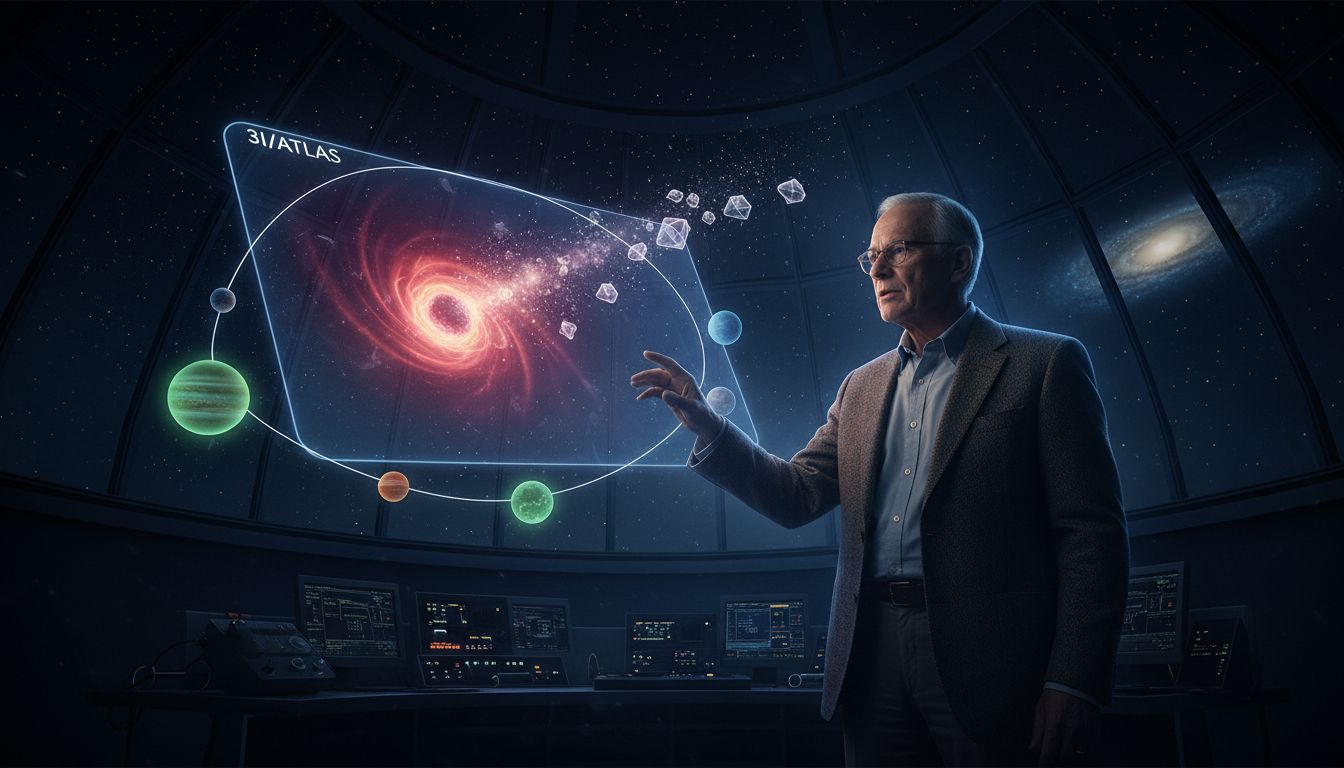
Harvard astronomer Avi Loeb has reignited debate over the origins of interstellar object 3I/ATLAS, suggesting the visitor may have been a “cosmic gardener” that delivered life’s building blocks as it swept past several planets in our solar system last year. In a recent Medium blog, Loeb likens the process to a dandelion shedding seeds, proposing that microbes or pre‑biotic molecules could have survived inside the object’s icy matrix and been released near Earth, Mars and other habitable worlds. The claim builds on his earlier, controversial proposal that 3I/ATLAS might be an alien spacecraft, but now frames the idea within the broader panspermia hypothesis.
The Interstellar Visitor and Loeb’s Hypothesis
3I/ATLAS was first detected in early 2025, drawing attention for its unusually close approaches to the inner planets—a trajectory that, Loeb argues, “aligns with the orbital plane of the habitable planets around the Sun.” He points to a sunward jet of large fragments observed as the object entered the inner solar system, interpreting it as a mechanism for dispersing embedded material. “In addition to natural origins, there is the possibility of directed panspermia, whereby an interstellar gardener seeded 3I/ATLAS on a fertilization mission targeting the habitable planets,” he wrote. Loeb’s scenario envisions microbes or complex organics shielded within the comet’s ice, released when solar radiation sublimates the surface layers.
Scientific Context and Panspermia Debate
The notion that life can travel between worlds is not new. Carl Sagan and other pioneers have long entertained both natural panspermia—whereby dust, asteroids or comets ferry organic compounds—and directed panspermia, a purposeful seeding by an advanced civilization. However, the majority of astrobiologists remain skeptical. Dr. Mira Patel, a planetary scientist at the University of Cambridge, notes that “the composition of 3I/ATLAS, as derived from spectroscopy, matches that of ordinary Oort‑cloud comets, showing water ice, carbonaceous material and silicates, with no anomalous signatures that would demand an artificial origin.” She adds that “the probability of a natural comet’s trajectory intersecting multiple planetary orbits is low but not extraordinary given the vast number of interstellar objects we now detect.”
Conventional Evidence Versus Speculation
Recent analyses published in Astronomy & Astrophysics identified a spectral fingerprint consistent with crystalline water ice and a dust-to-gas ratio typical of solar system comets. These findings, combined with dynamical models, suggest 3I/ATLAS was likely a fragile icy body ejected from another star system, not a engineered probe. While Loeb acknowledges the data, he argues that “the sheer coincidence of the object’s path and the timing of its close passes cannot be dismissed outright.” Critics counter that coincidence does not equate to causation, emphasizing that “our sample size of observed interstellar objects is still too small to draw statistically robust conclusions,” says Dr. Luis Hernández, an astronomer at the Max Planck Institute.
Looking Ahead: Missions and Tests
Loeb proposes a pragmatic response: launch a fast‑response probe to intercept future interstellar interlopers, sampling expelled material directly. “By directing a probe on a crash course towards the surface of these icebergs, we can diagnose the composition of the material they shed and infer whether it carries extrasolar life,” he wrote. Such missions, akin to NASA’s planned Comet Interceptor, could provide definitive chemical and possibly biological analyses. Until then, the scientific community urges caution, noting that “extraordinary claims require extraordinary evidence,” a principle echoed by many reviewers of Loeb’s work.
Implications If Proven True
If a future mission were to confirm that 3I/ATLAS—or any interstellar object—contained viable extraterrestrial organisms, it would revolutionize our understanding of life’s distribution in the cosmos and lend weight to the idea that Earth’s biosphere might share a common ancestry with distant worlds. Until such data emerge, Loeb’s suggestion remains a thought‑experiment that pushes the boundaries of astrobiology while reminding researchers of the need for rigorous, evidence‑based inquiry.


