Overview
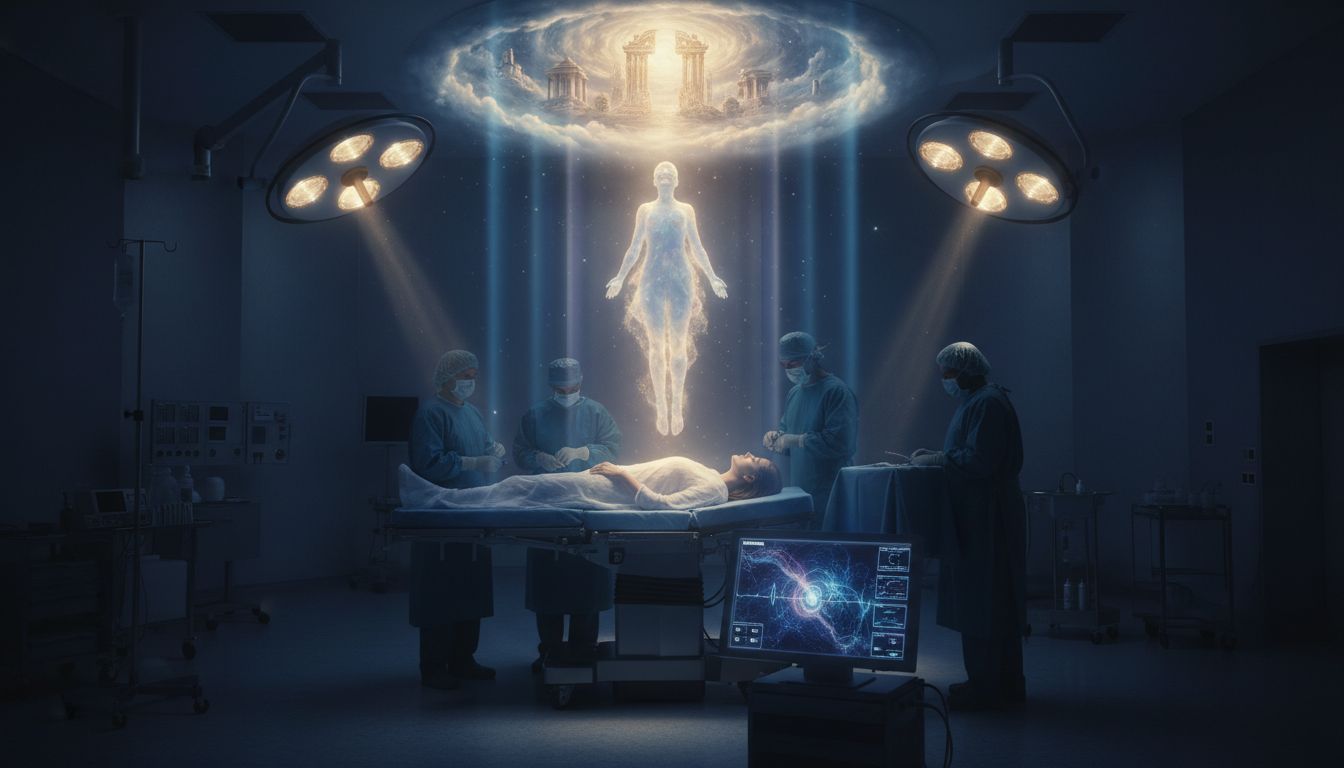
A routine septum‑correction surgery in 2012 turned into a life‑altering event for 28‑year‑old Sarah Gamm, who briefly died on the operating table before being revived by emergency cardiopulmonary resuscitation. During the two‑minute interval that clinicians recorded as cardiac arrest, Gamm reports a vivid, dark “void” in which she encountered deceased grandparents, felt an overwhelming sense of unconditional love, and heard a voice she identifies as God urging her return to the living world. Her account joins a growing body of near‑death experience (NDE) testimonies that challenge the dominant scientific view that such episodes are merely the brain’s final, internally generated simulation of “heaven” or “hell.”
The Case
Gamm, who holds a BSc in astrophysics, recalls the moment the surgical team announced she had stopped breathing: “I prayed for the person to be okay, not realizing she was talking about me.” She describes the experience as “complete darkness,” likening it to the biblical creation narrative of “the earth was without form and void.” Within that darkness she “reunited with her dead grandparents and other deceased loved ones” and sensed a profound, pure love that she says “was the most magical, beautiful feeling one can imagine.” When a divine voice told her she had to return, she argued for free will, only to be told she had no choice. The episode ended when a surge of epinephrine and vigorous CPR restored her heartbeat, leaving her with a memory that felt “almost eternal” despite lasting less than two minutes in clinical terms.
Scientific Explanation
In March 2026, a hypothesis paper in Frontiers in Psychology authored by neuroscientist Recai Kayış proposes that NDEs arise from a brief “storm” of terminal brain activity. According to Kayış, as oxygen and glucose supply collapse, the brain’s normal balance destabilizes: external sensory input wanes while internal networks governing memory, emotion, and self‑representation become disinhibited. The resulting state, he argues, can generate a rapid, dream‑like synthesis of stored memories, cultural imagery, and personal beliefs—a self‑contained simulation that the mind interprets as an otherworldly realm. “Memory provides the content,” Kayış writes, noting that the brain may assemble “the last world the mind ever enters” from whatever symbolic material is most salient at the moment of death.
Challenges to the Model
Critics point out that many NDE accounts, including Gamm’s, contain details that appear to exceed the information available to a dying brain. For instance, Gamm recounts hearing the nurse’s announcement about her own cessation of breathing—a statement she could not have heard once cardiac output ceased. Moreover, descriptions of specific deceased relatives, the sensation of “God’s voice,” and the perception of a structured, purposeful dialogue raise questions about whether purely internal reconstruction can account for such coherence. Researchers such as Dr. Elena Mendoza of the University of California, San Diego, note that “the predictive accuracy of some NDE reports suggests that additional mechanisms—perhaps residual cortical processing or even unknown neurophysiological pathways—may be at play.” While the Kayış model accommodates the subjective distortion of time, it does not fully explain the apparent “veridical perception” of events occurring outside the patient’s sensory reach.
Broader Implications
The debate over whether NDEs are brain‑generated simulations or evidence of consciousness persisting beyond death has significant implications for neuroscience, ethics, and end‑of‑life care. If the brain can produce richly detailed, emotionally charged experiences in its final moments, it may inform new strategies for supporting patients undergoing cardiac arrest, such as targeted neuroprotective interventions that mitigate distressing hallucinations. Conversely, if elements of NDEs point to phenomena beyond current neurobiology, the findings could prompt a reevaluation of how consciousness is defined in medical contexts. As Gamm reflects, “I got to experience the love that existed before there was light,” a sentiment that underscores the profound personal impact of these episodes, irrespective of the ultimate scientific explanation.