Overview
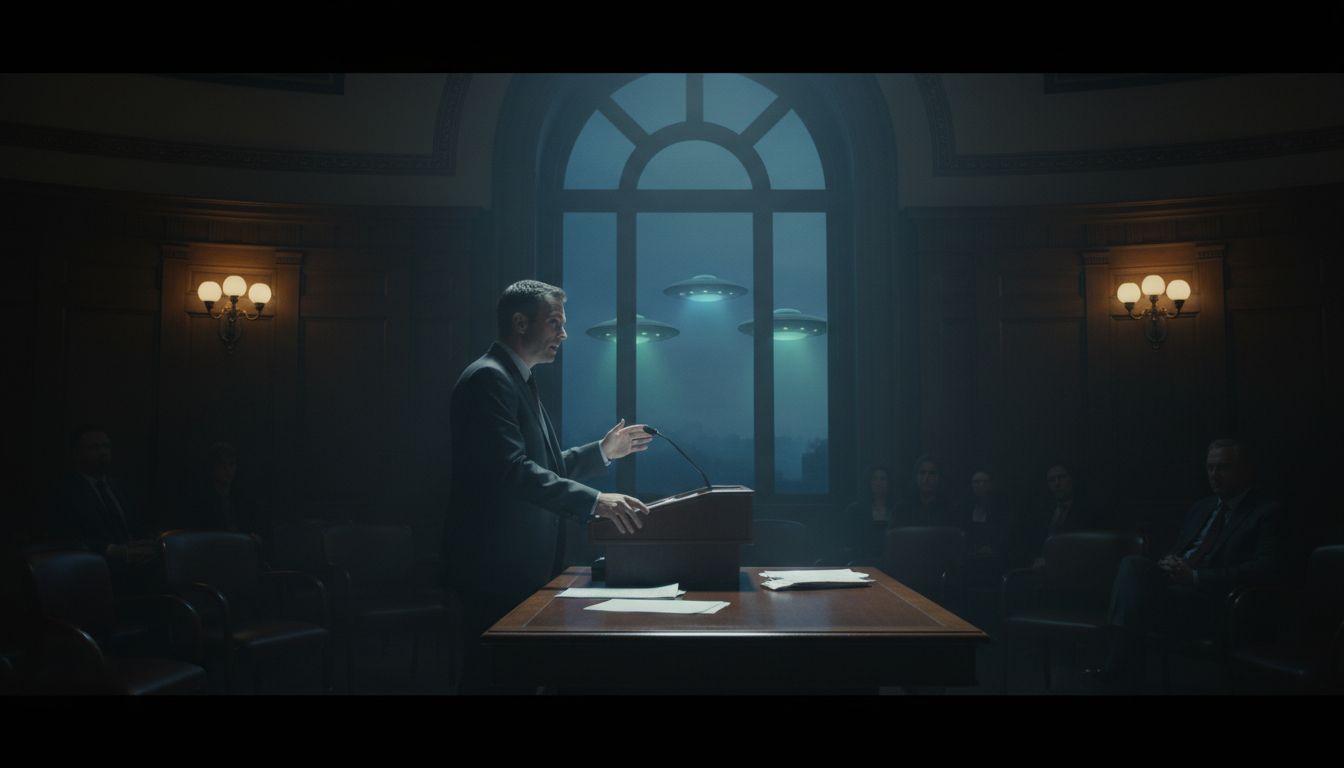
State Rep. John M. Kelley (D‑Norwalk) has formally asked the Connecticut General Assembly to schedule hearings on a proposal for a statewide, systematic study of unidentified aerial phenomena (UAP), commonly known as UFOs. In a letter submitted to the House and Senate leadership on March 10, Kelley argued that a structured investigation could improve public safety, protect critical airspace, and contribute to scientific knowledge about anomalous sightings that have been reported across the state for decades.
Legislative Proposal
Kelley’s request calls for the creation of a bipartisan task force within the Joint Committee on Public Safety and the Joint Committee on Science & Technology. The task force would be tasked with:
- Collecting and cataloguing UAP reports from pilots, law‑enforcement agencies, and civilian witnesses.
- Coordinating with the Federal Aviation Administration (FAA) and the Department of Defense (DoD) to determine whether any sightings intersect with restricted or commercial flight corridors.
- Evaluating existing research, including the Pentagon’s 2023 Unidentified Aerial Phenomena report, to identify gaps that a state‑level study could fill.
The proposed hearings would be open to the public, allowing experts from academia, aerospace, and national‑security circles to testify. Funding, Kelley suggested, could be sourced from existing allocations for public‑safety research, minimizing the need for new appropriations.
Arguments for a Formal Study
Kelley emphasized that “the safety of Connecticut’s airspace is a matter of public trust, and we cannot dismiss credible reports without a transparent, data‑driven approach.” He cited several incidents in recent years—most notably a 2024 sighting by a commercial pilot near the Long Island Sound corridor and multiple radar anomalies recorded by the FAA’s NextGen system—that, while not confirmed as threats, warrant systematic scrutiny.
Public‑safety officials have echoed similar concerns. Connecticut State Police Lieutenant Maria Torres, who oversees the agency’s aviation unit, noted that “unidentified contacts, even when ultimately explained, consume investigative resources. A coordinated study could streamline our response and reduce unnecessary alarm.”
From a scientific perspective, Dr. Ellen Chen, professor of atmospheric physics at the University of Connecticut, warned that “without a rigorous dataset, anomalous aerial events remain anecdotal. A state‑level effort could provide valuable empirical evidence that benefits both meteorological research and broader aerospace studies.”
Broader Context
Connecticut’s push aligns with a growing national interest in UAPs. Following the 2023 DoD report, several states—including Texas, Colorado, and New York—have launched or considered legislative measures to examine aerial phenomena within their jurisdictions. The Federal Aviation Administration has also announced plans to improve reporting mechanisms for pilots, reflecting a shift toward treating UAPs as a legitimate safety issue rather than a fringe curiosity.
Nevertheless, skeptics caution against allocating resources to an area that has historically yielded few concrete findings. Republican Representative Mark L. Sullivan (R‑Stamford) remarked that “while transparency is important, we must ensure that any study is grounded in rigorous methodology and does not become a political distraction.”
Next Steps
The General Assembly is expected to schedule a preliminary hearing in the upcoming legislative session, tentatively set for late April. If approved, the task force would convene within 90 days to draft a research framework and recommend budgetary needs. Stakeholders—including aviation professionals, academic researchers, and citizen‑reporting groups—have been invited to submit written testimony ahead of the hearing.
As the debate unfolds, Connecticut may become one of the first states to institutionalize a formal, government‑backed inquiry into UAPs, potentially setting a model for how sub‑national entities address phenomena that sit at the intersection of public safety, scientific inquiry, and public curiosity.


