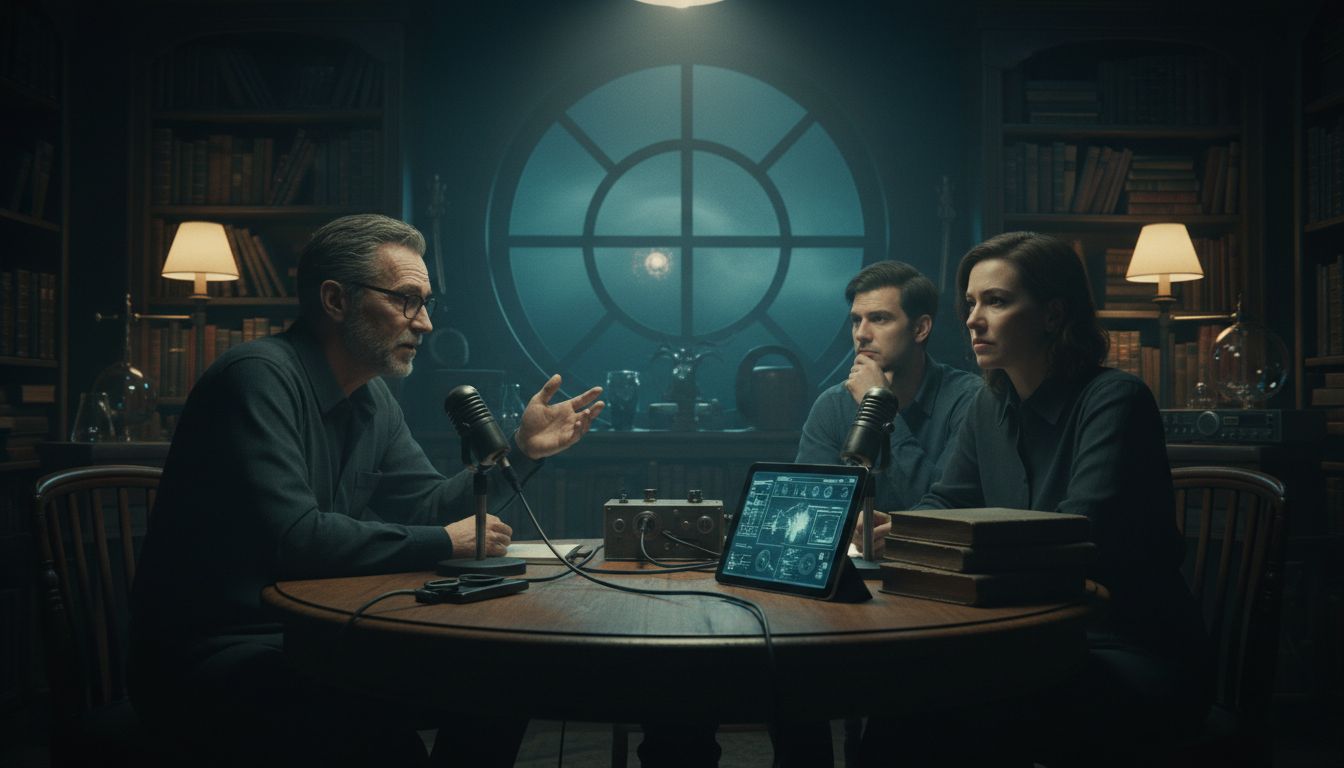
Dr. James Matlock, an anthropologist who has spent more than two decades studying reports of children who claim to remember previous lives, appeared as a guest on Matt Colborn’s “What Lies Beyond” podcast on October 16. Matlock, a Ph.D. graduate of the University of Southern Illinois at Carbondale and a research fellow at the Parapsychology Foundation, outlined the empirical methods he uses to evaluate these cases and emphasized the need for “open‑minded scientific inquiry” if reincarnation research is to gain credibility within mainstream psychology. He traced the modern field back to the work of Canadian psychiatrist Ian Stevenson, whose systematic documentation of over three hundred cases in the latter half of the 20th century remains the benchmark for contemporary investigators.
During the hour‑long interview, Matlock highlighted several of Stevenson’s most compelling subjects, including the Rylann O’Bannion case, in which a child’s birthmark matched a fatal injury suffered by a woman who died in a farming accident. “The correlation between the location of the mark and the reported trauma is statistically unlikely to be coincidental,” Matlock said, citing Stevenson’s 1997 two‑volume study, Reincarnation and Biology. He also described a recent case from the Indian state of Andhra Pradesh where a five‑year‑old not only recounted details of a previous family’s life but displayed a pronounced fear of water that mirrored the drowning of the purported former self. In each instance, Matlock stressed that investigators documented the child’s statements, corroborated them with independent witnesses, and recorded physical anomalies before the children’s memories faded—often within a few years.
The discussion turned to the skeptical critique that such reports are products of suggestion, cultural expectation, or selective memory. Matlock acknowledged these concerns, noting that “the most rigorous studies deliberately control for parental coaching and media exposure.” He referenced ongoing collaborations with researchers at the University of Virginia—anthropologist Marieta Pehlivanova and cognitive scientist Philip Cozzolino—who are applying modern statistical techniques and neuroimaging protocols to a subset of verified cases. According to Pehlivanova, “When we compare children who spontaneously report past‑life memories with matched controls, we see distinct patterns in narrative consistency and emotional response that cannot be easily dismissed as fabrication.” Cozzolino added that preliminary functional MRI scans suggest atypical activation in brain regions associated with autobiographical memory, though he cautioned that the sample size remains too small for definitive conclusions.
Matlock also addressed the broader implications of these findings for the anthropology of religion and the philosophy of consciousness. He argued that, regardless of whether reincarnation proves to be a literal transmigration of the soul, the phenomenon challenges prevailing assumptions about the continuity of personal identity. “If children can retain verifiable information that they could not have learned through ordinary means, we must ask what mechanisms—biological, psychological, or perhaps something we have yet to understand—could support that transfer,” he said. The conversation referenced the BBC documentary series In Search of the Dead, which dramatized several Stevenson cases and brought the debate into public view, underscoring the growing public fascination with the topic.
Concluding the episode, Matlock urged the academic community to treat reincarnation research with the same rigor applied to other fringe subjects, such as near‑death experiences or anomalous perception. He promoted his online course, Signs of Reincarnation, as a platform for training graduate students in systematic case collection, ethical interviewing, and interdisciplinary analysis. “Legitimacy comes not from sensational headlines but from reproducible methodology,” Matlock asserted. As the podcast drew to a close, listeners were left with a nuanced portrait of a field that straddles anthropology, psychology, and the enduring human quest to understand what, if anything, lies beyond death.