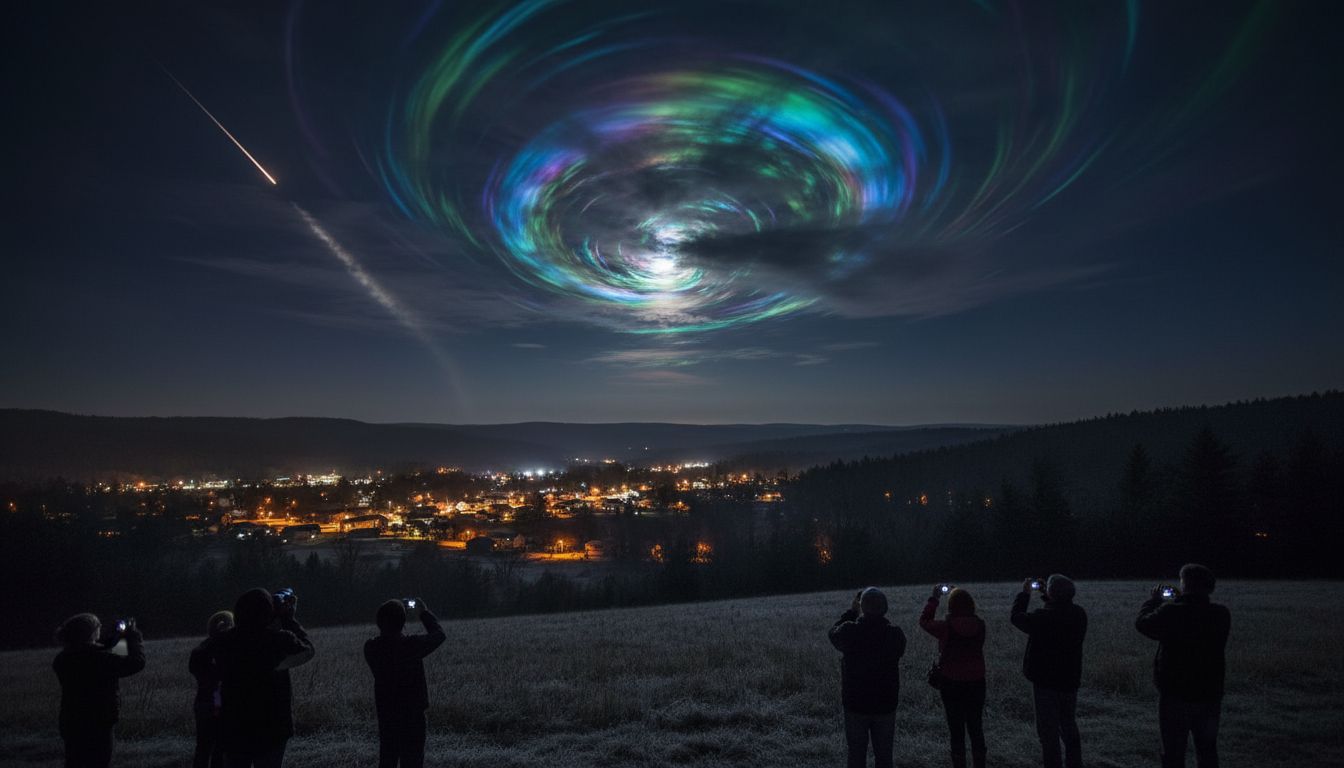
Late Tuesday night residents of Clinton, Maine, reported a sudden, bright flash that illuminated the sky for several seconds, prompting a flurry of social‑media posts that labeled the event a “UFO” or “alien visitation.” Within hours, officials from the Federal Aviation Administration (FAA), the U.S. Space Force, and the European Space Agency (ESA) confirmed the phenomenon was a routine, though spectacular, re‑entry of a European launch vehicle’s upper stage passing over the region.
The sighting occurred at approximately 10:42 p.m. Eastern Daylight Time, when a luminous, expanding fireball traversed the sky from northwest to southeast. Witnesses described a “silvery streak” that brightened before fading into a faint, lingering glow. The Maine Department of Public Safety logged 27 calls in a 30‑minute window, and local radio station 92 Moose ran a live segment fielding callers who speculated about extraterrestrials, drones, and secret military tests. “It was like nothing we’d seen before, and the internet immediately filled with alien theories,” said Matt James, the station’s morning‑show host.
A coordinated investigation quickly identified the source. The ESA confirmed that a Vega‑C launch from the Guiana Space Centre in Kourou, French Guiana, lifted off at 9:30 p.m. UTC (5:30 p.m. EDT) on the same day, carrying a scientific payload for the European Research Council. The rocket’s third stage, after completing its mission, was programmed to de‑orbit over the Atlantic and burn up in Earth’s atmosphere. Trajectory models released by ESA’s Mission Operations Center showed the stage re‑entering the upper‑mid‑Atlantic at 10:38 p.m. EDT, with a predicted ground track that would skim the northeastern United States, including Maine, before descending into the ocean.
Dr. Elena Marquez, an atmospheric physicist at the University of Maine, explained why the event appeared so dramatic. “When a spent rocket stage re‑enters, it experiences intense heating, creating a plasma sheath that can produce a bright, expanding fireball visible from hundreds of miles away,” she said. “The Vega‑C’s third stage carries a sizable amount of residual propellant, which, upon re‑entry, creates a luminous phenomenon comparable to a meteor but far brighter and longer‑lasting.” Marquez added that the timing and altitude of the burn matched the eyewitness reports, confirming a terrestrial origin.
The FAA’s regional office in Boston issued a brief statement noting that the re‑entry was “fully authorized, tracked, and posed no risk to civilian aircraft or populated areas.” The agency’s spokesperson, Lt. Cmdr. Aaron Patel, emphasized that such events are routine and that agencies maintain continuous radar and optical monitoring of all objects returning to Earth. “Public curiosity is understandable, but it’s important to rely on verified data rather than speculation,” Patel said.
While the incident sparked a temporary surge of UFO chatter online, the swift clarification by international space agencies underscores the importance of transparent communication when orbital debris or launch remnants cross populated skies. As commercial and governmental launch activity continues to increase, experts say similar luminous displays will become more common. “Educating the public about what these lights are—and why they happen—helps demystify space operations and reduces unfounded alarm,” Marquez concluded.


