Overview
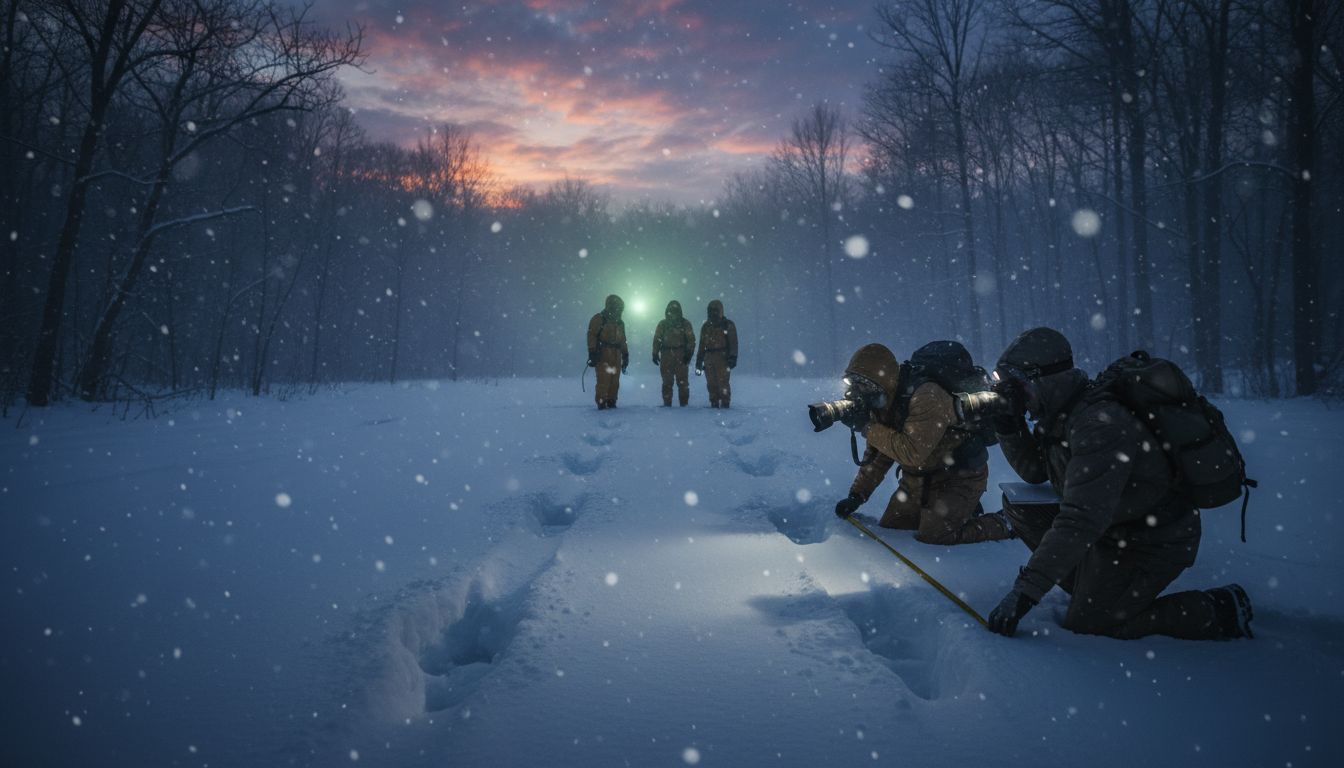
A weekend snowfall in New York’s Hudson Valley this month exposed a series of large footprints in the fresh white drifts, prompting a flurry of reports to local “Bigfoot Researchers of the Hudson Valley.” The prints, spaced roughly six feet apart, were documented in several private yards—including a backyard in Wappingers Falls—before being posted to the group’s Facebook page. While the images generated considerable online buzz, investigators who examined the evidence concluded that the tracks remain inconclusive and could not be definitively linked to an unknown primate.
Investigation Findings
The Hudson Valley research collective, a volunteer network that monitors alleged cryptid activity, received the first photographs from a Wappingers Falls resident on a Tuesday evening. The post, accompanied by three close‑up images of the impressions, showed clear, elongated depressions with a distinct heel‑to‑toe pattern. In the caption, the poster wrote, “I was contacted yesterday by a woman from Wappingers Falls who sent me these pictures from her yard!”
Lead investigator Mark “Marty” Sullivan replied that the tracks “look like a large animal with a long stride, but we have not ruled out more mundane explanations such as a pine marten, a ski boot or a prank.” The group measured the spacing at about six feet—a stride length that would be consistent with a creature standing roughly eight to nine feet tall, according to folklore standards. However, the lack of accompanying toe‑pad impressions, the presence of surrounding animal tracks, and the possibility of human‑made imprints led the team to label the evidence “unverified.”
The Hudson Valley group’s Facebook post, dated roughly two weeks ago, attracted over 100 reactions and a handful of comments asking for more details, but no follow‑up field investigation was reported. The researchers noted that the snow had since melted, eliminating the chance for a re‑examination.
Expert Commentary
Sociologists and cultural anthropologists have long studied the persistence of cryptid legends in modern society. Dr. Elaine Ramirez, a professor of sociology at the State University of New York, explained that the recent sightings “fit a pattern where unusual natural phenomena—like fresh snowfall—create a canvas for collective imagination.” Ramirez cited a 2023 Gallup poll indicating that about 25 percent of Americans believe in the existence of Bigfoot or similar creatures, a figure that has remained relatively stable over the past decade.
From a scientific perspective, wildlife biologist Dr. Thomas Greene cautioned against jumping to conclusions. “Hudson Valley forests are home to a variety of medium‑sized mammals—pine martens, bobcats, even escaped domestic dogs—that can leave ambiguous prints, especially when snow is involved,” he said. Greene emphasized the importance of controlled measurements, such as depth, pressure distribution, and the presence of dermal ridges, none of which were clearly captured in the posted photos.
Public Reaction
The images quickly spread beyond the local Facebook group, appearing on niche blogs and the broader OutKick platform, where they were featured under the “Bigfoot” category. Comment sections reflected a split audience: enthusiasts celebrated the possible discovery, while skeptics highlighted the need for rigorous documentation. The episode underscores the broader cultural fascination with the unknown, a sentiment echoed by Dr. Ramirez, who added that “cryptid lore offers a modern mythos that helps people grapple with mystery in an increasingly data‑driven world.”
Conclusion
While the Hudson Valley snowfall produced intriguing footprints that sparked a wave of speculation, the current evidence does not meet the standards required for scientific validation. The incident illustrates how seasonal weather events can revive longstanding folklore, especially when amplified by social media. As the snow recedes and the prints disappear, the story will likely linger as another chapter in the ongoing dialogue between mystery seekers and empirical inquiry—a reminder that extraordinary claims still demand extraordinary evidence.


