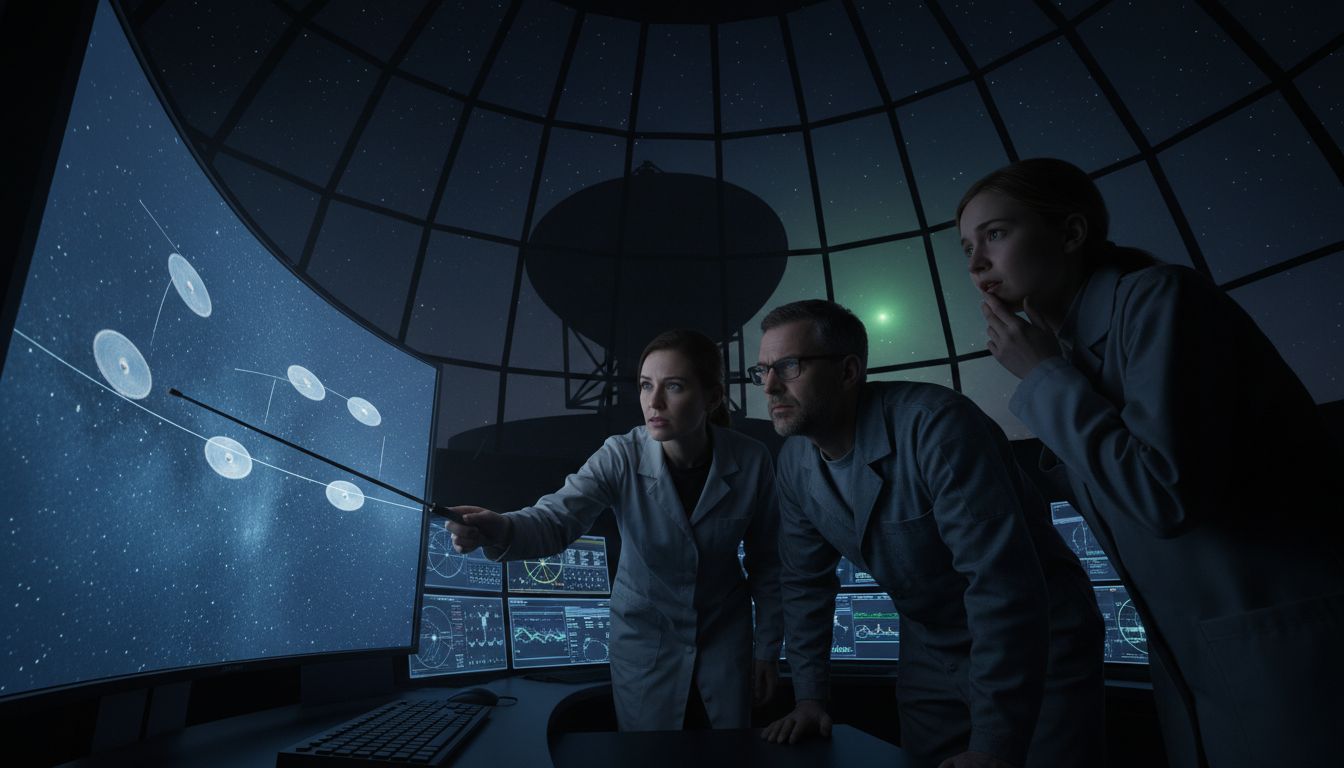
Scientists have turned a half‑century‑old trove of astronomical photographs into a fresh arena for the debate over unidentified aerial phenomena. By digitizing the 2,000 glass plates captured by the Palomar Schmidt telescope between 1949 and 1958, the Vanishing & Appearing Sources during a Century of Observations (VASCO) team identified more than 107,000 transient events—brief flashes that brighten, dim, or disappear altogether. The work, led by astronomer Beatriz Villarroel of the Nordic Institute for Theoretical Physics, was published in two peer‑reviewed papers this October, one in Scientific Reports and the other in the Publications of the Astronomical Society of the Pacific. While the authors stop short of declaring the transients as extraterrestrial craft, they note a subset of events that appear in linear alignments and lack obvious astrophysical explanations, prompting some observers to label them “UFOs” in the historical sense of unidentified flying objects.
Villarroel’s analysis deliberately avoids the era of human‑made satellites. “We focused on data taken before Sputnik 1 was launched in 1957 so that any signal we see cannot be attributed to space debris or satellite glints,” she explained in a university press release. Using modern image‑processing algorithms, the team filtered out known sources of variability—such as variable stars, atmospheric scintillation, and instrumental artifacts—leaving a residual catalog of unexplained flashes. Among these, a handful exhibit spatial coherence: multiple points of light occurring along a straight line within a single exposure, a pattern that, in principle, could arise from sunlight reflecting off a rotating or tumbling object in low Earth orbit.
The findings have been seized upon by UFO enthusiasts as potential evidence of pre‑space‑age alien visitation. However, many physicists caution that extraordinary claims demand extraordinary evidence, and they see the episode as a textbook illustration of scientific skepticism. “I think there are many in the UFO community who really want to know what’s going on,” said astrophysicist Adam Frank of the University of Rochester. “I think it is worthwhile for us to have these open, transparent investigations. This is a great way to show people how science works.” Frank, who writes frequently on the search for extraterrestrial life, emphasizes that the proper response is not dismissal but rigorous testing—re‑examining the raw plates, replicating the analysis, and seeking independent confirmation.
Alternative explanations for the aligned transients are already on the table. Atmospheric phenomena such as meteoric fragmentation can produce brief, linear streaks, and imperfections in the photographic emulsion or dust particles on the plate surface can generate spurious signals that masquerade as celestial events. Moreover, the digitization process itself can introduce artifacts, especially when scanning large, aged glass plates at high resolution. A recent NASA‑funded study on the recent surge in UFO reports concluded that “bad data, not aliens, may be behind many of the sightings,” underscoring how methodological pitfalls can masquerade as mysterious discoveries.
The VASCO project, now entering its second decade, aims to expand the search beyond the Palomar archive to other historic sky surveys, creating a century‑long baseline for transient detection. If future work uncovers repeatable, physically plausible signatures that cannot be explained by known astrophysical or terrestrial processes, the scientific community would be compelled to investigate further. Until then, the Palomar plates serve as a reminder that even the most mundane data can spark curiosity, and that the disciplined, peer‑reviewed process of hypothesis, testing, and critique remains the cornerstone of astronomy.


