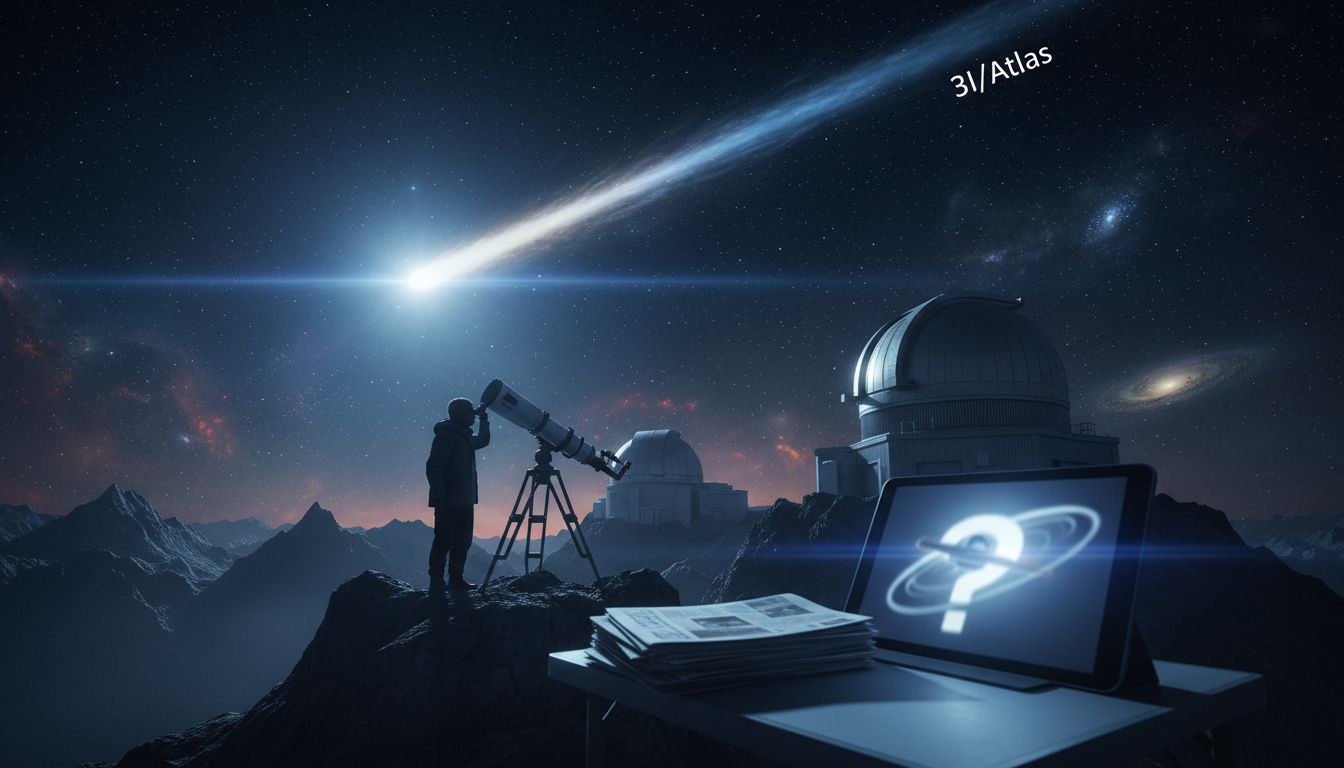
The interstellar visitor designated 3I/Atlas, first spotted by the Pan‑STARRS survey in early October, has reignited a debate that first surfaced after the discovery of ‘Oumuamua in 2017. While most of the astronomical community classifies the object as a comet‑like body—citing a faint, diffuse coma and a trajectory consistent with icy volatiles—a handful of researchers are questioning that interpretation. Dr. Elena Mikhailova, a senior lecturer in astrophysics at the University of Cambridge, argued in a recent interview that the object's observed properties could be compatible with an artificial origin, prompting headlines that suggest 3I/Atlas might be a “UFO”.
Mikhailova’s contention rests on three anomalous measurements. First, the object’s non‑gravitational acceleration, recorded by the European Southern Observatory’s Very Large Telescope, deviates from the pattern expected of outgassing comets, showing a steady thrust that does not correlate with any detectable dust or gas emissions. Second, high‑resolution spectroscopy from the Keck Observatory failed to identify the typical water‑ice or carbon‑based signatures that accompany known comets, instead revealing a featureless continuum across visible and near‑infrared wavelengths. Third, the object’s rotation period, inferred from light‑curve analysis, appears unusually stable over a span of weeks, despite the expected torques from asymmetric outgassing.
Most planetary scientists remain skeptical of the artificial‑origin hypothesis. Dr. Luis Alvarez, a comet specialist at the Instituto de Astrofísica de Canarias, cautioned that “the data are still sparse and the object is receding quickly; we must exhaust all natural explanations before invoking exotic ones.” He pointed to recent studies of comet C/2022 E3 (ZTF), which displayed similarly low outgassing signatures yet was later confirmed as a volatile‑rich body after a close solar approach. Alvarez also noted that interstellar objects travel at high velocities, and their surfaces may have been altered by prolonged exposure to cosmic rays, potentially suppressing typical spectral features.
The discussion around 3I/Atlas underscores a broader methodological challenge in the study of interstellar interlopers. Because these bodies are detected only after they have entered the inner Solar System, astronomers have limited windows—often a few weeks—to gather photometric, spectroscopic, and astrometric data. The rapid pace of observation has prompted calls for a coordinated, multi‑facility response, similar to the “Rapid Response Network” established after ‘Oumuamua’s passage. Funding agencies in Europe and the United States are reportedly reviewing proposals for dedicated space‑based telescopes capable of early detection and continuous monitoring of future interstellar visitors.
Regardless of the ultimate classification, 3I/Atlas has already spurred a renewed public interest in the search for extraterrestrial artifacts. While the majority of the scientific literature continues to treat the object as a natural cometary fragment, the episode illustrates how a single anomalous dataset can generate vigorous debate and, perhaps, motivate the development of more sensitive instrumentation. As the object now lies beyond the orbit of Jupiter, researchers will be left to sift through the existing observations for clues, and the astronomical community will watch closely for the next interstellar messenger that might finally settle the question.