Overview
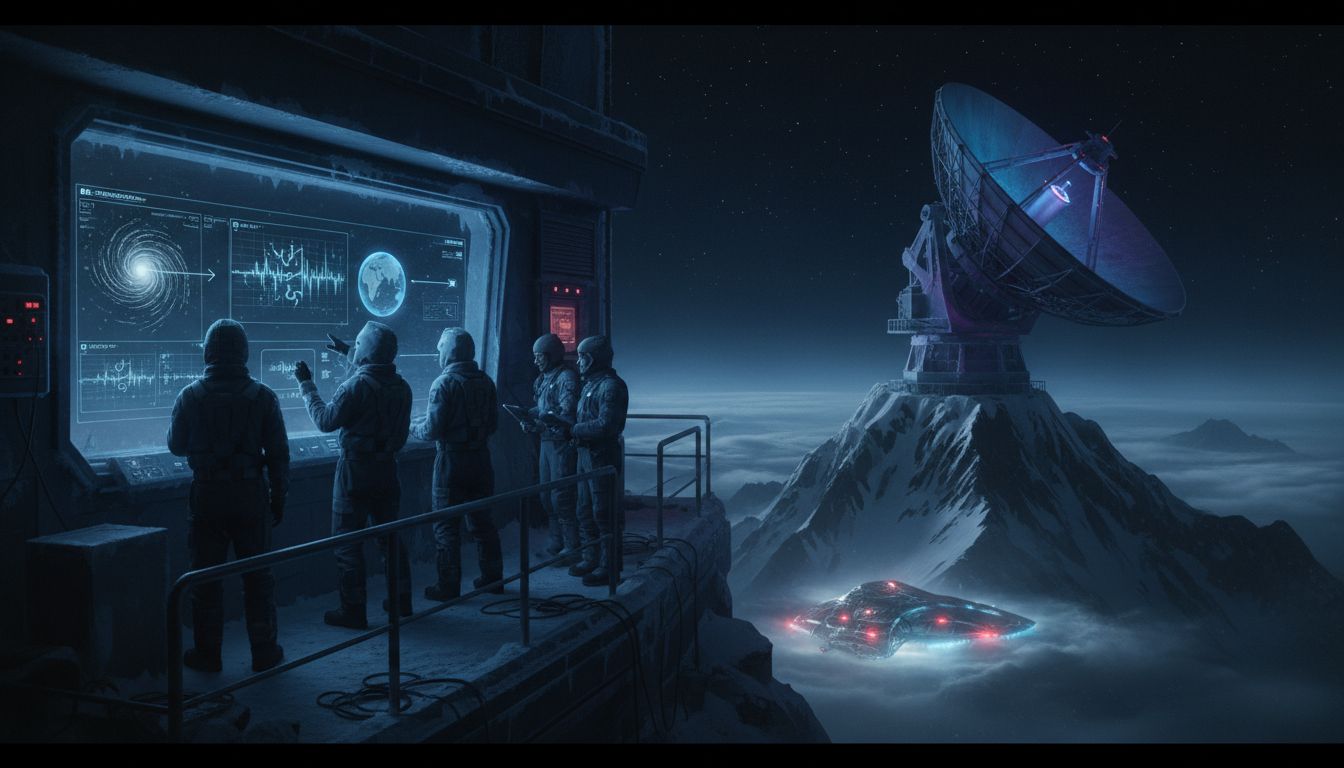
On March 24, 2026, Newser reported the detection of a series of unexplained radio transmissions that appear to be encoded in Persian and are directed toward Earth. The signals were first identified by a network of ground‑based radio telescopes monitoring the 1–10 GHz band, and their linguistic pattern has sparked a wave of speculation—from potential covert communications to the tantalising possibility of an extraterrestrial source. While the origin remains unverified, both U.S. intelligence agencies and civilian scientific bodies have opened formal inquiries to determine the nature and intent of the broadcasts.
Signal Detection and Characteristics
The anomalous emissions were captured during routine sky surveys conducted by the Deep Space Radio Array (DSRA) in New Mexico and the European VLBI Network. Researchers noted a repetitive pulse train with a carrier frequency of 4.2 GHz, modulated in a manner that, when processed through a standard Persian language decoder, produced fragments resembling Persian script. Dr. Sara Alavi, a radio astronomer at the University of Tehran who collaborated on the analysis, explained, “The modulation is unlike typical astrophysical phenomena such as pulsars or fast radio bursts. The pattern aligns with human‑engineered encoding schemes, yet the content is in Persian, which is unusual for known terrestrial transmitters.”
Preliminary spectral analysis ruled out common sources of interference—satellite downlinks, radar, and terrestrial microwave links—though the possibility of a deliberately concealed ground‑based transmitter has not been excluded.
Intelligence and Scientific Response
The Department of Defense’s U.S. Air Force Office of Scientific Research (AFOSR) confirmed that the signals are under review, stating, “We are coordinating with allied partners and relevant scientific institutions to assess any national security implications.” A spokesperson for the Central Intelligence Agency added, “At this stage, we have no evidence linking the transmissions to hostile actors. Our priority is a thorough technical assessment.”
Simultaneously, the Search for Extraterrestrial Intelligence (SETI) Institute has allocated time on its Allen Telescope Array to monitor the source region. SETI senior researcher Dr. Miguel Torres cautioned, “Extraordinary claims require extraordinary evidence. While the linguistic aspect is intriguing, we must first exhaust all terrestrial explanations before entertaining an extraterrestrial hypothesis.”
Context Within the Broader Search for Anomalous Signals
The Persian‑coded broadcast joins a growing catalogue of atypical radio events that have periodically surfaced over the past two decades, including the 1977 Wow! Signal and the 2020 ‘Fast Radio Burst’ with a repeating pattern. Unlike most astrophysical bursts, which are broadband and lack discernible language, the current emissions exhibit a structured, possibly semantic, format. Researchers point to the 2017 ‘Arecibo Message’—a deliberately crafted transmission aimed at potential extraterrestrials—as a precedent for purposeful encoding, though that message was human‑initiated and openly publicised.
Dr. Alavi emphasized the need for methodological rigor: “We have to consider cultural, geopolitical, and technical contexts. Persian is spoken by over 110 million people, and its use could indicate a human source seeking to obscure its origin or simply a misinterpretation of a non‑linguistic pattern.”
Next Steps and Public Transparency
Both governmental and civilian teams are slated to release a joint technical brief within the next 30 days. The brief will detail the signal’s spectral profile, sky coordinates, and any temporal variations observed. In parallel, the International Astronomical Union (IAU) has issued a statement urging the scientific community to share data openly, noting that “transparent collaboration is essential to avoid misinformation and to uphold the integrity of the investigative process.”
Until conclusive findings emerge, experts advise the public to treat the reports with measured curiosity. As Dr. Torres concluded, “The universe is full of mysteries, but our responsibility is to apply disciplined science before leaping to sensational conclusions.”


