Overview
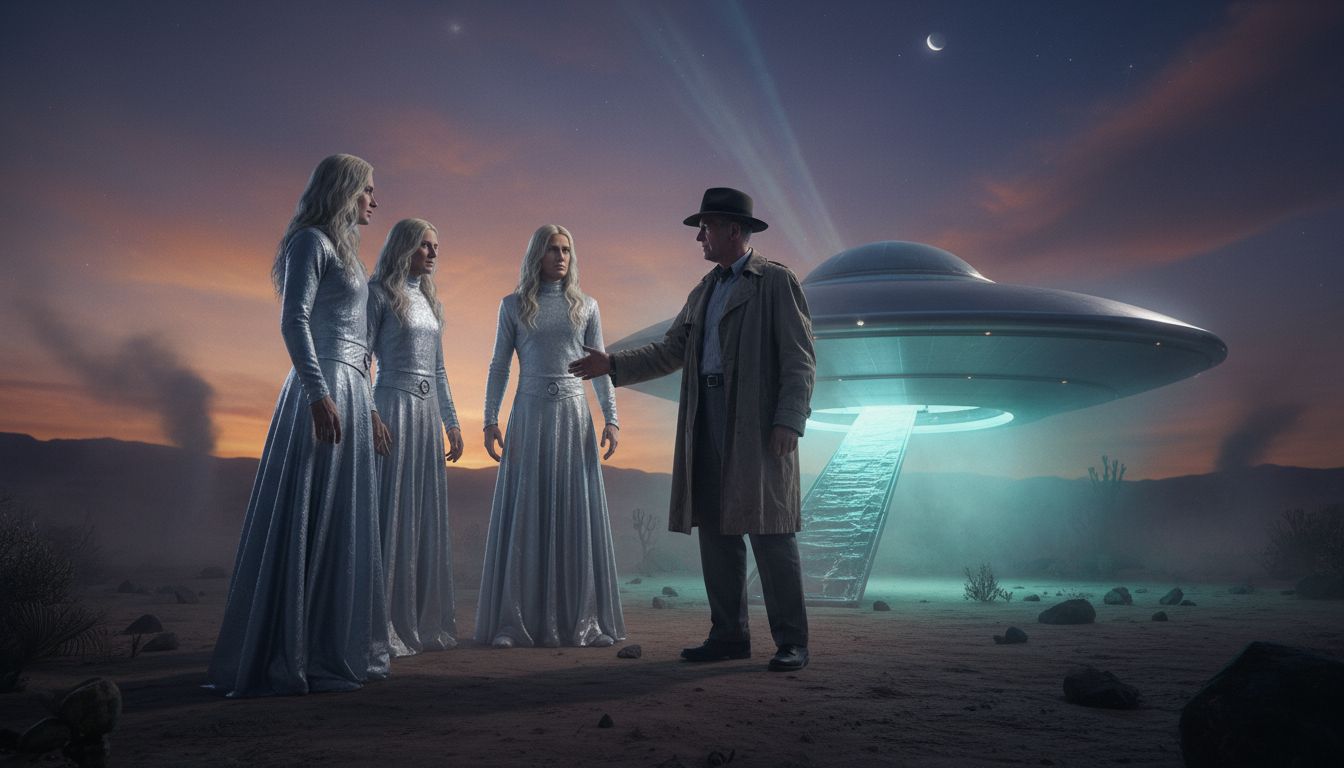
In 1952 self‑styled contactee George Adamski announced that he had met a group of benevolent “Space Brothers” who claimed to hail from Venus. During a public lecture he described a brief tour of their cigar‑shaped craft, called Orthon, and recounted a telepathic warning about the dangers of nuclear war. The episode, which has become a touchstone in the mid‑20th‑century UFO movement, is revisited in a recent Dangerous Minds feature that places Adamski’s claims within the broader cultural surge of post‑World‑War II fascination with flying saucers.
Historical Context
Adamski, a German‑born American who grew up in New York and later settled on a farm in California, was a janitor and mechanic by trade but cultivated a reputation as “the professor” among a small circle of occult and theosophical enthusiasts. By the late 1940s, after the 1947 Roswell‑era sightings sparked nationwide interest, he began reporting that he had observed 184 UFOs through a wooden telescope he had installed on his property. His lectures blended astrology, mysticism, and emerging “space‑age” ideas, attracting followers eager for concrete accounts of extraterrestrial contact.
The 1952 Encounter
According to Adamski’s own accounts, a Venusian visitor arrived in a cigar‑shaped craft that resembled the “Orthon” photographs that had been circulating in UFO magazines. He claimed the alien communicated via a mix of telepathy and hand signals, delivering a plea to humanity to avoid nuclear annihilation. As “proof,” Adamski displayed a plaster cast of the visitor’s shoes and a close‑up photograph of the ship’s hull. The image, however, has been repeatedly compared by skeptics to a chicken brooder—a farm heating device that Adamski would have readily accessed—raising questions about the authenticity of the evidence.
Skepticism and Scholarly Assessment
Researchers who have examined Adamski’s material note several red flags. The plaster shoe cast could be fabricated from any molded object, and the ship photograph lacks distinguishing features beyond a blurry silhouette. Historian Dr. Elaine Miller of the University of Arizona remarks, “Adamski’s narrative fits a pattern of post‑war anxieties projected onto imagined extraterrestrials; the emphasis on a warning about nuclear war mirrors contemporary political fears more than any verifiable contact.” Moreover, the claim that a Venusian being could survive Earth’s harsh environment contradicts current planetary science, which confirms that Venus’s surface pressure and temperature are inhospitable to known life forms.
Ongoing Interest and Legacy
Despite the doubts, Adamski’s “Space Brothers” continue to influence UFO folklore. His books, especially Flying Saucers Have Landed (co‑authored with Desmond Myles), have sold millions of copies and inspired later contactees who speak of “ benevolent interstellar emissaries.” Modern investigators, such as those at the Mutual UFO Network (MUFON), cite Adamski as a historical case study, emphasizing the need for rigorous documentation when evaluating alleged encounters. The Dangerous Minds article underscores that while Adamski’s claims remain unverified, they provide a valuable lens on how cultural anxieties and personal charisma can shape the narrative of extraterrestrial contact.
Bottom line: George Adamski’s 1952 testimony about Venusian “Space Brothers” reflects a unique blend of personal myth‑making and Cold‑War era dread. Though the physical evidence he presented has not withstood scientific scrutiny, the episode endures as a cautionary example of how extraordinary claims demand extraordinary proof—a principle that continues to guide contemporary UFO research.


