Overview
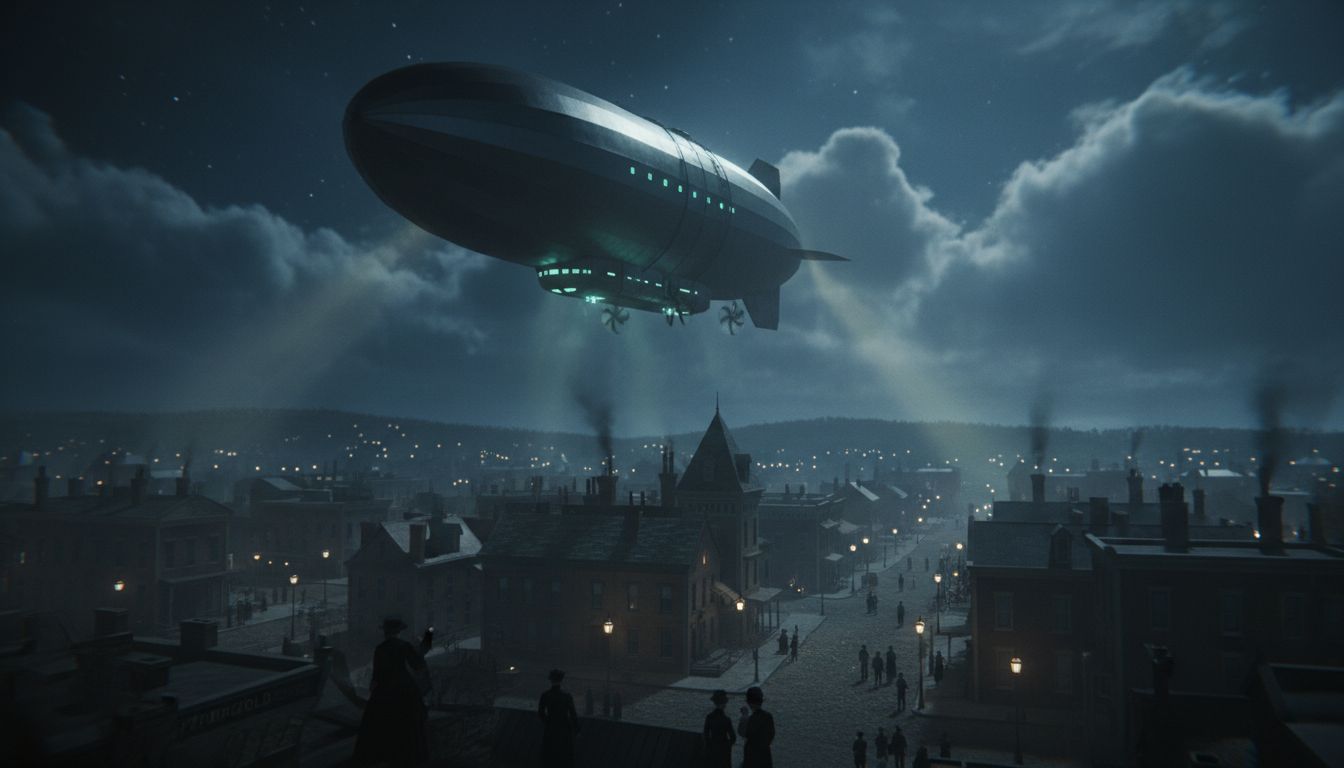
In the summer of 1897, residents of Springfield, Missouri reported a mysterious airship that appeared to hover and maneuver silently over the city’s downtown district. Contemporary newspaper clippings describe a luminous, cigar‑shaped object that lingered for several minutes before vanishing into the night sky. Though the incident faded from public memory, recent investigations by UFO historians have revived the case as one of the earliest documented sightings of an unidentified aerial phenomenon (UAP) in the American Midwest.
Historical Context
The late 19th century was a period of intense fascination with lighter‑than‑air craft. Following the 1896 “airship wave” that swept across the United States—spurred by sensationalist press coverage of alleged dirigible sightings—small towns like Springfield were primed to notice and report unusual aerial activity. Local papers such as the Springfield Daily News and the Missouri Gazette briefly ran headlines about “a strange flying vessel” seen near the Commercial Street Bridge on the night of July 22, 1897. At the time, the scientific community had only recently begun to understand the physics of balloons and early dirigibles, leaving a gap that folklore and speculation readily filled.
Eyewitness Accounts
The handful of surviving testimonies were recorded in a 1902 memoir by former city clerk Thomas H. Whitaker, who wrote:
“It was as if a great, silent whale floated above the rooftops, its hull glowing faintly amber. It hovered for what seemed like an eternity, then slipped eastward with a motion unlike any balloon I have ever seen.”
A second account, published in a 1915 retrospective of Springfield folklore, quotes a local schoolteacher, Mary L. Caldwell:
“Children were frightened, but the adults were bewildered. No engine sound, no smoke—just a steady, eerie presence that seemed to watch us.”
Both descriptions emphasize the lack of audible propulsion and the object’s ability to remain stationary, details that differentiate the 1897 sighting from contemporary balloon launches of the era.
Modern Analysis
Researchers at the Center for UFO Studies (CUFOS) and the University of Missouri’s Department of Atmospheric Sciences have examined the limited primary sources. Dr. Elena Ramirez, a historian specializing in 19th‑century aerial phenomena, notes:
“The documentation is sparse, but the language used—‘hovered,’ ‘silent,’ ‘glowing’—matches patterns we see in later, better‑recorded UAP cases. It suggests either a misidentified natural event, such as a luminous noctilucent cloud or a rare electrical discharge, or an early example of a hoax that was never fully debunked.”
Atmospheric physicist Dr. James Patel adds a meteorological perspective:
“July evenings in Missouri can produce temperature inversions that trap light and create mirage‑like effects. A distant fireball or a bright meteor could appear to linger, especially to observers without a frame of reference.”
Both experts agree that, while the incident cannot be definitively classified, it offers valuable insight into how cultural expectations and limited scientific knowledge shape the interpretation of anomalous sky events.
Conclusion
The 1897 Springfield airship remains a footnote in the broader tapestry of UAP history, illustrating how early reports blend folklore, emerging technology, and natural atmospheric quirks. As modern researchers continue to digitize 19th‑century newspapers and personal diaries, the case may yet yield clearer evidence—whether confirming a genuine unidentified sighting or revealing a captivating local legend. Until then, the “forgotten UFO” serves as a reminder that the sky has long been a canvas for human curiosity, imagination, and the enduring quest to understand the unknown.