Overview
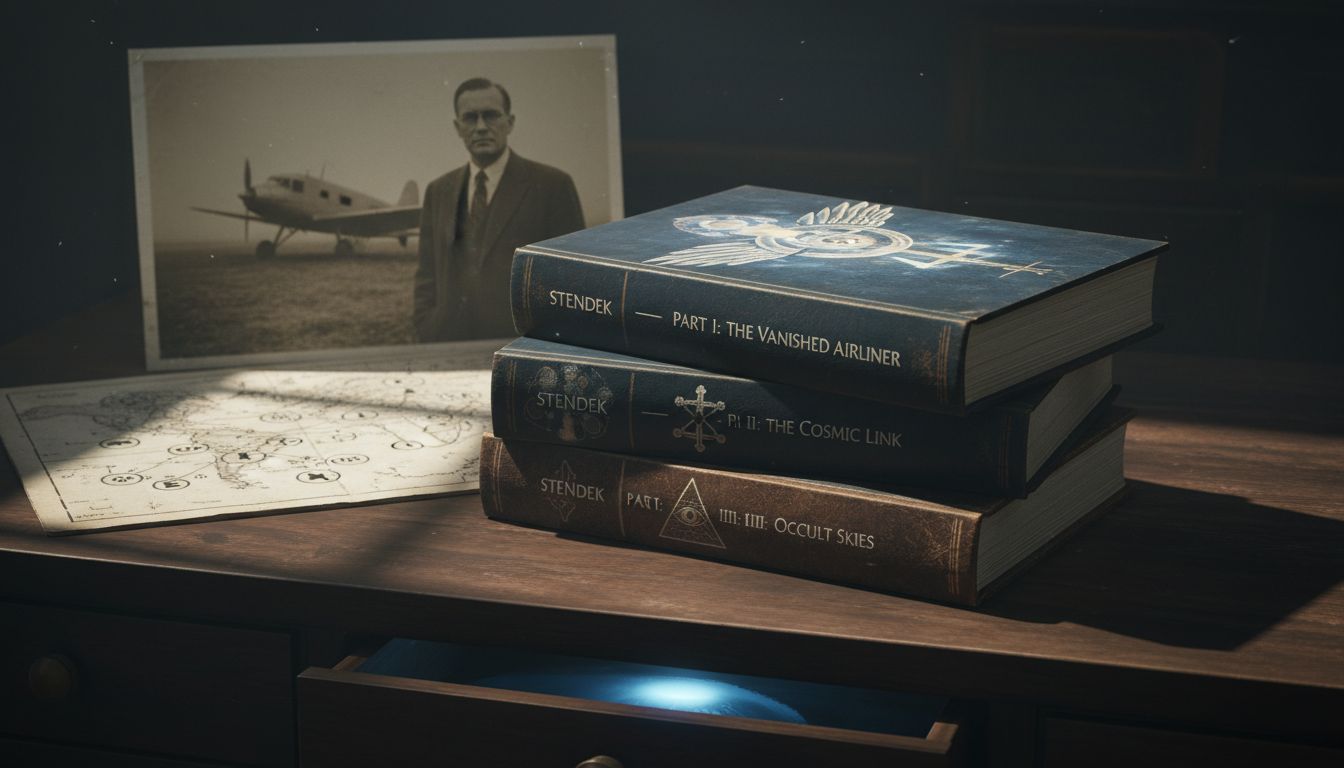
On Jan. 21, 2026, the John Keel website published a three‑part series by researcher Doug Skinner that revisits a little‑known 1973 manuscript titled Stendek. The proposal, drafted by the late ufologist John Keel, was intended as a book linking the mysterious disappearance of a 1937 commercial flight—known as the “Stendek” incident—to a broader synthesis of UFO phenomena, science, religion and occultism. Skinner’s analysis, posted in fifteen pages of scanned images, offers fresh insight into Keel’s ambitious agenda and its relevance to contemporary UFO scholarship.
Historical Context
The “Stendek” moniker derives from the final radio transmission of the 1937 flight of a Peruvian airline that vanished over the Andes, a case that has long fascinated investigators of the unexplained. Keel, who rose to prominence with The Mothman Prophecies and a prolific column in The Woodstock Times in 1973, saw the incident as a touchstone for a larger theory: that anomalous aerial events were not isolated sightings but part of a complex cultural and psychological tapestry. The original proposal, reproduced in three image sets on the site, spans fifteen pages and bears Keel’s characteristic marginal notes, including the self‑deprecating header “Not an authority on anything.”
Keel’s Interdisciplinary Vision
According to Skinner, Keel’s manuscript called for collaboration with scholars, historians and theologians, urging them to examine UFO reports through the lenses of myth, ritual and collective perception. Keel wrote, “The phenomenon is a mirror held up to the human mind; it reflects our hopes, fears, and the hidden structures of belief.” He argued that conventional scientific frameworks—physics, aerospace engineering—were insufficient to explain the recurring patterns of contact, and that psychological constructs rather than “physical dimensions or a creator” underpinned both UFO and supernatural narratives. This stance placed him in intellectual proximity to Jacques Vallée, whose “control‑system” theory posits that the phenomenon functions as a feedback loop influencing human culture.
Contemporary Analysis and Institutional Shifts
Skinner’s series also notes a parallel development in the 1970s: the United States Air Force’s gradual disengagement from Project Blue Book and related investigations. The withdrawal, he argues, signaled an institutional acknowledgment that the UFO issue could not be neatly contained within a purely defense‑oriented paradigm. By juxtaposing Keel’s interdisciplinary proposal with Vallée’s control theory, Skinner suggests that the 1970s marked a pivot from physical‑object explanations toward sociocultural models—a shift that continues to shape modern research agendas at agencies such as the U.S. Office of the Director of National Intelligence.
Scholarly Debate: Randle vs. Rudiak
The series further highlights an ongoing debate among contemporary ufologists, exemplified by the exchange between Kevin Randle and David Rudiak. Randle, a prolific author of UFO casebooks, maintains that empirical, field‑based evidence remains paramount. Rudiak counters that the “subjective reality” of witnesses, shaped by mythic and religious frameworks, must be foregrounded. Skinner positions Keel’s 1973 vision as an early articulation of Rudiak’s perspective, noting that Keel “sought to move beyond the hunt for hardware and instead map the symbolic terrain of the sightings.”
Implications for Future Research
While the original Stendek manuscript never materialized as a book, its resurfacing through Skinner’s meticulous digitization invites renewed scholarly attention. By emphasizing interdisciplinary collaboration and the primacy of psychological constructs, Keel’s proposal anticipates current calls for a “human‑centric” approach to anomalous aerial phenomena. As the U.S. government prepares to release additional data on unidentified aerial events later this year, the questions Keel raised—about belief, narrative, and the limits of conventional science—remain as pertinent as ever. The rediscovered proposal thus serves not only as a historical curiosity but also as a reminder that the quest to understand UFOs may ultimately be a quest to understand ourselves.


