Overview
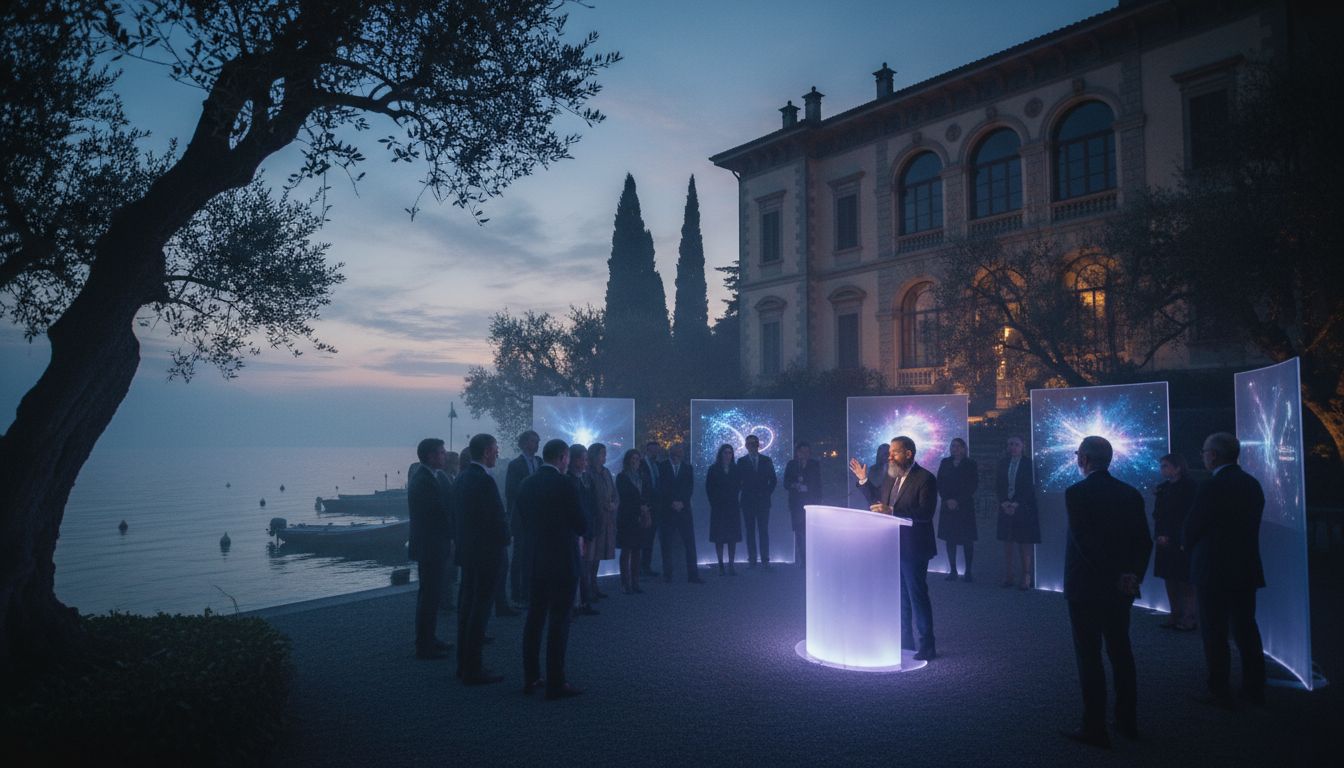
The 2025 SOL Foundation Symposium, held at the historic Hotel Dino in Baveno, Italy, brought together roughly 100 scholars, investigators and policymakers from more than a dozen nations to discuss the next steps for Unidentified Aerial Phenomena (UAP) research. Set against the tranquil backdrop of Lake Maggiore, the three‑day gathering emphasized two recurring imperatives identified by participants: interdisciplinary methodology and transparent public engagement. Society for UAP Studies (SUAPS) members accounted for a sizable share of the program, delivering talks that spanned archival astrophysics, legal analysis, social‑science theory, and investigative best practices.
Interdisciplinary Presentations
The symposium opened with Dr. Beatriz Villarroel, a SUAPS board member, who presented her work on “transient light phenomena” captured on pre‑space‑age star‑mapping plates. Villarroel explained that the photographs were taken at night, ruling out solar glare, and described a rigorous selection protocol designed to convert isolated visual anomalies into a searchable dataset. “Our goal is to treat these flashes as data points, not curiosities,” she said, underscoring the methodological rigor that set the tone for the event.
On Sunday, Dr. Christian Peters, advisory board member, turned the discussion toward the political and sociological dimensions of UAP disclosure. He warned against a binary “yes‑or‑no” framing of the phenomenon and introduced the notion of a societal “serenity crisis” – a potential collective anxiety that could arise if unexplained aerial events were presented without a clear interpretive framework. Peters called for “conceptual scaffolding” that would allow both researchers and the public to process anomalous information responsibly.
Legal perspectives were represented by Dr. Michael Bohlander, a retired international judge and SUAPS member. In his session, Bohlander applied comparative human‑rights law to reported abduction cases, outlining circumstances where consent, privacy and due‑process standards might be implicated. While he stopped short of asserting the factual truth of any individual claim, he argued that “legal reasoning can provide a neutral structure for evaluating testimony, clarifying ethical boundaries for investigators.” SUAPS founder Micke Cifone later described the talk as “touching the core of the strangeness” inherent to UAP inquiries.
Witness‑Centric Methodology
Former GEIPAN analyst Dr. Michael Valliant delivered a retrospective titled Uniting Experience and Science, charting two decades of French UAP case analysis. Valliant highlighted software tools developed to systematize investigator reasoning and reduce cognitive bias, stressing that “the witness remains the central pillar of any credible investigation.” He demonstrated how structured interview protocols, coupled with quantitative scoring of evidentiary consistency, can bridge the gap between anecdotal reports and scientific scrutiny. Attendees noted the practical relevance of these tools for ongoing investigations across Europe and North America.
Public Engagement and Community Building
Beyond formal sessions, the symposium fostered informal networking that many participants cited as essential to its success. An inclusive dinner organized by Edoardo Russo, head of the Centro Italiano Studi Ufologici and SUAPS board member, deliberately paired early‑career researchers with senior scientists, creating a “lab‑like” environment for idea exchange. The lakeside gatherings, described by several delegates as “refreshing” and “inspiring,” reinforced the event’s commitment to openness and collaboration, countering the secrecy that has historically hampered UAP discourse.
Outlook
The consensus emerging from SOL 2025 is that progress in UAP studies will depend on cross‑disciplinary partnerships and clear communication with the public. As SUAPS members continue to refine archival analysis, legal frameworks, and witness‑centred methodologies, the symposium’s participants pledged to share data openly through peer‑reviewed channels and to maintain dialogue with policymakers. Greg Bishop, a senior SUAPS coordinator, summed up the sentiment: “We are building a community that values both scientific rigor and public trust; that balance will define the next chapter of UAP research.”