Overview
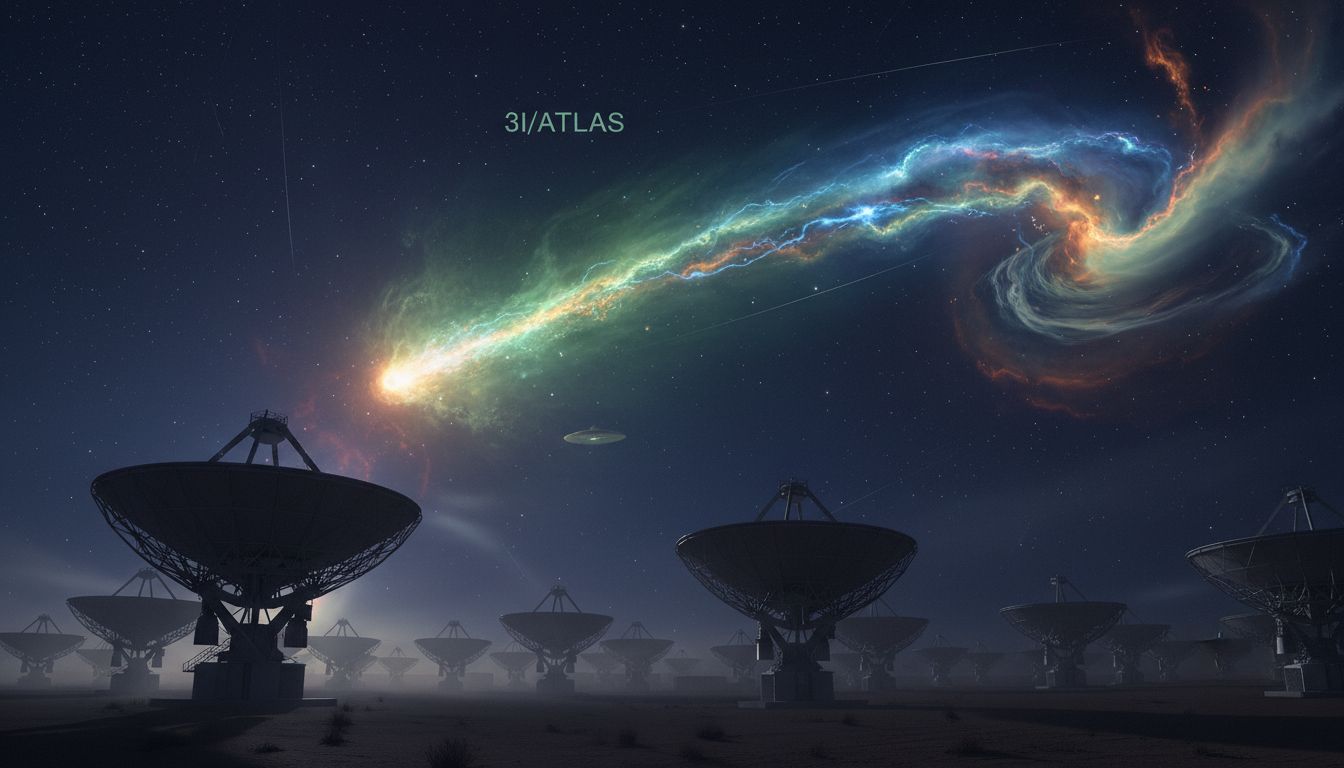
On 29 October 2025 the interstellar visitor 3I/ATLAS swung past the Sun at its closest approach, or perihelion, marking a rare celestial event that captured worldwide attention. Discovered by the ATLAS survey in Chile on 1 July 2025, 3I/ATLAS is only the third object ever identified as originating beyond the Solar System, joining the famed ‘Oumuamua (2017) and comet 2I/Borisov (2019). As the object emerged from the Sun’s glare, solar‑monitoring spacecraft recorded a powerful coronal mass ejection (CME) launched on the same day, prompting astronomers to wonder whether the CME would strike the fast‑moving interloper.
The CME‑Impact Test
A CME of this magnitude—estimated at a billion‑tonne plasma cloud traveling at roughly 1 500 km s⁻¹—has never been observed colliding with a known interstellar object. Theoretical models suggested that if the CME intersected 3I/ATLAS, the intense solar wind and ultraviolet radiation could strip or heat any surface volatiles, potentially producing a detectable signature. “It was a natural experiment,” said Dr. Mira Patel, senior researcher at the South African Radio Astronomy Observatory (SARAO). “If the object were an artificial craft, we would expect an anomalous response; a natural body should simply react like a comet.”
MeerKAT’s Faint Whisper
Within weeks of perihelion, the MeerKAT radio telescope array in South Africa tuned in to the region of sky where 3I/ATLAS had traveled. The array detected a faint hydroxyl (OH) emission line at 1 665 MHz—a classic indicator of water‑vapour outgassing in comets. The signal, though weak, was statistically significant after 12 hours of integration. “The OH line is the ‘smoking gun’ of cometary activity,” explained Prof. Lars Jensen, lead author of the study submitted to Astronomy & Astrophysics. “Its presence tells us that 3I/ATLAS is shedding water molecules, exactly what we expect from a natural icy body exposed to solar heating.”
Implications for the ‘Alien Craft’ Hypothesis
The detection has immediate consequences for the speculative narrative that 3I/ATLAS might be an extraterrestrial probe—a theory popularized by Harvard astronomer Avi Loeb after the object’s unusual light‑curve was first reported. While Loeb and colleagues have argued that non‑gravitational accelerations could hint at propulsion, the new OH signature aligns with conventional cometary physics and weakens the alien‑craft argument. “We are not ruling out any possibility outright, but the data now favor a natural explanation,” noted Dr. Patel. “The CME test was a decisive moment; a lack of anomalous radio emission would have kept the mystery alive, but the OH line is a clear, mundane fingerprint.”
Looking Ahead
Astronomers will continue monitoring 3I/ATLAS as it recedes from the Sun, using both optical telescopes and radio facilities to track any residual activity. The event also underscores the value of coordinated solar‑space weather observations with deep‑space surveys. “Future interstellar detections will benefit from real‑time solar monitoring,” said Prof. Jensen. “If a CME does intersect an object, we now have a proven methodology to test its composition quickly.” The episode serves as a reminder that even the most exotic visitors can be understood through established planetary science, and that the Sun itself remains a powerful probe of the cosmos.


