Overview
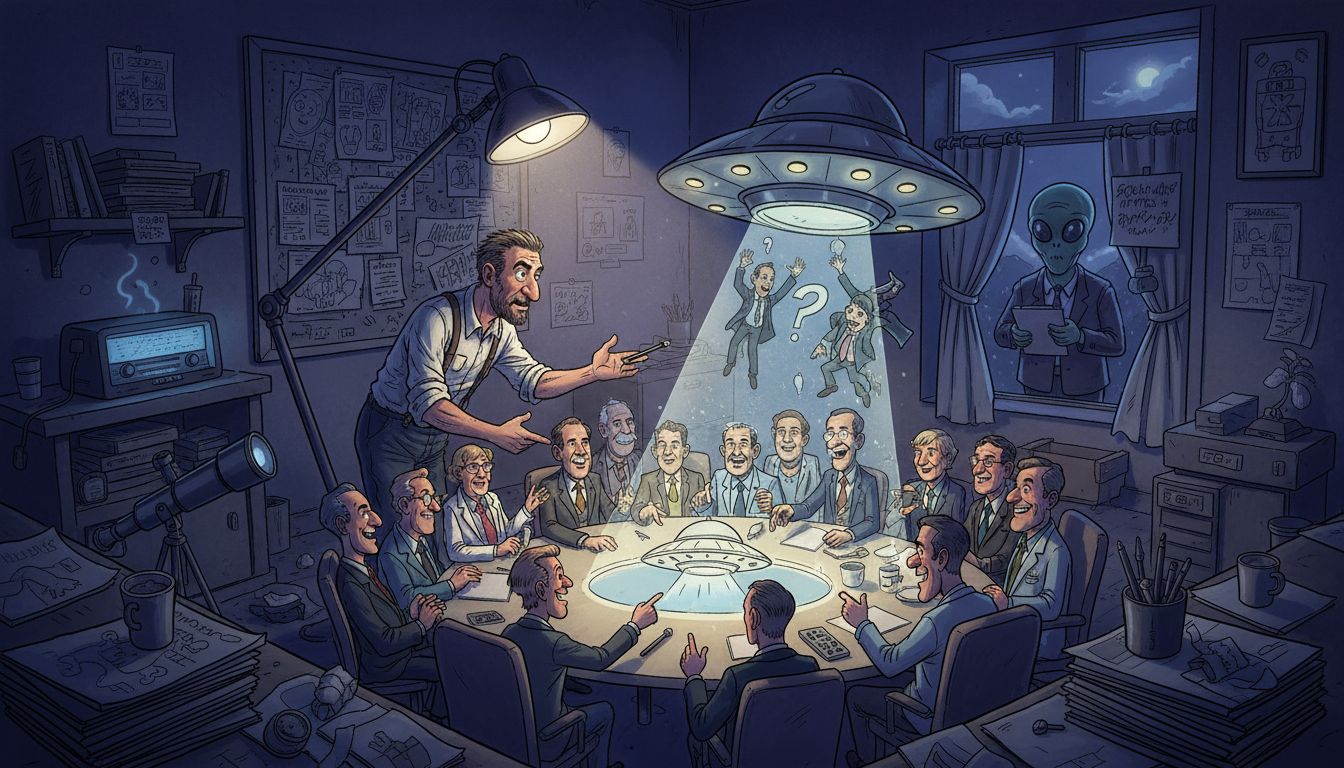
The Daily Grail’s recent “Sunday Funnies” column uses a vintage‑style cartoon by Miguel Romero to lampoon the long‑standing claim that the public knows about UFOs only because “the government said so.” While the illustration offers a tongue‑in‑cheek reminder of how secrecy has shaped popular imagination, the piece also notes a shift in the investigative landscape: universities, aerospace agencies, and independent research groups are now working together on systematic UAP (Unidentified Aerial Phenomena) studies. This convergence of art, science, and politics comes at a moment when a rumored presidential announcement—purportedly scheduled for July 8 2026—has reignited speculation about an imminent, large‑scale disclosure.
Satire and Public Perception
Romero’s cartoon, featured prominently in the article, depicts a bewildered citizen asking a bureaucrat why the government keeps “hiding the truth” about flying saucers. The caption, “Because the Government Said So!” echoes the frustration many UFO enthusiasts have voiced since the 1940s. In an interview for the column, Romero explained, “Humor lets us critique the opacity of official narratives without resorting to conspiracy rhetoric. It’s a way of saying, ‘We deserve answers, and we’ll keep asking.’” By juxtaposing the cartoon with contemporary headlines, the Daily Grail underscores how satire continues to serve as a barometer of public sentiment toward official secrecy.
Growing Academic and Scientific Collaboration
Beyond the comic strip, the article highlights a notable trend: increased collaboration among academic institutions, federal research labs, and private aerospace firms on UAP investigations. Since the 2022 establishment of the UAP Research Consortium (UARC), more than a dozen universities—including MIT, Stanford, and the University of Arizona—have received grants to study sensor data, atmospheric physics, and potential propulsion anomalies. A recent briefing from the National Aeronautics and Space Administration’s (NASA) UAP Task Force reported that joint analyses have yielded “over 200 high‑confidence sightings that merit further scientific scrutiny.” Dr. Lena Patel, a physicist at the University of Colorado and co‑author of a forthcoming paper on radar cross‑section anomalies, told the Daily Grail, “We’re moving from anecdotal reports to reproducible measurements, which is essential for any credible scientific inquiry.”
Political Disclosure Rumors and Geopolitical Stakes
The column also references a persistent rumor that former President Donald Trump plans to announce a comprehensive UFO disclosure on July 8 2026. While no official statement has confirmed the date, the speculation has been fueled by a leaked briefing memo seen by several journalists. Analysts warn that such an announcement could have geopolitical ramifications, noting that both Russia and China have accelerated their own UAP research programs. A senior defense analyst at the Center for Strategic Studies, speaking on condition of anonymity, warned, “If the U.S. were to release classified data without coordination, it could give adversaries a strategic window to either preempt the disclosure or use it to sow confusion.” The Daily Grail’s editorial team cautions readers to treat the July 8 claim as unverified until an official channel confirms it.
Cultural Reflections: “The Roswell Song”
Amid the serious discourse, the article closes with a nod to the cultural dimension of the UFO phenomenon. It recommends listeners stream “The Roswell Song” by Elle Cordova & Toni Lindgren, a folk‑rock ballad that blends historical references with contemporary concerns about transparency. The song’s lyric—“We’ve been watching the skies, waiting for the day they finally tell us why”—captures the blend of hope and skepticism that defines public engagement with UAP topics. By pairing Romero’s satire with a modern musical tribute, the Daily Grail illustrates how art and music continue to shape, and be shaped by, the evolving conversation on unidentified aerial phenomena.
The piece therefore paints a multifaceted picture: a satirical cartoon reminding us of decades‑long frustration, a burgeoning scientific effort to bring rigor to UFO research, a politically charged rumor that could alter diplomatic dynamics, and a cultural soundtrack that keeps the mystery alive in the public imagination. As the July 8 deadline approaches, observers from all sectors will be watching closely—not just for what is disclosed, but for how the disclosure, if it occurs, will be framed within science, policy, and popular culture.