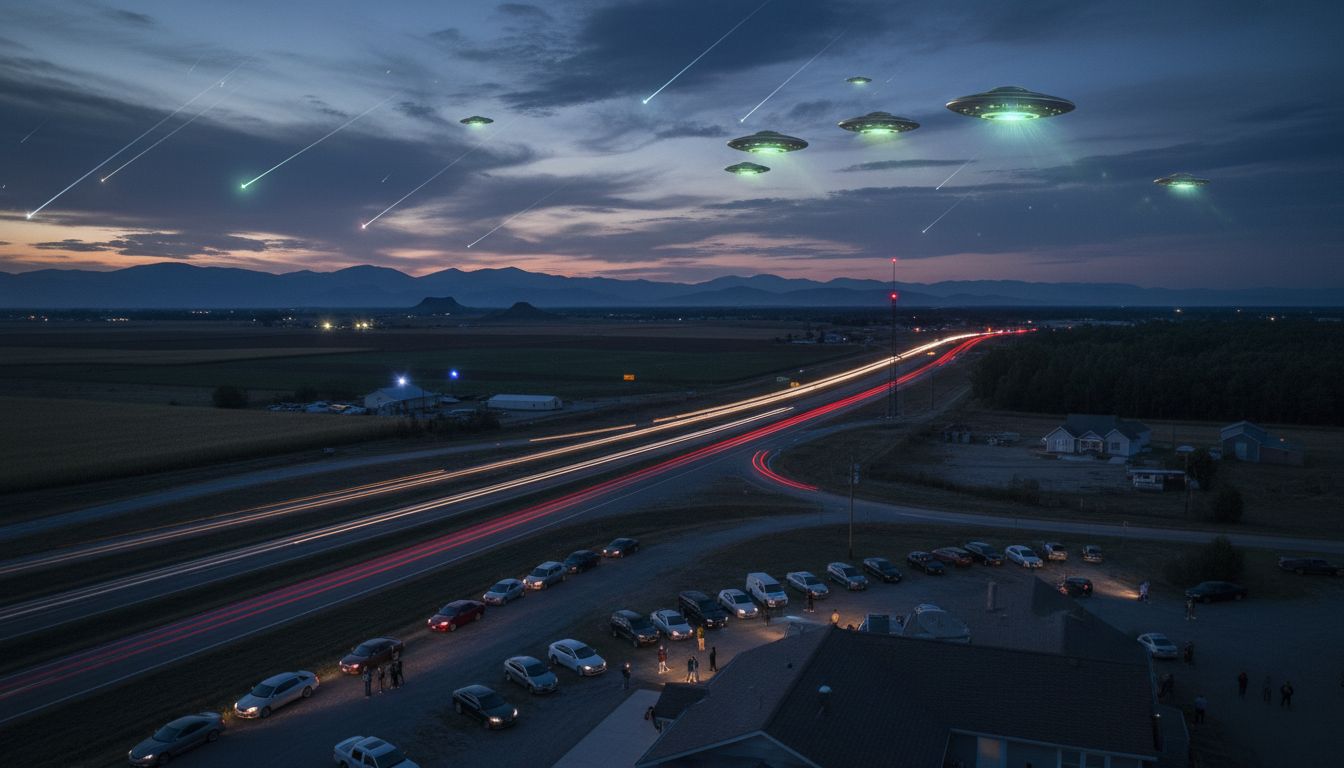
The United States saw an unprecedented spike in civilian UFO reports on Sunday, Oct. 26, according to data compiled by several independent tracking sites. More than 1,200 sightings were logged across 18 states, with the highest concentration in the New York metropolitan area. The surge follows a series of high‑profile government disclosures over the past year—including the Pentagon’s 2024 UAP Task Force report and the declassification of several Navy videos—that have heightened public awareness and encouraged more people to submit observations to databases such as the National UFO Reporting Center and the Mutual UFO Network.
What makes Sunday’s tally stand out is the prevalence of reports describing objects that appeared to be underwater or partially submerged. Witnesses from Long Island to the New Jersey shore described “glowing, green‑hued shapes moving slowly beneath the surface,” a phenomenon echoed in a separate set of reports from coastal Maine and Virginia. While experts caution that many of these accounts could involve bioluminescent marine life, discarded fishing gear, or atmospheric optical effects, the pattern has drawn attention from researchers at the University of Colorado’s Center for the Study of Extraterrestrial Phenomena. “The underwater element is unusual in the historical record,” said Dr. Lena Morales, a marine biologist who has been consulting with the UAP Task Force. “If these sightings are genuine, they suggest a broader range of environments where unidentified aerial—or perhaps sub‑aerial—phenomena are being observed.”
The heat map generated from the submissions shows a dense cluster over the greater New York area, a region that has historically attracted a disproportionate share of UAP reports. Analysts at the Advanced Aerospace Threat Identification Program (AATIP) note that urban centers generate more data simply because of higher population density and greater numbers of surveillance cameras. Nonetheless, the “New York hotspot” has persisted for years, prompting speculation that the city’s electromagnetic environment or its air traffic patterns might create conditions conducive to anomalous sightings. “We’re not saying New York is a magnet for aliens,” said former Navy pilot and current UAP analyst Captain James Whitaker, “but the concentration of reports does warrant a closer look at local atmospheric and electromagnetic variables.”
Internationally, Russia’s Federal Service for Supervision of Communications, Information Technology and Mass Media (Roskomnadzor) released a brief statement on Sunday confirming that its own monitoring stations recorded “unusual luminous objects” over the Ural region at roughly the same time as the U.S. sightings. Russian observers described the objects as moving “slowly, with a distinct green hue,” a description that mirrors several U.S. accounts. While the Russian Ministry of Defense has not linked these observations to any known aerospace activity, the simultaneous reports on opposite sides of the Atlantic have reignited discussions about a possible shared phenomenon, whether natural or man‑made.
The timing of the surge also coincides with renewed public interest in the so‑called 3I/Atlas object—a large, slow‑moving body currently traversing the solar system that has been the subject of both scientific scrutiny and speculative conspiracy theories. Although the 3I/Atlas is a distant object and its trajectory does not intersect Earth, some commentators have drawn parallels between its unusual orbital characteristics and the “slow, green” descriptors used by several eyewitnesses. “It’s a tempting narrative, but we must separate astrophysical objects from atmospheric or near‑surface phenomena,” cautioned Dr. Emily Chen, an astrophysicist at the Smithsonian Astrophysical Observatory. “The data we have so far suggest these are separate events, but the coincidence underscores how heightened media coverage can amplify public perception of a pattern.”
As the week progresses, federal agencies are expected to review the Sunday data alongside other recent spikes, with the Office of the Director of National Intelligence slated to release an interim assessment in early November. For now, the surge serves as a reminder that, despite decades of investigation, the catalog of unexplained aerial and sub‑aerial observations continues to expand, challenging both scientific inquiry and public imagination.


