Overview
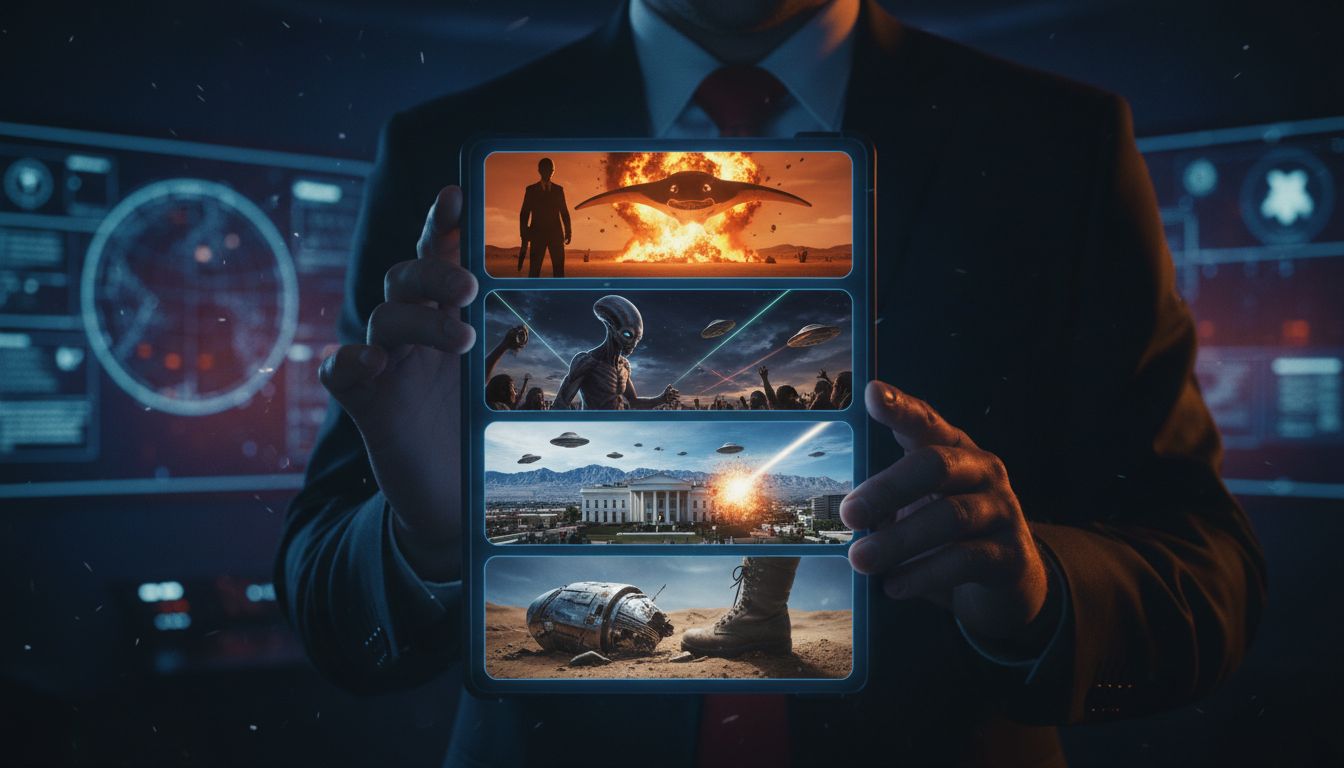
Former President Donald J. Trump posted a series of AI‑generated images depicting alien encounters on his Truth Social account on May 17, 2026. Each image was accompanied by the caption “Target destroyed.” The posts appeared one week after the Department of Defense’s newly created Department of War released a batch of previously classified UFO files, including photographs and video clips, to the public. The timing has prompted media analysts to examine whether the former president is using synthetic media to comment on the renewed government focus on unidentified aerial phenomena (UAP).
The Posts
The eight images shared by Trump feature stylized extraterrestrials, spacecraft, and dramatic battle scenes rendered in a hyper‑realistic, computer‑generated style. None of the pictures bear any official attribution; the captions are brief and uniform, reading “Target destroyed.” A screenshot of Trump’s Truth Social feed, captured by the El Paso Times, shows the posts were uploaded at 02:14 a.m. MT and quickly amassed thousands of likes and comments. The platform’s algorithm flagged the content as “AI‑generated,” a label now required by the network’s updated policy on synthetic media.
Context of Recent UFO Disclosure
On May 10, the Department of War—established in 2025 to consolidate national security efforts on anomalous aerial phenomena—published over 300 declassified documents, including high‑resolution photos taken by Navy pilots and radar data from 2022‑2024. The release, described by the department as “the most comprehensive public disclosure of UAP evidence to date,” reignited public and congressional interest in the subject. In the weeks following the announcement, several bipartisan committees scheduled hearings to evaluate the implications for air‑space safety and national defense.
Trump’s post arrives amid this heightened attention. While he has not issued a formal statement linking the images to the Department’s findings, his communications director, Jenna Whitaker, told reporters that the former president “often uses visual metaphors to underscore his views on national security and sovereignty.” Whitaker declined to comment on whether the AI images were intended as satire, political commentary, or a broader statement on the UAP issue.
Reactions
Political analysts and media ethicists have offered measured perspectives. Dr. Elena Ramos, a professor of media studies at the University of Texas, noted, “The convergence of AI‑generated content and high‑profile political figures raises legitimate concerns about misinformation, even when the creator’s intent is not deceptive.” The Federal Trade Commission’s Office of Public Awareness, which monitors synthetic media disclosures, confirmed that the posts comply with current labeling requirements but urged platforms to provide clearer context for users.
Within the UFO research community, reactions are cautious. Luis Ortega, director of the nonprofit UAP Research Alliance, said, “We welcome any public discourse that brings attention to the data released by the Department of War, but we must separate artistic renderings from verified evidence.” The alliance also emphasized that the images lack any corroborating metadata and should not be treated as documentary proof.
Outlook
The episode highlights the growing intersection of political communication, artificial intelligence, and national‑security disclosures. As synthetic media tools become more accessible, experts anticipate increased scrutiny from regulators and fact‑checking organizations. For now, Trump’s “Target destroyed” posts remain a visual footnote to the broader conversation sparked by the Department of War’s UFO file release, underscoring the need for clear guidelines on how public figures employ AI‑generated imagery in political discourse.