Overview
A new bonus episode of Richard Hatem’s “Paranormal Bookshelf” podcast, released on January 9, features parapsychologist Dr. Callum Cooper discussing two intertwined topics: the unsolved 1990 murder of investigative writer D. Scott Rogo and Cooper’s ongoing work with Instrumental Transcommunication (ITC)—a method that claims to capture images, text and voices from the deceased via electronic media. Cooper also announced plans to republish Rogo’s controversial book Phone Calls from the Dead in a more affordable format, arguing that the material provides empirical support for the survival of consciousness.
Context: The Rogo Case and Its Legacy
D. Scott Rogo, a prolific author of over thirty books on UFOs, cryptids and other fringe phenomena, was found dead in his New York apartment in June 1990. The case remains officially unsolved, though speculation has linked it to his investigative work on government secrecy and alleged extraterrestrial encounters. Over the past three decades, the murder has been cited by paranormal researchers as a possible “silencing” of a critical voice, but law‑enforcement records show no conclusive motive.
Dr. Cooper, who has studied Rogo’s writings for more than a decade, says his investigation “combines forensic review of police files with an analysis of Rogo’s own notes on anomalous communications.” While Cooper does not claim to have identified a perpetrator, he emphasizes that the case highlights the risks faced by researchers who probe the boundaries of mainstream science.
Instrumental Transcommunication: Method and Controversy
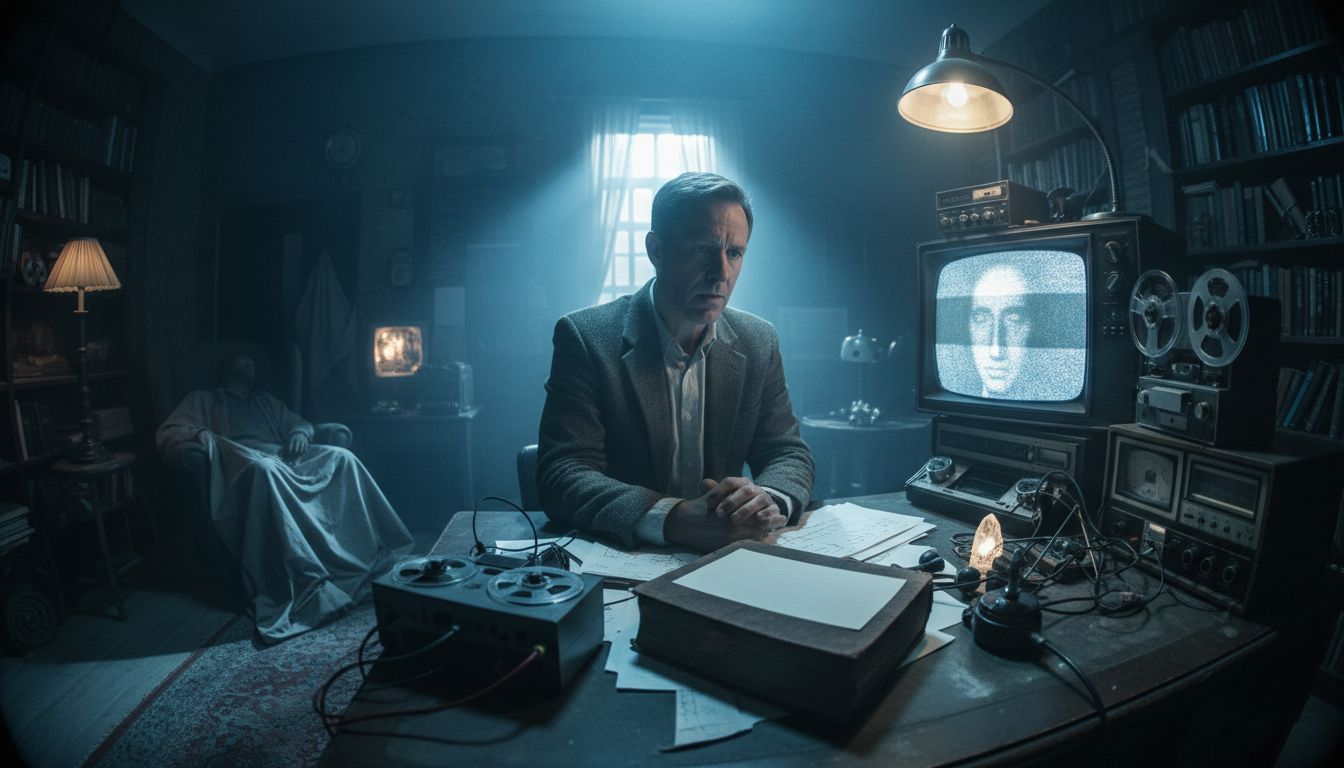
Instrumental Transcommunication, first explored in the 1970s by Soviet scientists and later popularized in the United States, involves the use of radios, televisions, and other electronic devices to capture purportedly spontaneous signals from non‑physical entities. Practitioners report hearing voices, seeing static‑filled faces, or receiving typed messages that appear on screen without human input.
Cooper explains that his laboratory employs “high‑sensitivity receivers and digital signal‑processing algorithms to isolate anomalous patterns from background noise.” He cites several instances where “the content of the captured speech corresponded to verifiable personal details of the participants,” which he believes “strengthens the hypothesis that consciousness can persist beyond bodily death.” Critics, however, argue that many ITC recordings can be explained by pareidolia, radio interference, or deliberate hoaxing, and note the lack of peer‑reviewed publications confirming the phenomenon.
Publishing Rogo’s Phone Calls from the Dead
The podcast episode also announced Cooper’s intention to re‑issue Rogo’s 1991 book Phone Calls from the Dead as an inexpensive e‑book and print‑on‑demand paperback. The original work compiled transcripts of alleged telephone conversations with deceased individuals, many of which were recorded using early ITC equipment. Cooper contends that “the book remains a valuable data set for anyone studying electronic communication with the afterlife, but its high price and limited distribution have kept it out of reach for most researchers.”
He plans to include new commentary that situates the original recordings within the broader scientific discourse on consciousness, as well as supplemental audio excerpts from his own ITC experiments. The revised edition is slated for release later this year through a small academic press specializing in fringe science.
Implications for the Study of Consciousness
While the scientific community remains skeptical of ITC’s claims, Cooper argues that “systematic documentation and open‑access publishing can at least bring the conversation into a more rigorous arena.” He hopes that the updated Phone Calls from the Dead will encourage interdisciplinary collaboration among psychologists, physicists, and parapsychologists.
Regardless of one’s stance on the underlying phenomena, the episode underscores a growing trend: researchers on the margins of mainstream science are leveraging digital platforms to disseminate data that would otherwise remain obscure. Whether these efforts will lead to verifiable breakthroughs or remain within the realm of speculative inquiry remains to be seen, but they undeniably keep the dialogue about the nature of consciousness alive.