Overview
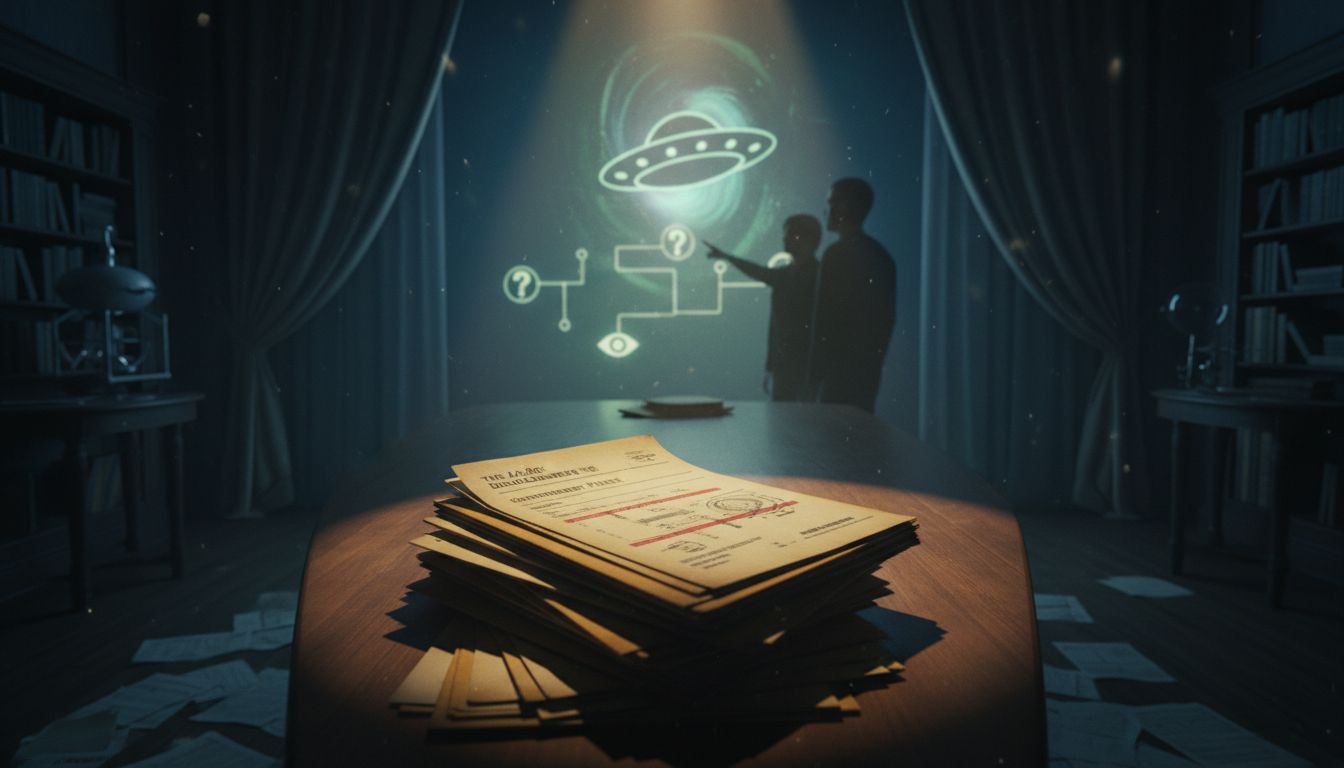
The New York Times’ recent review of the documentary The Age of Disclosure calls for an immediate declassification of the United States government’s UFO and UAP (Unidentified Aerial Phenomena) files. The critic, writing on November 20, 2025, frames the release as a “pivotal step toward transparency” that would satisfy both a growing public curiosity and the scientific community’s demand for data. While the review stops short of asserting the existence of extraterrestrial life, it argues that withholding the accumulated evidence hampers rigorous inquiry and erodes trust in federal institutions.
Core Arguments
The reviewer highlights three main reasons for disclosure. First, public interest has reached an unprecedented level, fueled by recent congressional hearings and the Pentagon’s 2024 UAP task‑force report, which acknowledged “anomalous aerial observations that could not be readily explained.” Second, the scientific community has repeatedly requested access to raw sensor data, flight logs, and radar recordings so that independent analysts can apply peer‑reviewed methodologies. Finally, the piece suggests that a systematic release could clarify the line between national‑security concerns and genuine scientific phenomena, preventing speculation from filling the vacuum left by secrecy. “A measured, phased declassification would allow policymakers to protect legitimate security interests while opening the door for legitimate research,” the review notes.
Historical Context
Government handling of UFO reports has evolved dramatically over the past three decades. The 1990s “Project Blue Book” archive was partially released, but many files remained classified. In 2017, the Department of Defense confirmed the existence of the Advanced Aerospace Threat Identification Program, and in 2023 the Office of the Director of National Intelligence issued a preliminary assessment that documented 144 UAP incidents between 2004 and 2022, with 18 cases deemed “highly credible.” Subsequent congressional hearings in 2024 and early 2025, featuring testimonies from former pilots and intelligence officers, amplified calls for transparency. The Age of Disclosure builds on this momentum, positioning the documentary as a cultural catalyst that could push the government to act.
Scientific Implications
If the files were released, researchers could apply modern analytical tools—machine‑learning classification, high‑resolution imaging reconstruction, and cross‑referencing with astronomical data—to assess the phenomena objectively. Dr. Elena Ramirez, a physicist at the University of Colorado who studies atmospheric anomalies, told the Times review, “Having access to raw sensor signatures would let us determine whether we are dealing with sensor artifacts, novel atmospheric physics, or something entirely new.” The review stresses that objective data, not conjecture, is essential for any credible scientific discourse on UAPs, and that withholding information risks relegating the subject to fringe speculation.
Path Forward
The article concludes that a phased release strategy—starting with older, less sensitive records and moving toward more recent, classified material under oversight—could balance national‑security imperatives with public and scientific demand. It recommends the establishment of an independent review board composed of former defense officials, scientists, and civil‑rights advocates to evaluate each batch of documents. As the Times reviewer puts it, “Transparency is not a zero‑sum game; it strengthens democratic accountability while enabling the scientific method to do what it does best—question, test, and understand.” The review thus positions The Age of Disclosure not merely as a documentary but as a call to action for policymakers to finally open the extraterrestrial files that have long been kept under lock and key.