Overview
A 2024 Department of Defense report released by the All‑Domain Anomaly Resolution Office (AARO) concluded that no U.S. government investigation has confirmed extraterrestrial technology behind any Unidentified Anomalous Phenomena (UAP) sighting. The 63‑page “Report on the Historical Record of U.S. Government Involvement with Unidentified Anomalous Phenomena” directly counters the high‑profile August 2023 congressional testimony of former Pentagon UAP Task Force member Dave Grusch, who alleged a multi‑decade crash‑retrieval and reverse‑engineering program. While Grusch’s claims remain unsubstantiated, the AARO report attributes persistent alien‑technology narratives to popular culture and the “vast amount of internet and social media content” surrounding UAPs.
Hynek’s Early Role with Project Blue Book
When the Air Force first tasked J. Allen Hynek, an astronomer at the University of Colorado, with reviewing Project Blue Book cases in the 1950s, he was a staunch skeptic. Appointed as a scientific consultant in 1952, Hynek was expected to apply rigorous astronomical standards to dismiss “flying saucer” sightings as misidentifications or hoaxes. His early reports echoed the Air Force’s official stance that UAPs posed no national security threat and required no further study. At that time, Hynek’s work was largely isolated from civilian UFO research groups such as the National Investigations Committee on Aerial Phenomena (NICAP) and the Aerial Phenomena Research Organization (APRO), both of which were conducting independent data collection and analysis.
From Skeptic to Advocate
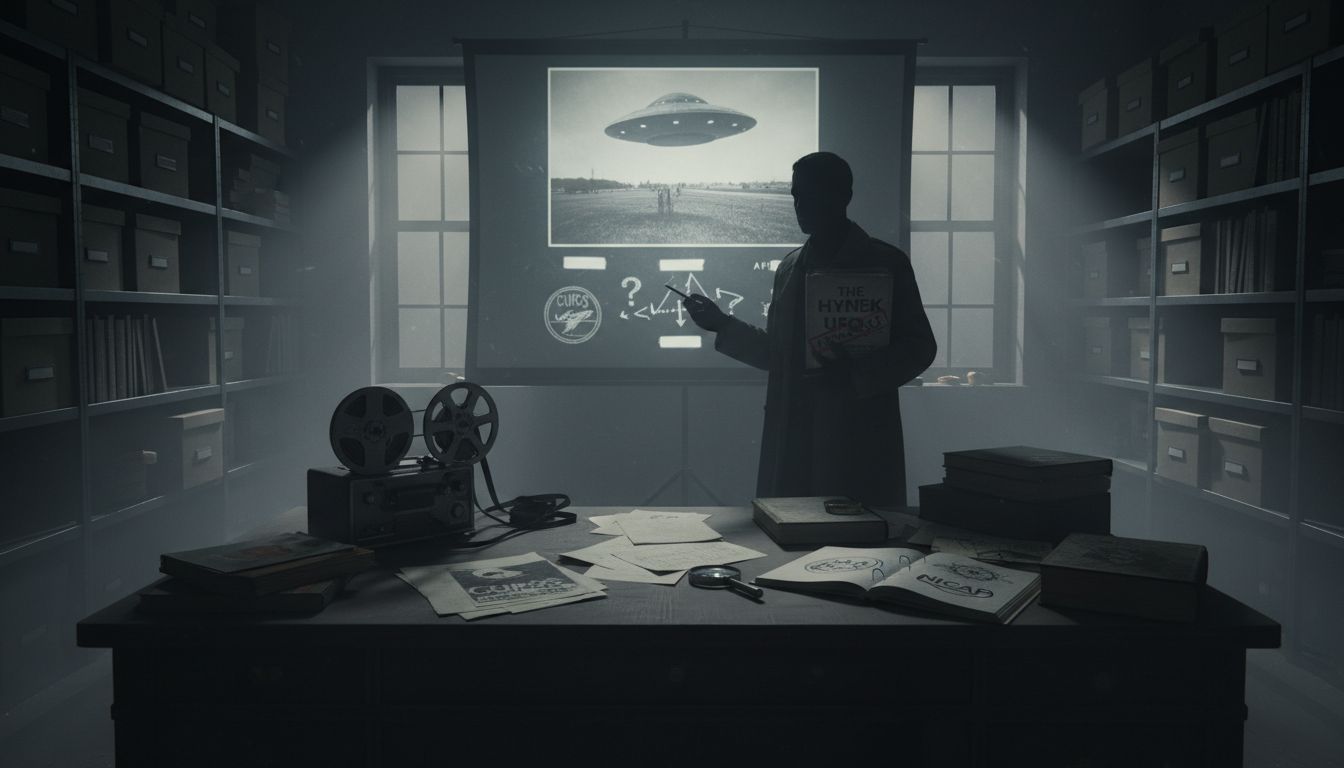
Over a decade of reviewing case files, however, led Hynek to question the adequacy of the Air Force’s conclusions. In 1969 he published The UFO Experience: A Scientific Inquiry, arguing that a subset of sightings exhibited “highly credible” characteristics that merited systematic study. The Air Force, uncomfortable with his growing independence, gradually reduced Hynek’s access to classified files, effectively “pushing him away” from official investigations. Undeterred, Hynek founded the Center for UFO Studies (CUFOS) in 1973, creating a repository for sighting reports, photographs, and witness interviews. CUFOS later donated its archives to the National UFO Historical Records Center in New Mexico, ensuring that researchers could examine primary data outside government channels.
Government Reports, Public Skepticism, and the Role of Media
The 2024 AARO findings echo earlier Pentagon assessments that emphasize the lack of concrete evidence for alien technology, yet they also acknowledge the “consistent theme” in popular culture that the U.S. government has concealed recovered extraterrestrial craft. As the report states, “AARO recognizes that many people sincerely hold versions of these beliefs… The proliferation of television programs, books, movies, and the vast amount of internet and social media content… most likely has influenced the public conversation.” This cultural backdrop, from The X‑Files to modern streaming documentaries, fuels ongoing conspiracy theories despite the absence of verifiable data—a dynamic Hynek himself warned about in his later writings.
Legacy and Resources for Further Study
Hynek’s transformation from government consultant to leading UFO scholar underscores the importance of independent research. Scholars now reference not only Hynek’s own publications but also the extensive archives of NICAP, APRO, and CUFOS, all housed at the National UFO Historical Records Center. Academic articles in journals such as Journal of Scientific Exploration and biographies published by reputable presses provide nuanced analyses of U.S. UFO history, correcting earlier popular‑mechanics style oversimplifications. For journalists and investigators seeking a factual baseline, these repositories offer primary documents, correspondence, and declassified Air Force memos that chart the evolving relationship between the military, academia, and the public on the UFO question.


