Overview
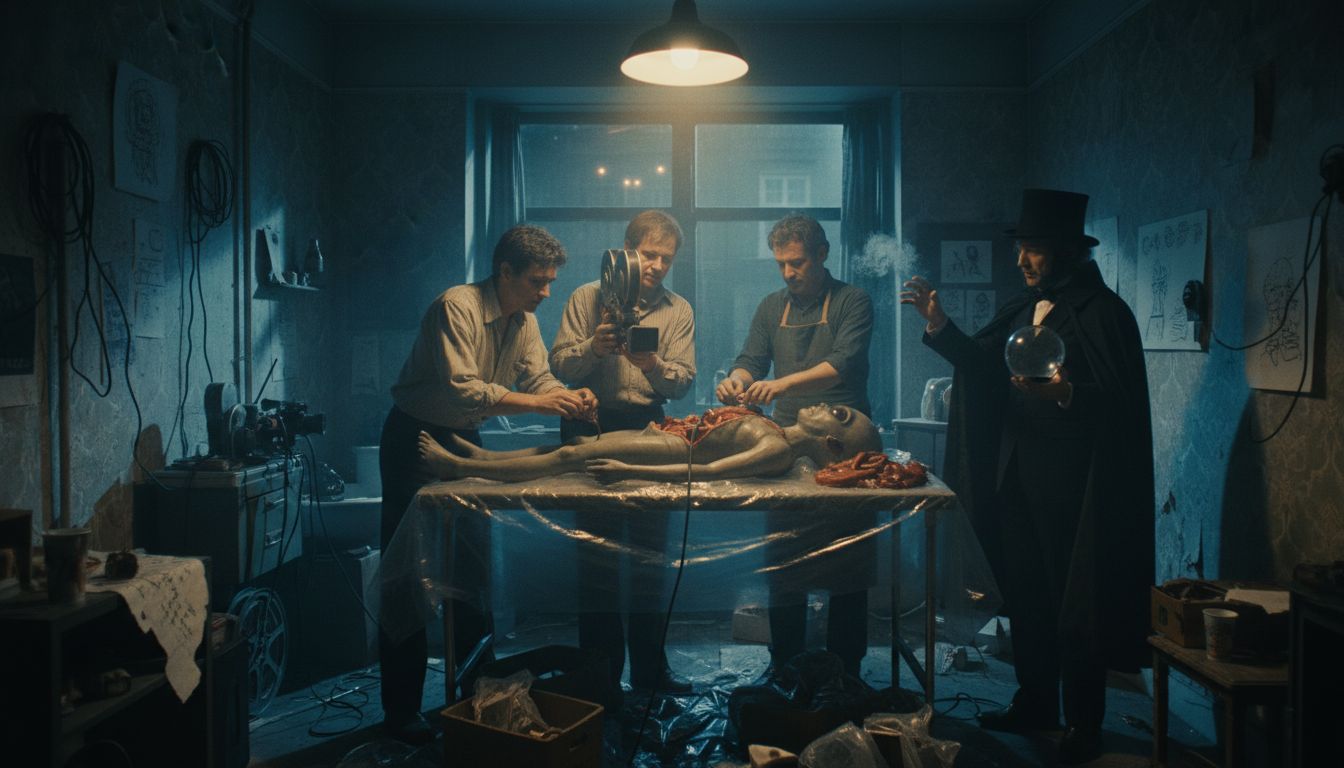
A new Sky documentary revisits the 1995 “Alien Autopsy” footage that, for two decades, was presented by some media outlets as authentic evidence of a Roswell‑era extraterrestrial corpse. The film, titled All Good: The Alien Autopsy Scandal, unpacks how the grainy clip was in fact a deliberately staged hoax concocted in a modest London flat. By tracing the roles of producer Ray Santilli, co‑producer Gary Shoefield, a former Doctor Who sculptor, a professional magician, and the unexpected involvement of 1960s rock singer Reg Presley, the documentary offers a meticulous account of one of the most elaborate deceptions in UFO folklore.
Origins of the Footage
In 1995, Santilli claimed to have acquired a reel of film showing a government‑run autopsy of an alien recovered from the 1947 Roswell crash. The clip, with its eerie, muted lighting and a limp, grey‑skinned being on a metal table, quickly captured the imagination of the public and was amplified by major broadcasters, including the Fox network’s primetime special that attracted millions of viewers. At the time, skeptics dismissed the material as a clever reconstruction, but the lack of verifiable provenance allowed the narrative of “real evidence” to persist, feeding a wave of books, documentaries, and internet speculation.
The Making of the Hoax
The Guardian’s investigative team, working with the documentary’s producers, uncovered that the “autopsy” was assembled in a cramped South‑London flat using hand‑crafted props. A former Doctor Who prop sculptor fashioned the alien’s torso from silicone and latex, while a magician supplied the illusion‑techniques that made the dissection appear plausible on low‑resolution tape. Santilli and Shoefield coordinated the shoot, employing a borrowed 16‑mm camera and a makeshift lighting rig. In an interview for the documentary, Santilli admitted, “We wanted to see how far the story could go if we gave the world something it wanted to believe.” The team’s willingness to blur the line between art and deception underscores the era’s nascent internet culture, where viral content could spread faster than any fact‑checking mechanism.
How the Hoax Spread
The clip’s first public exposure came not from a news agency but from Reg Presley, the former lead singer of the 1960s group The Troggs. Presley, an avid UFO enthusiast, shared the film with a friend who worked at a London production company, setting off a chain that led to its broadcast on U.S. television. The documentary highlights Presley’s enthusiasm: “I thought it was the most convincing thing I’d ever seen,” he recalled in a 2024 interview. The ensuing media frenzy saw the footage cited in parliamentary hearings, featured in The X‑Files‑style dramas, and merchandised on T‑shirts. The hoax’s reach was amplified by the era’s limited means of verifying visual material, allowing the story to embed itself in popular consciousness despite early doubts from scientific circles.
New Documentary Reveals
All Good combines archival footage, newly recorded interviews, and a forensic analysis of the original reel. Experts in visual effects dissect the prosthetic seams, while forensic pathologists point out anatomical impossibilities—such as the alien’s rib cage lacking a true vertebral column. The film also uncovers the financial motives behind the stunt: Santilli and Shoefield reportedly earned a modest sum from licensing the clip to television networks, and the publicity helped launch Santilli’s later “UFO documentary” ventures. By presenting these findings without sensational language, the documentary aims to restore a measure of journalistic integrity to a story that has long been mired in myth.
Implications
The revelation that the iconic “Alien Autopsy” was a DIY hoax serves as a cautionary tale for contemporary media consumers. It illustrates how a combination of creative craftsmanship, celebrity endorsement, and media hunger for the spectacular can conspire to create a lasting falsehood. As the documentary concludes, “In an age of deepfakes, the 1995 hoax reminds us that the tools of deception are not new; they are merely evolving.” The Guardian’s coverage, anchored in the new documentary’s evidence, reinforces the need for rigorous source verification—especially when extraordinary claims intersect with popular culture.