Overview
In recent months, the once‑marginalized topic of unidentified aerial phenomena (UAP) has moved firmly into the mainstream of U.S. policy discourse. A series of high‑profile events—including a televised House Oversight hearing, congressional‑funded research programs, and the Pentagon’s rebranding of “UFOs” as “UAPs”—signal a shift from speculation to systematic inquiry. Analysts note that the change reflects both growing public pressure and a reassessment within the defense establishment of potential national‑security implications tied to unexplained aerial encounters.
Congressional Hearing Highlights
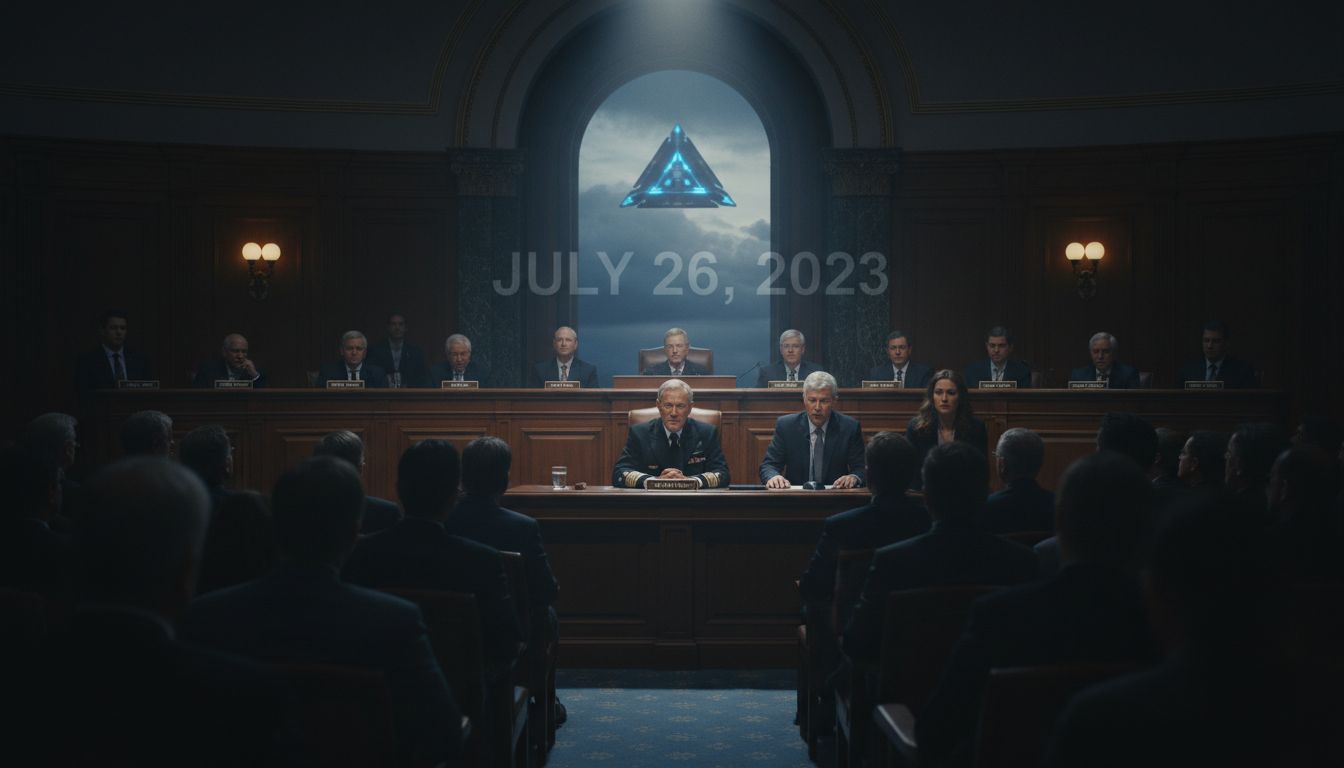
On July 26, 2023, the House Oversight Committee convened a public hearing that featured retired Navy pilot David Fravor, a key witness from the 2004 “Tic‑Tac” incident off the coast of San Diego. Fravor testified that Navy pilots had been ordered to conceal “what we saw” and that the “military has known about these advanced, possibly non‑human craft for years.” He said, “We were told not to talk about it, but the truth is out there and it’s getting harder to hide.” The hearing, chaired by Rep. Jim Jordan (R‑OH), included testimony from former intelligence officials who affirmed that multiple credible sightings had been recorded but not fully analyzed, prompting the committee to request a comprehensive audit of all UAP data held by the Department of Defense.
Defense Department “Legacy Program”
Parallel to congressional scrutiny, a classified Defense Department effort—referred to in internal memos as the “Legacy Program”—has attracted renewed attention. The program, allegedly operating since the early 2000s, purportedly focuses on the retrieval, reverse‑engineering, and technological assessment of non‑conventional aerial objects recovered from crash sites. While the Pentagon has not officially confirmed the program’s existence, former officials briefed to the hearing disclosed that “materials and propulsion concepts observed in recovered artifacts are unlike anything in our current aerospace inventory.” Documentary series such as “UFOs: The Untold History” and “Beyond the Sky” have cited the program, amplifying public interest and prompting calls for greater transparency.
Institutional Rebranding and the AARO
In 2022, the Department of Defense established the All‑Domain Anomaly Resolution Office (AARO), tasked with standardizing the collection and analysis of UAP reports across air, space, and maritime domains. The office explicitly replaced the term “UFO” with “UAP” to reduce stigma and broaden the scope of investigations. AARO’s annual report, released in March 2024, documented 1,400 incidents, of which 173 remained “unexplained” after rigorous analysis. The agency’s director, Dr. Sean Kirkpatrick, emphasized that “the goal is not to prove extraterrestrial origins, but to understand any technology that could pose a threat to U.S. interests.” This language shift has been credited with encouraging more pilots and radar operators to come forward, improving the data pool for scientific assessment.
Outlook and Legislative Action
The convergence of congressional hearings, internal defense programs, and the AARO’s systematic approach suggests a new era of institutional scrutiny. The House Armed Services Committee is expected to draft legislation this summer that would allocate $250 million for a joint inter‑agency UAP research initiative, with mandatory reporting requirements for all armed services. Critics caution that without clear oversight, the program could become a conduit for classified misinformation. Proponents argue that transparency will bolster national security by ensuring that any advanced technology—whether foreign, domestic, or otherwise—receives appropriate scientific evaluation. As the debate unfolds, the phrase “the truth is still out there” may evolve from a cultural catch‑phrase to a policy imperative.


