Overview
Michaela Towfighi’s recent feature revisits the 1961 Barney and Betty Hill abduction, a case that has long stood at the crossroads of popular culture and serious scientific inquiry. Marking the 60th anniversary, the article notes the installation of a New Hampshire highway marker on Route 101 that commemorates the Hills’ claim of being taken aboard a “saucer‑shaped” craft near the town of Manchester. Towfighi places the marker within a broader landscape of regional UFO remembrance, noting that the site has become a modest pilgrimage point for researchers, artists, and curious travelers alike. The piece also surveys several contemporaneous developments—including a Canadian military review of a 2023 sighting in Vidora, Saskatchewan, the unearthing of previously unseen 1965 Kecksburg footage, and the opening of a Princeton university archive dedicated to atmospheric physicist James E. McDonald—underscoring a renewed institutional interest in documenting unexplained aerial phenomena.
The Hill Marker and Local Tributes
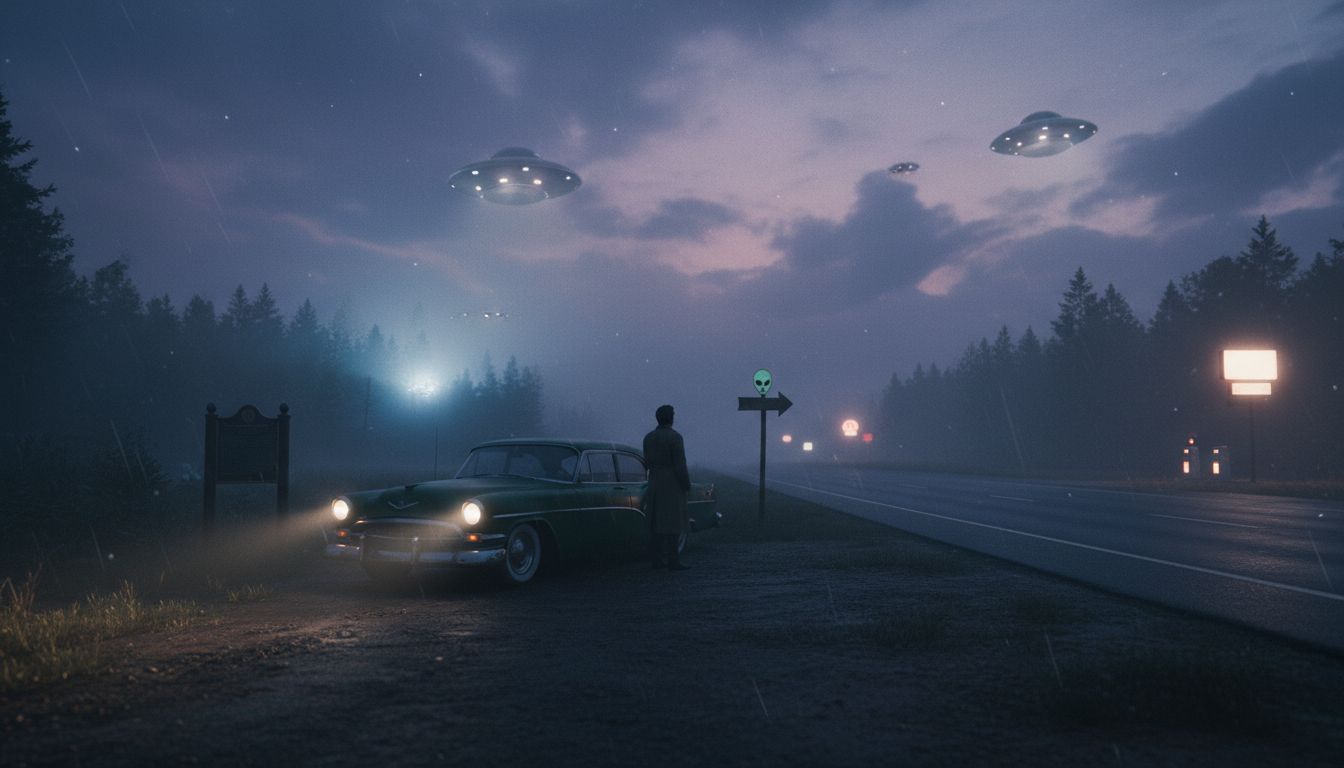
The New Hampshire Department of Transportation unveiled the “Barney and Betty Hill UFO Sighting” marker in June 2025, the first state‑sponsored acknowledgment of the incident. The bronze plaque reads, “On the night of September 19, 1961, local residents Barney and Betty Hill reported an encounter with an unidentified flying object near this location.” Nearby, a small sculpture by visual artist Lila Chen depicts a stylized, wing‑less craft, echoing the description offered by the Hills in their 1964 book The Interrupted Journey. “The marker is not about sensationalism,” said town historian Samuel Ortiz, “it’s about preserving a moment that sparked a national conversation on extraterrestrial life and governmental transparency.” Towfighi quotes Ortiz: “In New England, we have our own ‘Area 51,’ a quiet reminder that the unknown can sit just off the interstate.”
Parallel UFO/UAP Stories
While the Hill marker draws regional attention, the article highlights three other noteworthy UFO‑related events. First, the Royal Canadian Air Force has released a declassified briefing on a 2023 encounter over Vidora, Saskatchewan, where radar operators recorded an object performing maneuvers beyond known aircraft capabilities. Defense analyst Dr. Nadia Patel remarked that “the Vidora case adds weight to the growing body of credible, sensor‑based reports that defy conventional explanation.” Second, archivists at the National Museum of American History announced the discovery of a 1965 film reel documenting the Kecksburg meteor incident, offering clearer visuals of a metallic object recovered by local authorities. Finally, Princeton University’s newly opened James E. McDonald Archive houses over 3,000 pages of the late physicist’s correspondence with the U.S. Air Force, revealing his persistent advocacy for scientific study of unidentified aerial phenomena during the Cold War.
Preservation and Scholarship
Towfighi emphasizes that these developments reflect a broader shift from fringe speculation to systematic preservation. The Princeton archive, curated by former NASA researcher Dr. Elena Ruiz, aims to make McDonald’s work accessible to scholars across disciplines. “McDonald was a respected scientist who argued that dismissing UAPs outright hindered our understanding of atmospheric physics,” Ruiz explained. Similarly, the Kecksburg footage restoration project, led by film historian Mark Linder, employs digital enhancement techniques to clarify previously indecipherable frames, offering historians a more reliable visual record. These efforts, combined with the New Hampshire marker, illustrate an emerging consensus that historical UFO cases merit the same methodological rigor applied to other anomalous events.
Community and Cultural Impact
The renewed focus on the Hill case has sparked artistic and civic engagement throughout New England. Local galleries have hosted exhibitions featuring paintings, sculptures, and multimedia installations inspired by the Hills’ narrative. One such show, “Beyond the Lights,” curated by Megan O’Leary, includes a soundscape that blends 1960s radio broadcasts with contemporary testimonies, inviting visitors to contemplate the lingering mystery. Commentators such as podcaster Jared Kline note that “the Hill story endures because it sits at the intersection of personal trauma, Cold‑War paranoia, and the universal human yearning for contact.” Towfighi’s article captures this sentiment, quoting a high‑school teacher from Manchester who uses the marker as a teaching tool: “It’s an entry point for students to discuss critical thinking, media literacy, and the limits of scientific knowledge.”
Looking Forward
As the 60th anniversary passes, the convergence of memorials, archival releases, and governmental disclosures suggests a new era of transparency surrounding unidentified aerial phenomena. Towfighi concludes that while definitive answers remain elusive, the systematic documentation of cases like the Hill abduction, Vidora sighting, and Kecksburg incident provides a foundation for future inquiry. “Whether these events point to extraterrestrial visitation, advanced terrestrial technology, or atmospheric anomalies, the commitment to preserving the evidence is a step toward a more informed public discourse,” she writes. The article thus positions New England’s modest highway marker not merely as a roadside curiosity, but as a symbol of an evolving, evidence‑based approach to one of humanity’s most enduring questions.