Overview
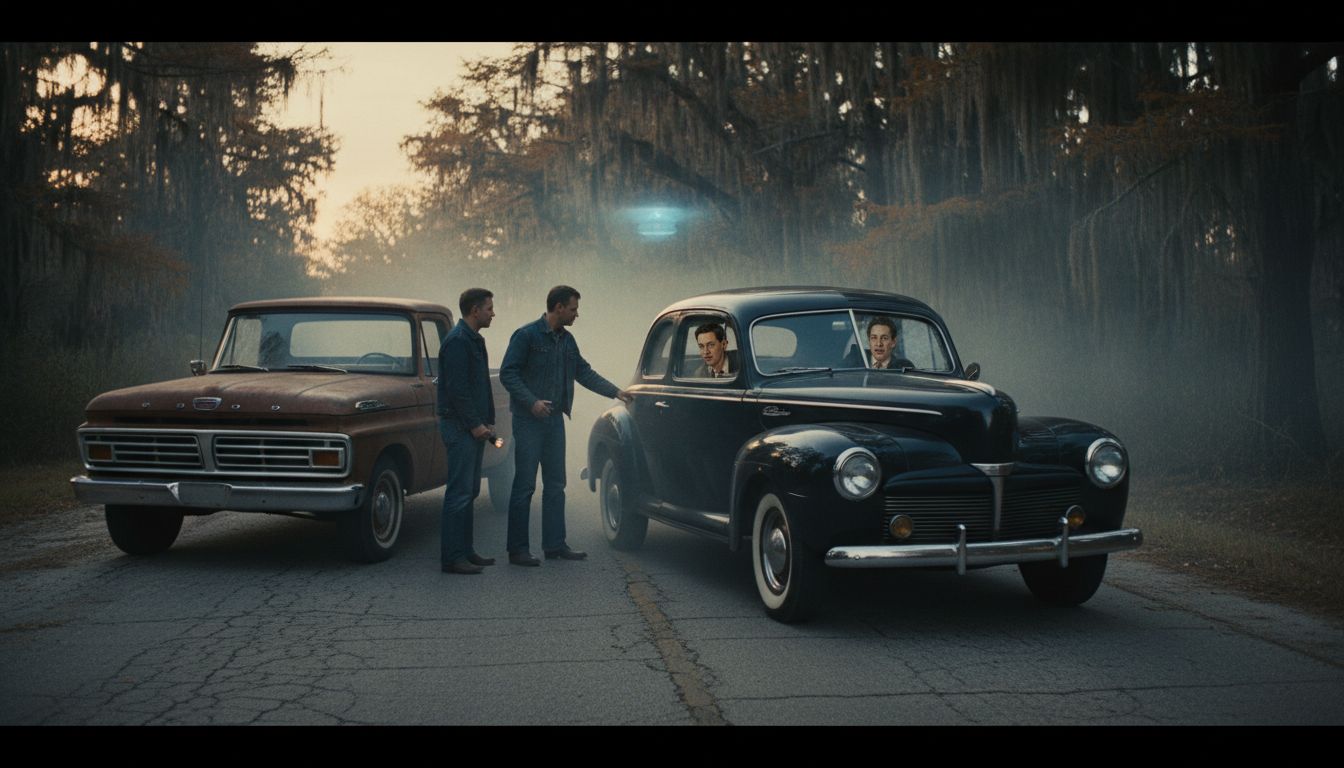
On October 20, 1969, two motorists traveling north on Louisiana Highway 167 reported an inexplicable encounter with a seemingly intact 1940s automobile. The drivers, identified only as “L.C.” and his business associate “Charlie,” described a slow‑moving “turtle‑back‑type” car bearing an orange license plate marked “1940.” According to their recollection, the vehicle vanished from the roadway without a trace after the men pulled over to assist the occupants. The story, originally recounted in the Spring 1988 issue of Strange Magazine and later reproduced on the blog Strange Company (January 2026), has resurfaced in UFO and time‑slip circles as a classic example of a “missing‑vehicle” phenomenon.
Witness Account
L.C. recalled that the driver of the antique car was a young woman dressed in period‑appropriate 1940s attire, accompanied by a small child. Both were bundled in warm clothing despite a “pleasant, warm day.” The woman appeared visibly panicked, repeatedly glancing over her shoulder. When L.C. called out, she nodded “yes” to their offer of help, despite the rolled‑up windows that hampered communication. The men signaled the woman to pull onto the shoulder, but after they themselves stopped, “the vintage auto was no longer there.” A third driver who arrived moments later reported witnessing the same sequence: his own modern car passing the old vehicle, which then “suddenly disappeared” as it attempted to pull over. The three men searched the area for roughly an hour but found no evidence of the car, its occupants, or any wreckage.
Follow‑up and Interpretation
The incident sparked immediate speculation among the witnesses. One of the men considered filing a “missing person” report, but the others feared the story would be dismissed as “lunacy.” The lack of any physical trace—no tire marks, oil stains, or debris—has led some researchers to label the event a time‑slip or temporal anomaly, while others argue it fits more comfortably within the framework of a ghostly apparition. Dr. Elaine Harcourt, a historian of anomalous phenomena at the University of New Orleans, notes that “the 1940s vehicle description aligns with known parade cars used in the region during the 1940s, but the disappearance defies conventional explanation and warrants cautious documentation.” The original Strange Magazine article cautioned readers that the account “may be too good to be true,” emphasizing the need for corroborating evidence.
Related Anomalies
The Louisiana case is often mentioned alongside a separate, unrelated mystery that surfaced in Wales earlier this year: a pair of Victorian‑era shoes washed ashore on a remote beach, sparking theories of a 19th‑century shipwreck or a temporal displacement. Archaeologists from the University of Cardiff identified the footwear as genuine period pieces, yet the circumstances of their appearance remain unexplained. Both incidents have been cited by time‑slip enthusiasts as possible evidence of “chronological bleed‑through,” where objects or people from a different era briefly intersect with the present. Critics, however, point out that such coincidences can arise from misidentified artifacts and human memory biases.
Assessment
While the 1969 highway encounter continues to intrigue UFO and paranormal investigators, law‑enforcement records from Lafayette Parish show no official reports of a missing vehicle or persons on that date. The absence of a police file, combined with the reliance on a second‑hand interview published decades later, underscores the challenges of verifying such claims. Nonetheless, the story illustrates the enduring fascination with unexplained temporal phenomena and the importance of rigorous documentation. As Dr. Harcourt advises, “Until tangible evidence emerges—photographs, physical remnants, or corroborating eyewitnesses—events like these remain anecdotal curiosities, valuable for cultural study but not definitive proof of time travel.”