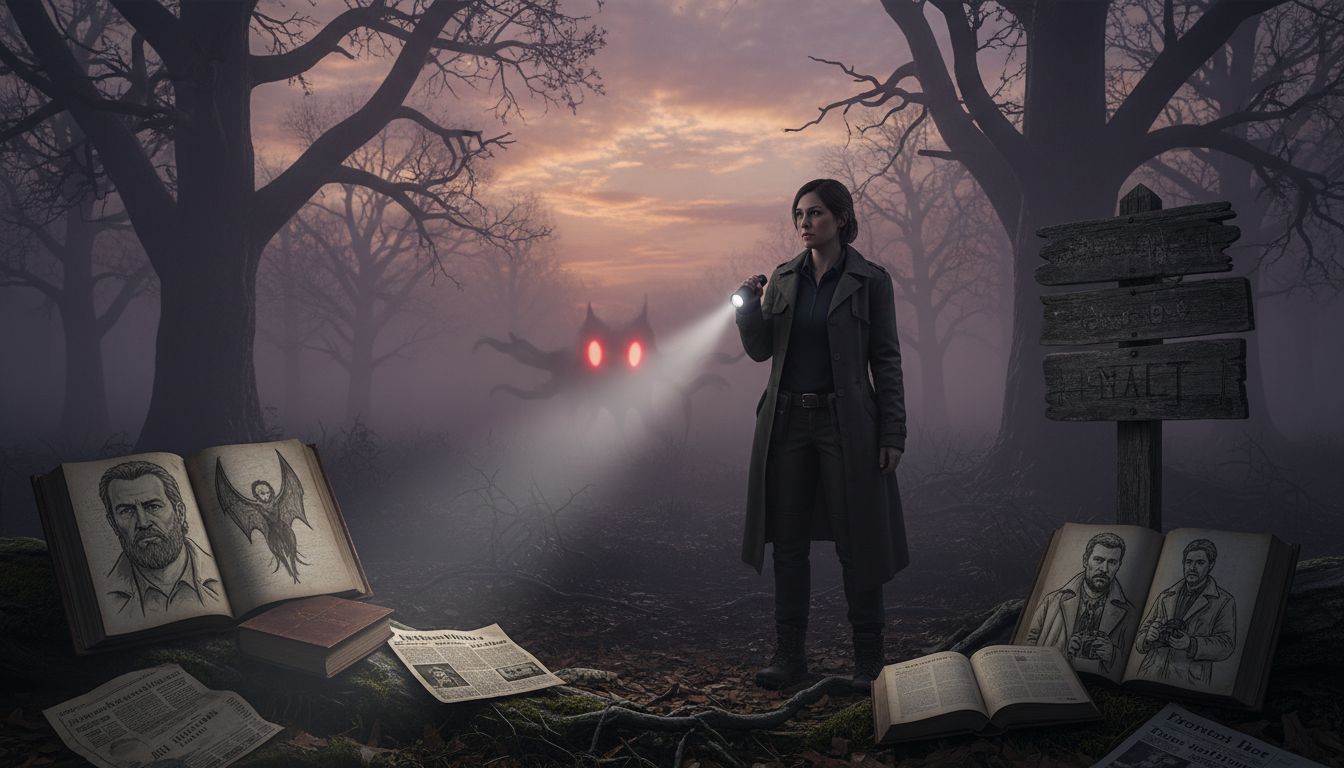
Since the first reported sighting in Point Pleasant, West Virginia, in 1966, the creature known as Mothman has been reshaped repeatedly by writers, filmmakers and internet culture. What began as a handful of eyewitnesses describing a “large, winged humanoid with glowing red eyes” quickly morphed into a symbol of “high strangeness,” a term coined by the late paranormal researcher John A. Keel. Keel’s 1975 book The Mothman Prophecies—later adapted into a 1999 feature film—linked the sightings to the catastrophic collapse of the Silver Bridge, cementing the creature’s reputation as an omen of disaster. In an interview for her recent blog post, folklorist Sharon A. Hill explained that the legend “has been a collage of everything people fear about the unknown: UFOs, mutated wildlife, interdimensional beings, and even moral warnings about environmental neglect.”
Two early Fortean writers were instrumental in giving Mothman its enduring identity. Gray Barker, who popularized the term in a 1967 newspaper column, framed the creature as a “cryptid” that could be catalogued alongside Bigfoot and the Chupacabra, while Keel expanded the narrative to include the enigmatic figure Indrid Cold, a UFO flare, and a series of unexplained phenomena that stretched from West Virginia to Chicago and even Russia. Hill notes that “the original reports never mentioned bridges or prophecies; those connections were woven together later, largely by Keel’s storytelling.” By the late 1970s the Mothman had become a fixture of local folklore, inspiring the annual Mothman Festival in Point Pleasant and spawning countless adaptations in video games, podcasts, and internet memes.
The fluidity of the myth was highlighted in a recent comedy sketch that went viral on social media. In the clip, a character named Daniel summons Mothman through a phone line and asks, “What’s your deal?” The joke underscores the creature’s “most confusing cryptid” status—a point Hill emphasizes in her analysis. “Mothman is a cultural mirror,” she says. “To some he’s a terrifying winged predator that chases dogs; to others he’s a tragic messenger or even a stylized fantasy hero.” This multiplicity has allowed the figure to survive six decades of reinterpretation, but it also makes scholarly assessment difficult, as the evidence for sightings outside the original West Virginia cluster is “thin and largely anecdotal,” according to Hill.
Amid the discussion of Mothman, Hill also warned readers about a wholly fictional urban legend circulating in New York City: the so‑called “Demon Dogs.” According to the tongue‑in‑cheek warning, these imagined canines possess “fiery eyes that glow like embers” and allegedly stalk late‑night commuters. Hill’s advice, delivered with a wink, suggests carrying “liver snacks” as a protective talisman—an obvious nod to the absurdity of the tale. “It’s a reminder that not every bizarre story deserves serious investigation,” she remarks, “but the humor can be a useful tool for keeping the public skeptical about unverified claims.”
The evolution of Mothman illustrates how folklore can be amplified by media, personal testimony, and creative reinterpretation. While the creature’s origins remain rooted in a handful of 1960s eyewitness accounts, each subsequent retelling—whether in a serious investigative book, a Hollywood thriller, or a comedic sketch—adds new layers that both enrich and complicate the narrative. As Hill concludes, “Mothman’s staying power lies not in any concrete evidence of his existence, but in our collective fascination with the unknown and our willingness to reshape that mystery to fit the cultural moment.” Whether as a harbinger of tragedy, a pop‑culture icon, or a punchline in a comedy video, the legend endures, reminding us that the line between folklore and fact is often as thin as the wings of the creature itself.


