Overview
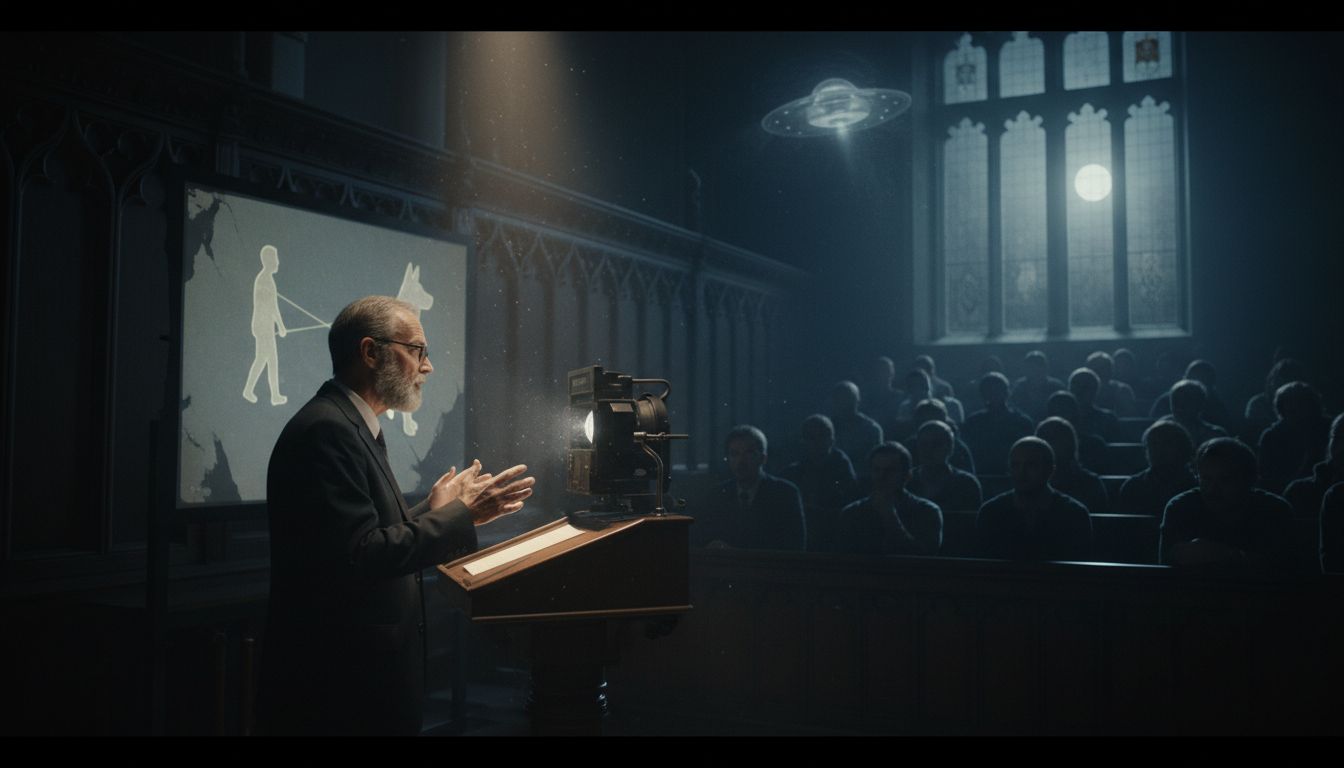
In a Cambridge University lecture titled “The Evolution of Telepathy”, biologist Rupert Sheldrake argued that psychic phenomena should be regarded as a natural extension of biological communication rather than a fringe paranormal curiosity. Drawing on a series of peer‑reviewed papers and his book Dogs That Know When Their Owners Are Coming Home, Sheldrake presented anecdotal and experimental evidence of telepathic-like interactions among animals and humans—ranging from dogs apparently sensing a owner’s return to mothers intuitively responding to a newborn’s needs. He framed these observations as traits that could have been shaped by natural selection, suggesting that telepathy, like vision or hearing, may have an evolutionary basis.
Research Foundations
Sheldrake’s interest in telepathy stems from decades of work on morphic resonance, a hypothesis that patterns of behavior and form can be transmitted across space and time. His recent investigations have expanded into “automated telepathy tests” that participants can run online, as well as studies of “telephone telepathy” (thinking of a person who subsequently calls) and “email telepathy.” The empirical core of his claim is documented in several journals, including the Journal of Anomalous Experience and Cognition (2025, Vol. 5, pp. 47‑69) and Explore: The Journal of Science and Healing (2015, Vol. 11, pp. 310‑319). These publications report statistically significant correlations in controlled settings, though they remain contested within mainstream biology.
The Cambridge Lecture
Delivered under the auspices of the Perrott‑Warrick Project, the lecture emphasized three points: (1) telepathy is observable in social animal groups; (2) similar mechanisms may operate in humans, especially in close relational contexts such as mother‑infant bonds; and (3) the scientific community has cultivated a taboo that discourages open inquiry into such phenomena. Sheldrake quoted a poll he posted on Substack, noting that 204 respondents—including scientists and medical professionals—had concealed personal telepathic experiences for fear of professional backlash. “I hope the essays and talks I share… will stimulate fresh thinking and encourage a more holistic approach to science,” he wrote, underscoring his call for rational, rather than dismissive, investigation.
Institutional Response and Funding
Sheldrake acknowledged that traditional funding bodies are “reluctant to pay for these kinds of exploration,” a sentiment echoed by many researchers working on unconventional topics. Consequently, his work relies heavily on private donations and crowd‑sourced support, allowing him to maintain open‑access publications and online experimental platforms. While his peer‑reviewed articles appear in niche journals, they have not secured endorsement from major scientific societies, and critics continue to label his hypotheses as speculative. Nonetheless, the presence of co‑authors such as Tom Stedall and Patrizio Tressoldi—both established in the field of anomalous cognition—provides a modest degree of scholarly legitimacy.
Outlook
Sheldrake’s lecture adds a new dimension to the ongoing debate over what constitutes legitimate scientific inquiry. By positioning telepathy as a potential evolutionary adaptation, he invites interdisciplinary research that bridges ethology, psychology, and information theory. Whether future studies will replicate his findings under stricter experimental controls remains to be seen. For now, the conversation is shifting from outright dismissal toward a cautious appraisal, driven in part by the growing willingness of some scientists to disclose personal experiences that were previously silenced. As Sheldrake himself notes, “a more holistic approach to science” may ultimately determine whether telepathy moves from the margins to the mainstream of biological research.