Overview
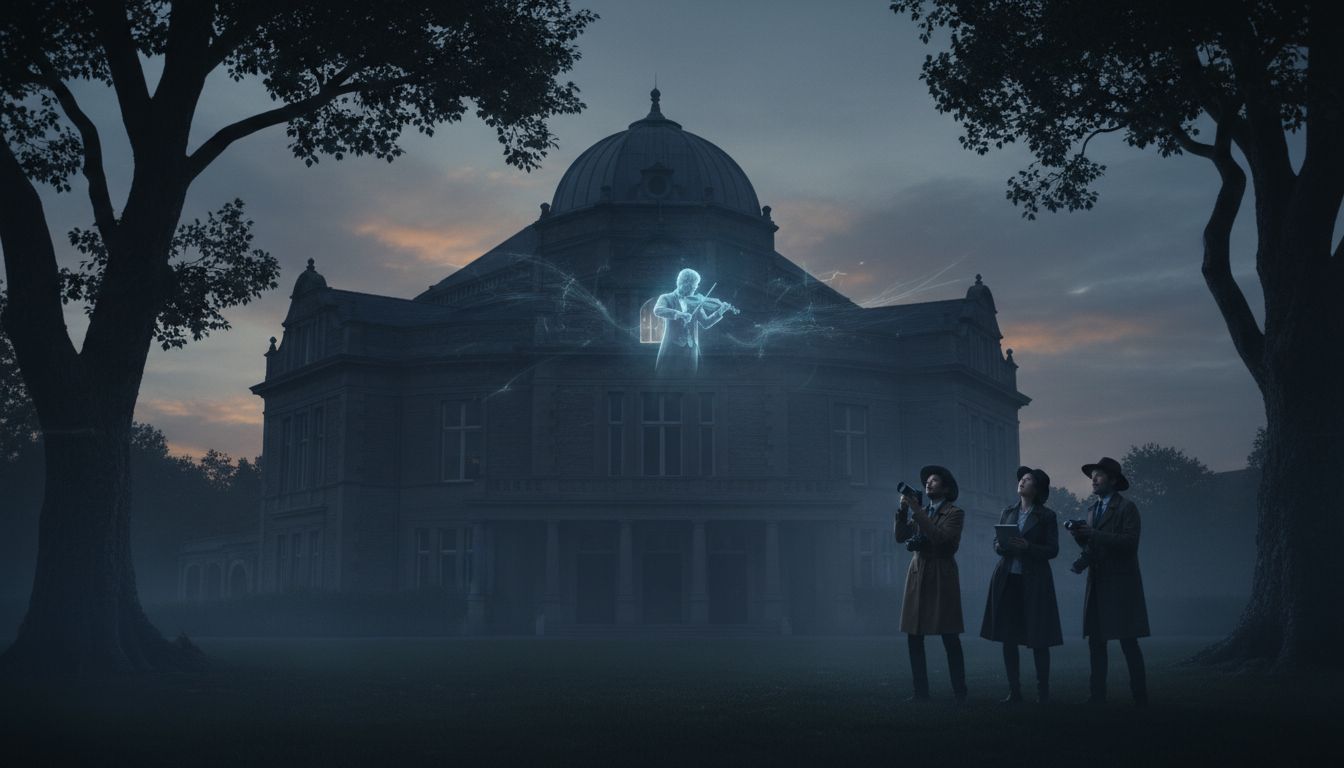
Devonshire Park Theatre in Eastbourne has long been admired as one of England’s most elegant Victorian playhouses, but it also carries a quieter reputation: according to local lore, it may be haunted by the sound of a phantom violinist. Reports of a spectral musician have circulated for decades, with visitors and staff describing fleeting glimpses of a man in white tie and tails standing in the orchestra pit or seated among the stalls before disappearing into the dim light. The figure is said to leave behind not just an eerie image, but a lingering sense of sadness that deepens the mystery surrounding the theatre after hours.
The story is especially compelling because it has often been linked to the Titanic tragedy. For years, some locals believed the ghost to be John Wesley Woodward, the English cellist who performed on the ship and reportedly continued to play as it sank in 1912. That connection gave the haunting a powerful emotional charge, tying one of Eastbourne’s best-known cultural venues to one of the most famous maritime disasters in history.
The Theatre and the Ghostly Reports
Opened in 1884, Devonshire Park Theatre has hosted generations of performances and audiences, making it a natural setting for stories that blur the line between memory and myth. According to the accounts preserved in local storytelling, sightings of the violinist or cellist date back to the 1960s and 1970s, when staff and theatre-goers reported seeing a man briefly materialize during rehearsals and late-night performances. The apparition was typically described as calm and silent, holding his instrument as if preparing to play.
Witnesses have also said the figure vanishes the moment someone turns to look directly at him. That recurring detail is typical of ghost lore, where the reliability of the sighting often rests on its fleeting nature. Still, the persistence of these reports over time has kept the story alive in Eastbourne, even as fewer people now claim to have seen the phantom musician in person.
The Titanic Connection
John Wesley Woodward’s name became attached to the haunting because of his strong ties to Eastbourne. He played the cello locally, including at the Grand Hotel and with the town orchestra, before joining the White Star Line musicians who performed aboard transatlantic ships. On 10 April 1912, Woodward boarded the RMS Titanic in Southampton for its maiden voyage. Five days later, the ship struck an iceberg and sank. According to some survivor accounts, the band’s final music included “Nearer, My God, To Thee,” a detail that has become part of Titanic legend.
Woodward, along with the rest of the ship’s musicians, died in the disaster, and his body was never recovered. A memorial plaque on the Eastbourne promenade has helped cement his place in local memory. For a time, that association made him the most plausible candidate for the theatre’s alleged ghostly violinist.
Why the Story Persists
Yet the article notes that later researchers concluded the apparition at Devonshire Park Theatre could not be Woodward, suggesting the story’s origins are more complicated than the Titanic connection alone. The exact identity of the mysterious figure remains unresolved, and that uncertainty may be what keeps the legend in circulation. In a theatre, where performance, atmosphere, and history are already tightly intertwined, reports of unexplained music can take on a life of their own.
Whether viewed as a genuine haunting or a lasting piece of local folklore, the phantom violinist reflects something larger about how communities preserve the past. Eastbourne’s theatre story endures because it combines Victorian grandeur, wartime-era memory, and Titanic tragedy into a single compelling narrative — one that continues to invite the same unanswered question: if music is still heard there after dark, who, exactly, is playing?