Overview
The legend of a UFO crash in Cape Girardeau, Missouri, in 1941 has endured for decades as one of the earliest and most contested entries in American UFO lore. If the story were true, it would predate the better-known Roswell incident by six years, placing it among the first alleged crash-retrieval cases in the United States. But despite its longevity in UFO circles, the Cape Girardeau account remains unverified, with no known contemporary reports, physical evidence, or official records confirming that the event happened as described.
Cape Girardeau itself is a real and prominent city in southeastern Missouri, known as an economic center and home to Southeast Missouri State University. The legend places the alleged event in a rural area outside the city during April or June 1941, when local residents supposedly discovered wreckage after an unexplained crash. Over time, the story has grown into a hybrid of local folklore, secret-military narrative, and extraterrestrial speculation.
The Alleged Crash Site
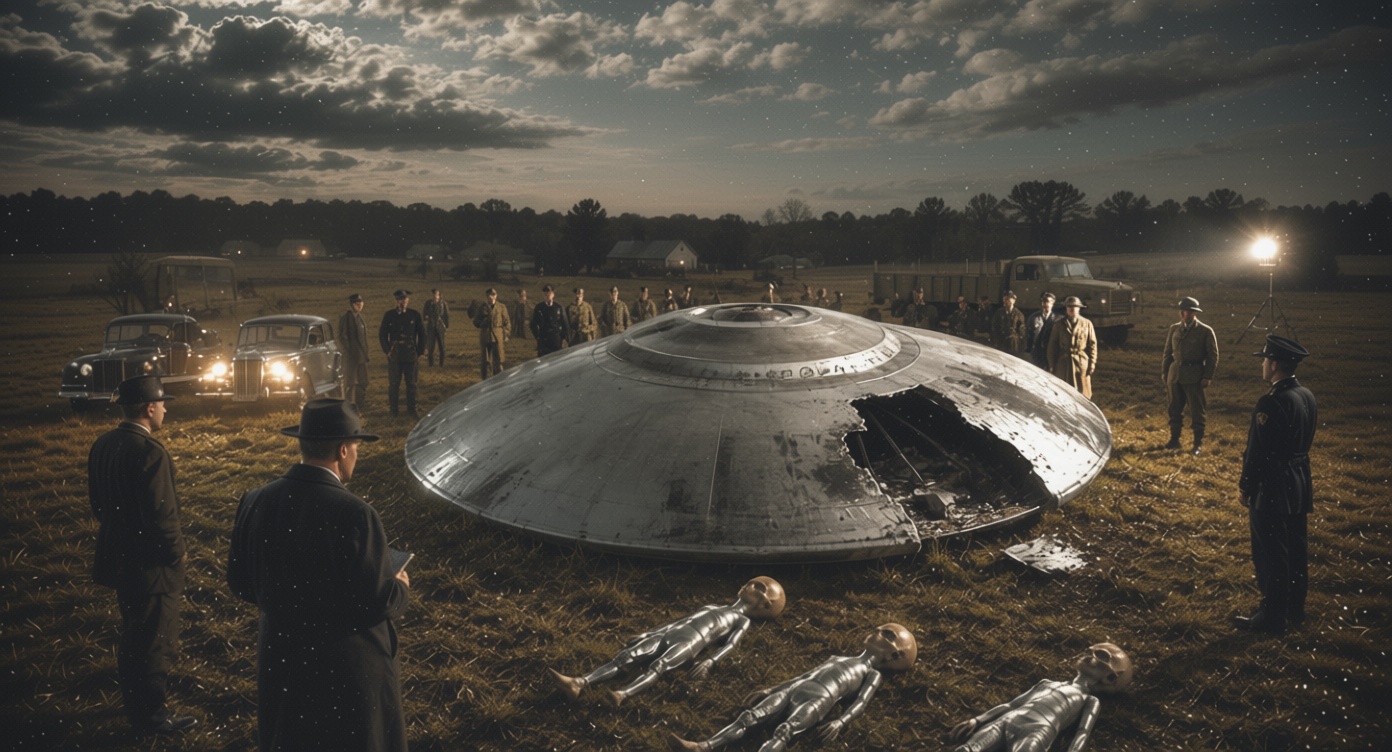
At the center of the legend is Reverend William G. Huffman, a Baptist minister who reportedly was summoned late at night by local authorities under the pretense that he would be administering last rites after an airplane accident. According to later accounts, Huffman arrived expecting a conventional tragedy, only to find a scene that allegedly included police officers, military personnel, and plainclothes officials already securing the area.
The story claims that instead of an airplane, Huffman saw a disc-shaped metallic craft—the kind of object that would later be popularly labeled a “flying saucer.” Nearby, he allegedly encountered three small dead humanoid beings described in subsequent retellings as roughly 4 feet tall, hairless, with large heads, large eyes, thin limbs, and seamless metallic suits. Some versions of the story also describe unfamiliar symbols or hieroglyphic-like markings inside the craft or on its surface, adding to the tale’s mystique but not its credibility.
Military Secrecy and Missing Evidence
A recurring element in the Cape Girardeau story is the claim of a rapid and secretive military response. According to the legend, the crash site was quickly sealed off, and witnesses were warned not to discuss what they had seen. One of the most frequently repeated details is that a military photographer allegedly provided Huffman with a photograph of him standing beside one of the bodies. However, no such photograph has ever been publicly produced, and no authenticated copies are known to exist.
That absence of documentation is one reason the case remains so controversial. Unlike many historical aviation accidents or military incidents, there are no surviving newspaper reports, police logs, or official wartime records from 1941 that substantiate the claim. Historians and mainstream researchers therefore generally treat the Cape Girardeau account as a legend rather than a documented event, even while acknowledging its importance in UFO folklore.
How the Legend Entered UFO History
The story did not surface publicly until decades after the alleged incident. In the early 1990s, UFO researcher Leonard Stringfield published an account based on information provided by Charlette Mann, Reverend Huffman’s granddaughter. Mann said her grandfather had privately told the family about the encounter shortly before his death and had remained silent for years because of alleged government pressure. Stringfield, a prominent figure in crash-retrieval research, helped bring the Cape Girardeau case into broader UFO discussion, though he did not claim firsthand knowledge of the event.
Stringfield’s interest gave the story a measure of legitimacy within UFO research circles, but it did not resolve the central issue: whether the event ever actually occurred. As with many legendary UAP cases, Cape Girardeau sits at the intersection of testimony, memory, and missing evidence. For believers, it is an early example of a concealed encounter. For skeptics, it is a cautionary tale about how stories can evolve over time, especially when they emerge long after the fact.