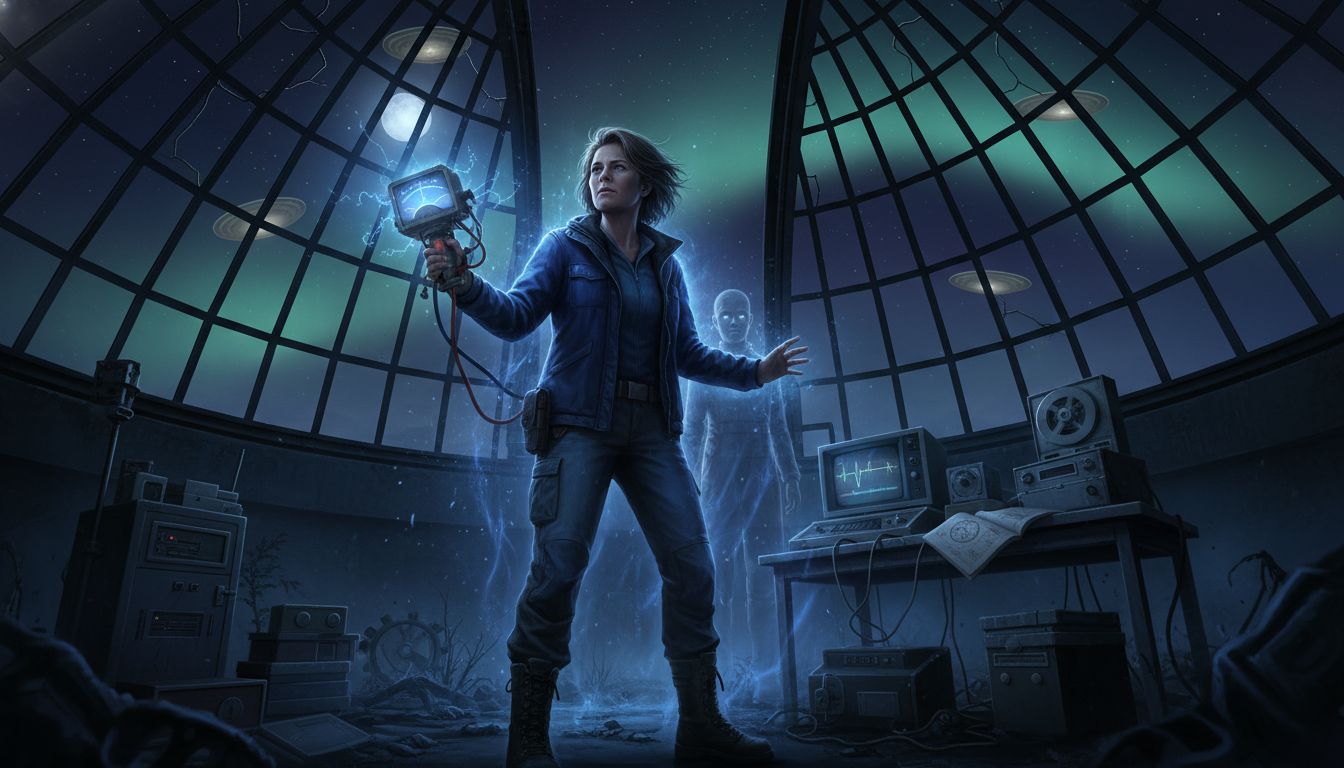
In recent weeks the conversation surrounding unidentified aerial phenomena (UAP) has shifted from isolated sightings to a broader inquiry into the physiological and environmental factors that may shape human perception. The discussion draws on a 1980 experiment by British engineer Vic Tandy, who traced a series of “haunted” sensations in a university laboratory to an extractor fan emitting a low‑frequency soundwave at roughly 19 hertz (Hz). When the fan was switched off, the reported chills, feelings of being watched and visual anomalies vanished, leading Tandy to label the tone “the haunted frequency.” Subsequent research has confirmed that the human body, which naturally resonates between 1 and 10 Hz, can experience distorted vision, goosebumps and heightened anxiety when exposed to frequencies in the 15‑30 Hz band.
Building on that foundation, Dr. Lisa Puzo Strickland, a philosopher‑parapsychologist and board member of the Hollywood Disclosure Alliance, proposes a two‑fold explanation for why certain individuals become repeat UAP witnesses. First, she argues that ambient electromagnetic fields—particularly those amplified by the “haunted frequency”—can induce hallucinatory and somatic effects, effectively priming the brain for anomalous experiences. “When the surrounding ionospheric field is boosted from its baseline 7.83 Hz to higher cycles, the nervous system is essentially being tuned to a different channel,” Strickland said in an interview. Her second hypothesis posits that these altered states may also act as a perceptual gateway, allowing witnesses to glimpse a genuine alternate reality that remains hidden under normal physiological conditions. The dual model seeks to reconcile the subjective intensity reported by “extreme experiencers” with measurable environmental variables.
The notion of “extreme experiencers” has been highlighted by researcher CJ Arabia, who groups repeat witnesses with apocalyptic or cult‑linked worldviews. Arabia notes that many of these individuals report not only visual phenomena but also profound emotional shifts that align with the timing of seismic activity, solar flares or intense thunderstorms—events known to perturb the Earth’s ionosphere and temporarily raise its resonant frequency. “The correlation between heightened geomagnetic activity and clusters of UAP reports suggests we are dealing with a complex interplay of environmental physics and human cognition,” Arabia wrote in a recent paper. While skeptics caution against attributing sightings solely to infrasound or electromagnetic interference, the emerging data set encourages a more nuanced appraisal that incorporates both neurophysiological and sociocultural dimensions.
The debate has gained traction among advocates for greater transparency about non‑human intelligence (NHI). Dan Harary, co‑founder of the WOW! Signal project, called on the disclosure movement to accelerate its efforts, emphasizing that society must be prepared for the possibility of contact—whether human‑originated or otherwise. “If we are on the cusp of an event that could reshape our understanding of intelligence, the public deserves clear, evidence‑based information and training on how to interpret anomalous experiences safely,” Harary told a briefing in October. He added that interdisciplinary research, spanning atmospheric science, neuroscience and parapsychology, is essential to distinguish between hallucination, misinterpretation and genuine encounters.
As the scientific community continues to investigate the “haunted frequency” and its potential role in UAP perception, the discourse underscores a broader shift: moving from sensational anecdotes toward systematic, cross‑disciplinary inquiry. Researchers are now deploying broadband electromagnetic sensors at known “UAP hot spots,” monitoring Schumann resonance fluctuations and correlating them with eyewitness reports. Early findings indicate that localized frequency spikes often coincide with the timing of sightings, though causality remains unproven. Whether these spikes merely alter perception or genuinely open a window onto an alternate reality, as Strickland suggests, will likely determine the next phase of both academic study and public policy.
In the meantime, experts advise caution. “People should be aware that environmental frequencies can affect mood and perception, but they should also seek corroborating evidence before concluding they have witnessed an extraterrestrial craft,” Strickland warned. The ongoing collaboration between physicists, psychologists and disclosure advocates aims to produce guidelines that help civilians navigate these ambiguous experiences responsibly, ensuring that curiosity is met with rigor rather than hysteria.


