Overview
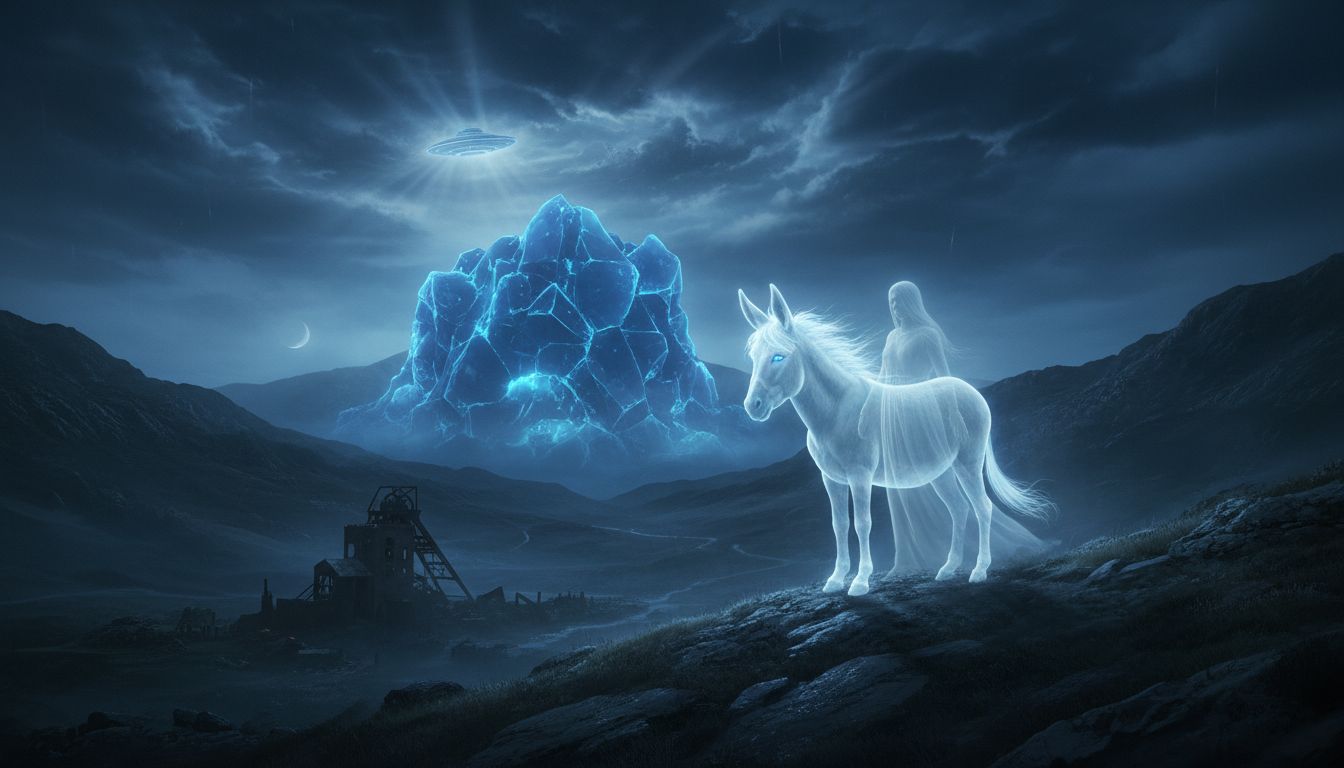
In the winter of 1906, miners working near Coalisland in County Tyrone reported a nightly apparition that has since become known locally as the Lady in White. The phenomenon began with a figure dressed in a flowing white robe and a white headcover that appeared at a coal‑mine road at midnight, walked to an old chestnut tree in the historic Mass Garden, and vanished. Over the next few nights the sighting changed dramatically, taking on the shape of a four‑legged animal before reverting to a dazzling human form. Contemporary newspaper accounts from the Belfast Newsletter and the Derry Journal describe the sightings as so unsettling that even “the strongest‑nerved man in Ireland” was terrified.
Historical Context
The Mass Garden where the apparition first appeared was a clandestine site used for Catholic worship during the Penal Laws era (late‑17th to early‑18th centuries). Those laws severely restricted Catholic religious practice, prompting worshippers to hold Mass in hidden outdoor locations such as the chestnut‑tree clearing. Local folklore suggests that disturbing such a sacred place could awaken a restless spirit. Miners James Hughes and Joe McMahon were the first witnesses; McMahon recalled, “You could not see the arms and legs on it, but nevertheless it was distinctly the form of a human being.” Their accounts were later corroborated by fellow workers Joe Hararan and Bernard Quinn, who observed the figure both moving and standing motionless near the tree before it disappeared into a field.
Key Details of the Sightings
- First night (December 1906): A white‑robed figure appeared at midnight, walked to the chestnut tree, then faded.
- Second night: The apparition lingered near the tree for several minutes before moving across a ditch and vanishing, prompting the miners to fall to their knees and pray.
- Third night: Witnesses described a sheep‑sized, four‑legged creature with a two‑foot tail and 18‑inch ears, followed shortly by a second, fully human, dazzling white form in the middle of the road.
- Subsequent nights: The entity continued to appear, sometimes as an animal, sometimes as a woman, leading miners to avoid looking toward the site and to work with their backs to the tree. Priests were called in to comfort the workforce, underscoring the deep psychological impact on the community.
Comparative Hauntings: Blue Bell Hill, Kent
While the Lady in White remains a regional legend, a separate stretch of road in Kent—Blue Bell Hill—has earned a reputation as the United Kingdom’s most haunted thoroughfare. Local folklore records three distinct spirits: a bride who died in a 1965 car crash, a woman in a red scarf murdered in 1916, and an “old lady” often described as a gray‑cloaked figure. Drivers report sudden brake failures, unexplained cold spots, and the feeling of being watched, prompting many to avoid the road after dark. Unlike the Tyrone sightings, which were concentrated over a few nights in 1906, the Kent hauntings have accumulated reports over decades, creating a persistent narrative that influences traffic patterns and local tourism.
Expert Insight
Dr. Fiona McDermott, a cultural historian at Queen’s University Belfast, notes that “both the Lady in White and the Blue Bell Hill phenomena illustrate how collective memory can embed traumatic or sacred events into the landscape, turning ordinary places into sites of supernatural expectation.” She adds that the transformation of the apparition—from human to animal and back—mirrors folklore motifs where shape‑shifting signals a spirit’s unsettled state. In contrast, the Kent accounts align with residual hauntings, where repeated tragic events imprint a “recording” on the environment.
Current Status
No modern investigations have produced verifiable evidence of the Lady in White, and the original newspaper reports remain the primary documentation. Nevertheless, the story persists in local tours and oral histories, serving as a reminder of the intertwining of industrial hardship, religious oppression, and folklore in rural Ireland. Meanwhile, Blue Bell Hill continues to attract paranormal enthusiasts and cautious motorists alike, reinforcing the enduring power of place‑based legends in shaping community behavior.