Overview
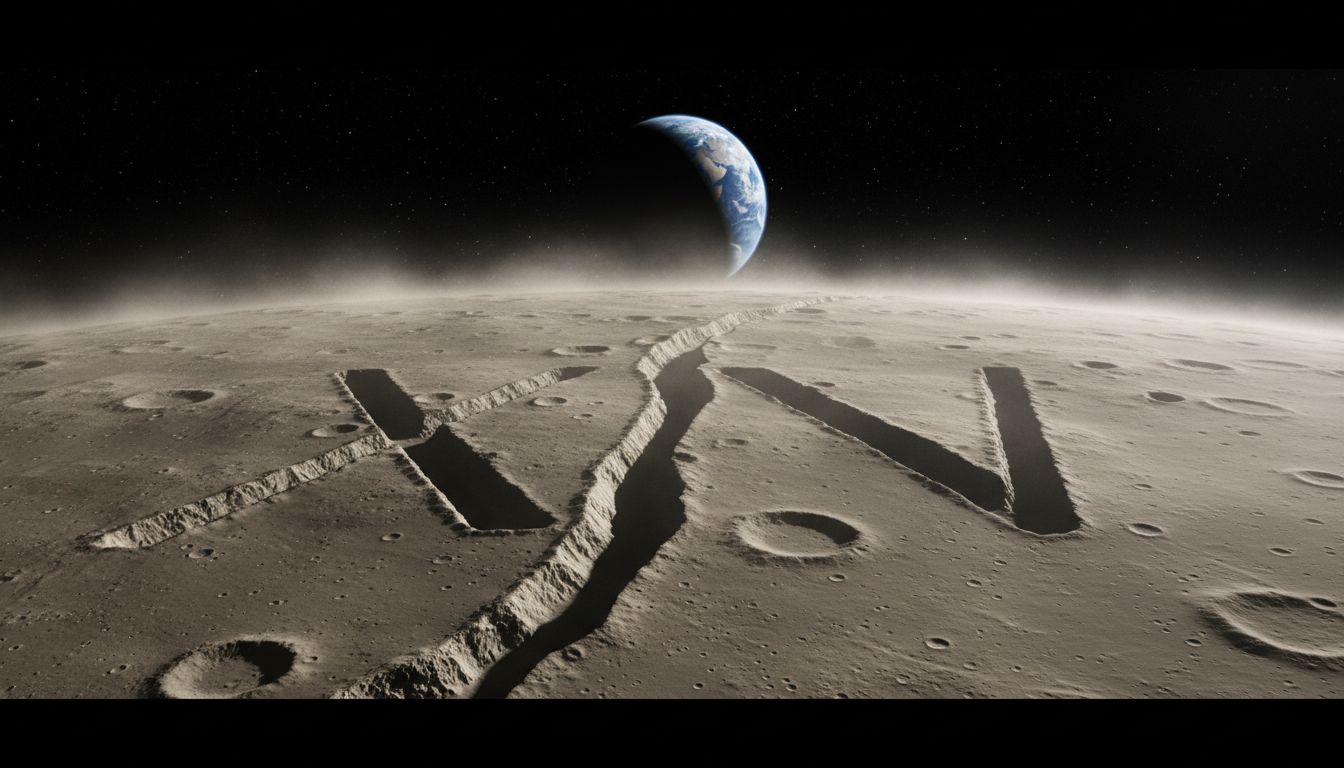
On the night of May 23‑24, 2026, observers around the world reported seeing giant Latin letters “X” and “V” etched across the lunar surface. The striking shapes, captured in live‑stream footage from several amateur telescopes, sparked a wave of speculation on social media. Astronomers quickly identified the cause as a rare play of sunlight and shadow known as clair‑obscur, an optical illusion that can make surface features appear as bold, geometric symbols. The consensus among planetary scientists is that the phenomenon is entirely natural and bears no indication of extraterrestrial signaling.
Observation Details
The first reports emerged from a network of hobbyist astronomers in North America and Europe who were monitoring the Moon’s waning crescent for a scheduled meteor‑shower observation. At approximately 02:17 UTC, a sudden contrast surge illuminated a series of high‑albedo crater rims and valleys in such a way that two intersecting lines formed an unmistakable “X,” while a nearby set of parallel ridges created a “V.” The images, later verified by the International Astronomical Union’s (IAU) Lunar Observation Working Group, show the letters spanning roughly 30 km across the Mare Imbrium region.
The phenomenon lasted only a few minutes before the Sun’s angle shifted, causing the illusion to fade. Video recordings posted by the amateur groups were later compiled by the Universe Space Tech portal, which added technical metadata confirming the timing and solar incidence angle.
Scientific Explanation
The effect is a textbook example of clair‑obscur, a term borrowed from art history to describe the dramatic contrast between light and dark. When the Sun skims the Moon’s surface at a low angle—typically less than 5° above the horizon—long shadows stretch across the regolith, accentuating subtle topographic variations. In this case, a combination of a high‑reflectivity ejecta blanket and a series of linear rilles aligned fortuitously to produce the impression of crisp, alphabetic characters.
Dr. Elena Martínez, a lunar geologist at the European Space Agency (ESA), explained: “The Moon’s surface is a patchwork of basaltic plains, crater walls, and ancient volcanic valleys. When sunlight strikes at a grazing angle, even modest elevations can cast shadows that outline patterns resembling familiar shapes. This is a purely geometric effect, not a physical inscription.”
Similar occurrences have been documented before. In 2018, a “M” appeared over the Tycho crater during a lunar eclipse, and in 2021 a series of “U” shapes were observed over the Sea of Serenity under comparable lighting conditions. Each instance reinforced the understanding that human pattern‑recognition instincts can readily impose familiar symbols onto random natural features.
Expert Opinions
NASA’s Lunar Reconnaissance Orbiter (LRO) team reviewed the footage and confirmed that the illuminated terrain corresponded to known topographic maps. “There is no evidence of any artificial structure or anomalous reflectivity that would suggest an extraterrestrial origin,” said Dr. Michael Chen, LRO mission scientist, in a press briefing on May 26.
The International SETI Institute also weighed in, emphasizing the importance of rigorous analysis before jumping to conclusions. “While the public’s fascination with potential signals is understandable, the scientific method demands that we first exhaust conventional explanations,” noted Dr. Aisha Patel, SETI research director. “In this case, the optical illusion hypothesis fits the data perfectly.”
Context and Outlook
The “X” and “V” episode underscores how quickly visual anomalies can ignite speculation, especially in an era of instant global communication. It also highlights the value of coordinated observation networks that can rapidly validate or debunk such reports. Astronomers plan to use the upcoming Lunar Polar Explorer mission, slated for launch in 2028, to gather higher‑resolution imaging of the Moon’s terminator region, where similar lighting conditions often produce dramatic visual effects.
For now, the letters remain a reminder of the Moon’s ever‑changing play of light and shadow—a natural spectacle that, while occasionally resembling human symbols, is rooted firmly in geology, not extraterrestrial messaging.