Overview
In the latest episode of the New Thinking Allowed series, host Debra Lynne Katz, PhD, interviewed self‑identified physical medium Julie Adriani about the practice of materializing spirits during séances. Adriani, a former neonatal paramedic and bereavement counselor, presented a range of phenomena—ectoplasm, “direct” and “independent” voice, transfiguration, apports, and precipitated art—while also referencing her training under well‑known contemporary mediums. The conversation was framed as an invitation for scientific scrutiny, with Adriani urging institutions such as Stanford or Harvard to conduct controlled studies.
Personal History and Motivations
Adriani traced her interest in the paranormal to early childhood experiences in Chicago, describing a vision of a “spirit guide” at age four that she initially interpreted as a “boogeyman.” She later linked her decision to pursue mediumship to a health crisis involving her son, stating, “When he recovered I promised to devote myself to spirit work.” Her professional background includes 26 years in a neonatal intensive care unit and work as a bereavement counselor, which she says informs her compassionate approach to clients seeking contact with deceased loved ones.
Reported Mechanisms of Physical Mediumship
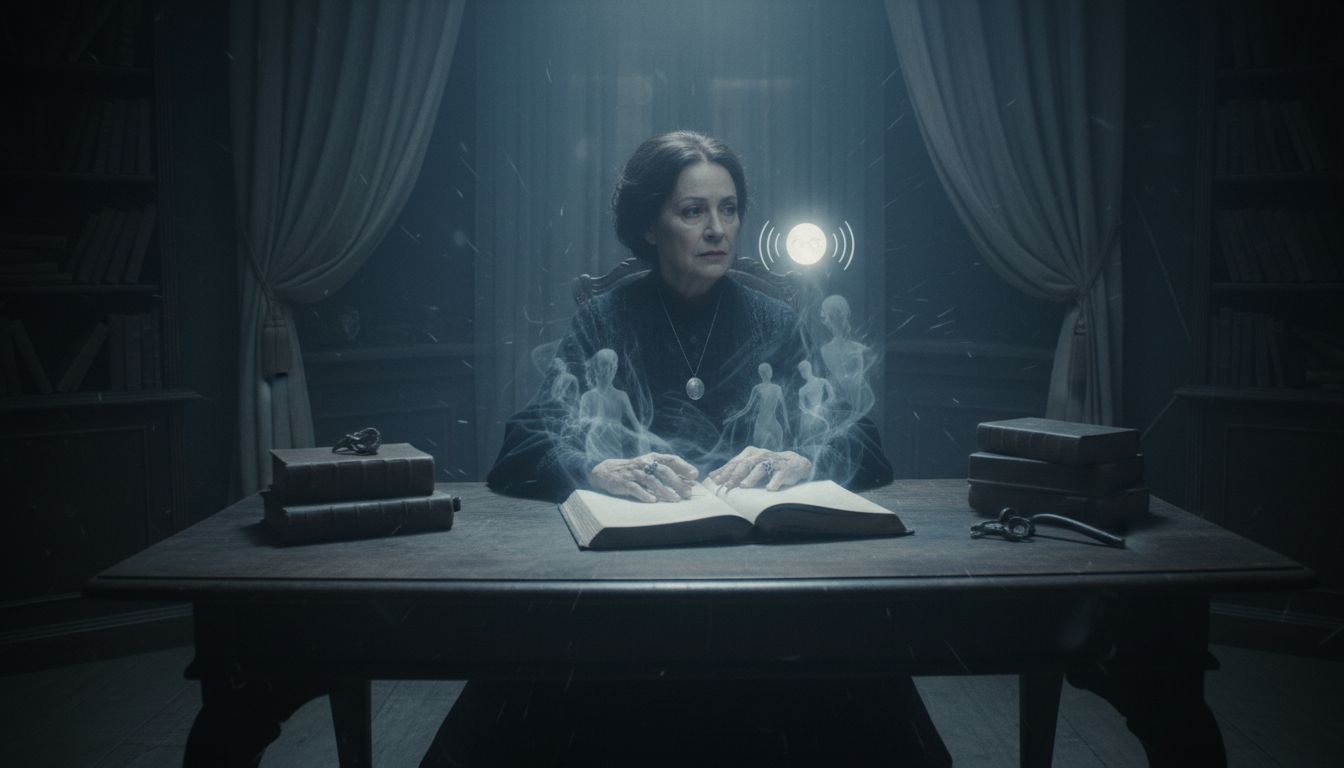
During the interview, Adriani detailed several specific manifestations that she claims occur under controlled conditions. Ectoplasm was described as a dough‑like or misty substance that can be expelled from the mouth or solar plexus and used by spirits to form “voice boxes” or facial masks. In “Direct Voice” sessions, a trumpet allegedly amplifies a spirit’s speech, whereas “Independent Voice” allows the spirit to speak unaided. She also recounted transfiguration, where ectoplasm supposedly reshapes the medium’s facial features, and apports, citing an incident in which she allegedly produced 1,881 crystals at a UFO conference—crystals later examined by a scientist who suggested a possible link to propulsion technology. Finally, she presented “precipitated art,” canvases that appeared painted without any human hand present.
Context, Historical Comparisons, and Skepticism
Adriani positioned her work alongside historic figures such as Leslie Flint and Helen Duncan, acknowledging that many 19th‑ and early‑20th‑century mediums were later exposed as frauds. She referenced the “rubber‑band effect,” a purported risk where ectoplasm can retract violently, causing injury. To address concerns of deception, Adriani described protocols such as being zip‑tied to a chair and having her mouth taped shut with duct tape, sometimes holding water in her mouth while a spirit allegedly speaks. Critics note that such restraints, while visually compelling, do not eliminate all avenues for trickery, and independent verification remains absent. Scientific literature on ectoplasm and materialization remains sparse, and prior controlled investigations have generally failed to reproduce these effects under double‑blind conditions.
Prospects for Scientific Evaluation and Closing Remarks
Adriani expressed a clear desire for rigorous testing, stating, “I want reputable labs to design protocols that can either confirm or refute what we see.” She highlighted her upcoming book, Messages from the Beyond, which documents her experiences and the testimonies of participants. While she emphasizes the potential therapeutic value of connecting with perceived spirit guides, she also frames physical mediumship as evidence of a “one consciousness” that might include ancestors and, intriguingly, extraterrestrial entities. The interview therefore sits at the intersection of personal belief, anecdotal evidence, and the ongoing call for empirical research into claims of life after death.


