Overview
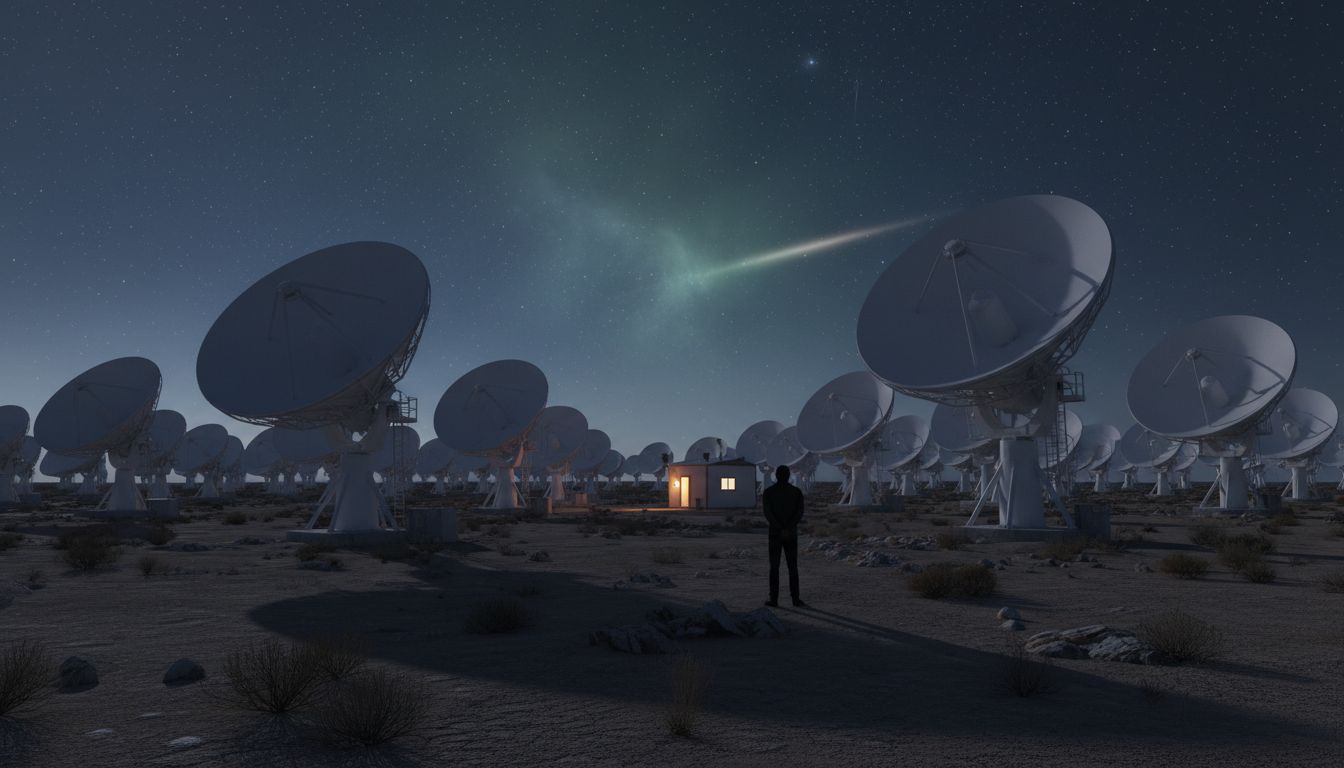
Last summer, the interstellar object 3I/ATLAS—the third known visitor from beyond the Solar System—prompted a flurry of observations across the astronomical community. While most researchers classified it as a natural comet, the object's unusual trajectory and brightness led some, notably Harvard astronomer Avi Loeb, to suggest a possible artificial origin. In response, the SETI Institute deployed the Allen Telecope Array (ATA) at Hat Creek to conduct the most comprehensive radio technosignature search to date, ultimately reporting no evidence of engineered signals.
Methodology
The ATA’s wide‑band capability allowed SETI scientists to monitor 1–10 GHz across billions of narrowband channels simultaneously. “We searched for narrowband signals across a broad range of spectrum: 1–10 GHz. We can do this efficiently due to the ATA’s ability to record and search billions of channels at a time,” explained Dr. Sofia Sheik, lead author of the new paper describing the effort. Observations were timed to coincide with the object’s closest approach to Earth, maximizing signal‑to‑noise ratio. Data were processed using the institute’s standard pipelines for radio technosignature detection, which flag any signal that is both narrowband and non‑repeating—hallmarks of artificial transmission.
Findings
After weeks of continuous monitoring, the analysis returned no narrowband or broadband anomalies that could be attributed to technology. The null result aligns with the consensus among planetary scientists that 3I/ATLAS exhibits cometary composition, including a dusty coma and a trajectory consistent with solar radiation pressure. “The data were clear: no signs of artificial signals,” Dr. Sheik reiterated in an email to The Debrief. The paper notes that the sensitivity of the ATA during the observation window was sufficient to detect transmissions comparable to Earth’s most powerful radar systems, should they have been directed toward the object.
Expert Commentary
Avi Loeb, who has long advocated for keeping an open mind about potential extraterrestrial artifacts, responded calmly to the SETI findings. “The absence of a radio signature does not rule out other forms of technology,” Loeb said, adding that “future missions might need to look for optical, infrared, or even gravitational signatures.” Independent experts echoed this measured view. Dr. Megan Rossi of the University of Arizona, a specialist in interstellar comet dynamics, noted, “Radio searches are a logical first step, but we should also consider that an advanced civilization might employ communication methods beyond our current detection capabilities.” Meanwhile, Dr. Carlos Mendoza of the International Astronomical Union stressed the importance of null results, stating that “each non‑detection refines our models of what natural interstellar objects look like, sharpening the tools we’ll need if a truly artificial object ever appears.”
Broader Implications
The 3I/ATLAS campaign highlights a growing trend: the integration of SETI protocols into routine observations of transient celestial bodies. As telescope technology advances, the frequency of interstellar object detections is expected to rise, providing more opportunities to test hypotheses about extraterrestrial technology. Dr. Sheik reflected on the long‑term perspective, “Eventually, our own Voyager spacecraft will be extraterrestrial artifacts in other stellar systems. Understanding the natural distribution of interstellar objects now is essential for recognizing any future anomalies.” The episode also underscores the scientific community’s cautious stance on UFO claims—favoring rigorous data analysis over speculation—while keeping channels open for interdisciplinary collaboration should any credible technosignature ever emerge.