Overview
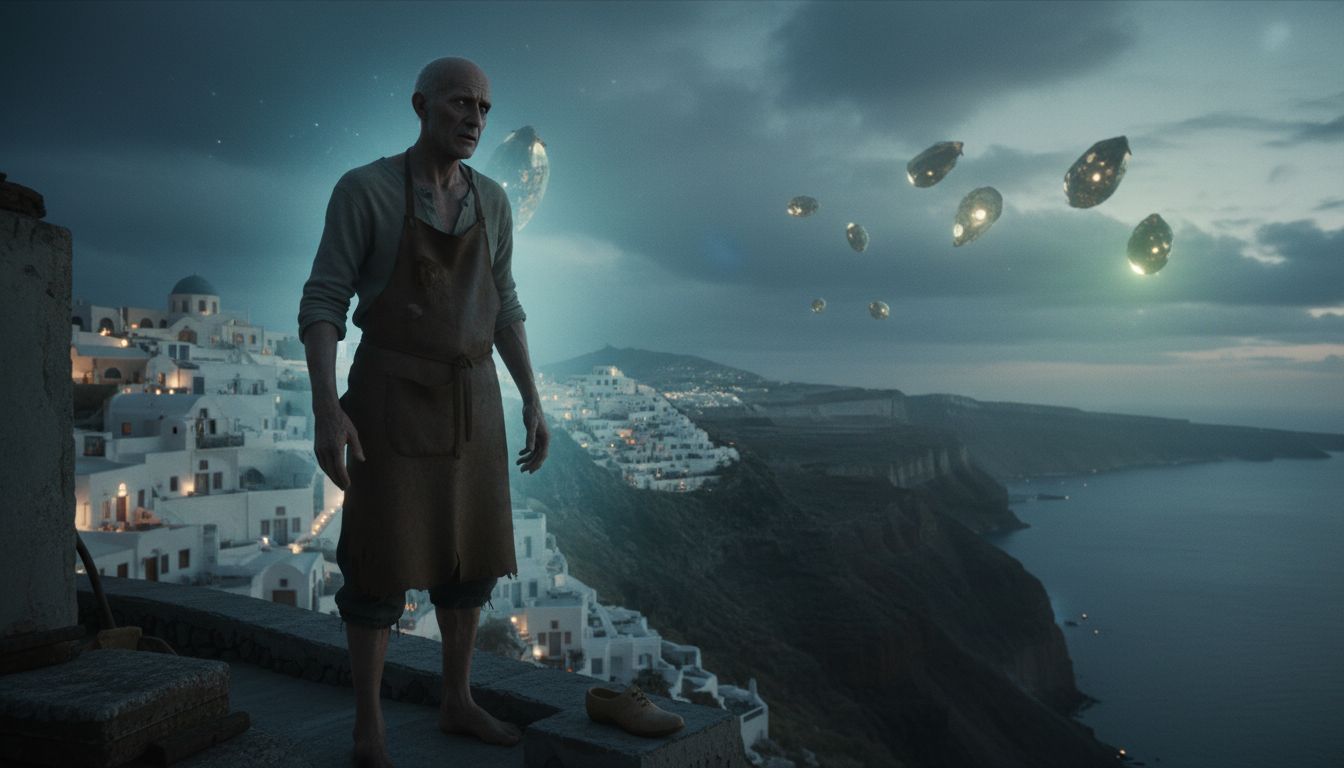
On the sunlit island of Santorini, better known today for its whitewashed villages and volcanic caldera, one of Greece’s oldest documented vampire legends takes an unusual turn. The story centers on Alexander of Pyrgos, a shoemaker who, according to local folklore, returned from the dead as a Vrykolakas — the Greek undead figure often compared to a vampire. But unlike the bloodthirsty monsters common in later folklore, Alexander was remembered for something far stranger: he reportedly came back not to prey on the living, but to help his family.
The tale is preserved in early written accounts from a French Jesuit priest, François Richard, whose 1657 publication, Relation de l’Isle de Sant-erini, helped bring Santorini’s ghostly traditions into the historical record. Richard interpreted the Vrykolakas through a religious lens, describing it as a form of diabolic possession. His account is among the earliest sources cited in discussions of Greek vampiric folklore and offers a rare glimpse into how such stories were understood in the 17th century.
The Shoemaker at Pyrgos Castle
According to the story, Alexander lived a humble life as a shoemaker at Pyrgos Castle on Santorini, also known historically as Pyrgos Kallistis. He was remembered as a gentle and kind man in life, which makes his posthumous transformation all the more mysterious. The sources do not explain exactly what caused him to become a Vrykolakas, and that absence of detail is notable: in many Greek vampire traditions, the undead are said to arise from lives marked by sin, social transgression, or improper burial. Alexander does not seem to fit that pattern.
His profession has also attracted attention because he is not the only shoemaker in folklore said to have returned as a vampire-like figure, though no clear reason has ever been established for the connection. In this case, the shoemaking detail may simply reflect the way oral tradition preserves memorable occupations, making the figure easier to recall and retell across generations. What remains striking is that the story presents a dead man who continues the ordinary labor of family life rather than becoming a threat to it.
A Helpful Undead Figure
The most eerie aspect of Alexander’s story is that his return from the grave was described as useful rather than violent. Instead of attacking his household, he was said to have appeared to his wife much as he had in life, mending the children’s shoes, carrying water, working on the house, and chopping firewood. In a folklore tradition where the dead often return to disturb the living, this version of the undead blurs the line between domestic devotion and supernatural unease.
That contradiction likely helped keep the story alive. It is unsettling precisely because it reverses expectations: the dead do not always come back as monsters. In Alexander’s case, the Vrykolakas becomes less a predator than a spectral laborer, a figure whose persistence after death may have reflected both grief and fear in the community that told the tale.
Folklore, Landscape and Belief
Scholars and storytellers alike have noted that Santorini’s volcanic soil may have contributed to the island’s vampire lore, since bodies do not always decompose in the same way as they might elsewhere. Whether or not that influenced the emergence of Vrykolakas stories, the island clearly provided fertile ground for legends shaped by Byzantine, Ottoman and Orthodox Christian traditions. Santorini’s reputation as a place of beauty and sunlight sits in stark contrast to these darker narratives, which may be why they continue to fascinate.
Alexander of Pyrgos stands out not because he was the most terrifying undead figure in Greek folklore, but because he was among the most human. His story captures an older world in which death, religion and local custom intersected in ways that made the supernatural feel close at hand. It is this tension — between the ordinary life of a shoemaker and the extraordinary claim that he rose again — that gives the tale of Pyrgos Castle its enduring chill.