
Overview
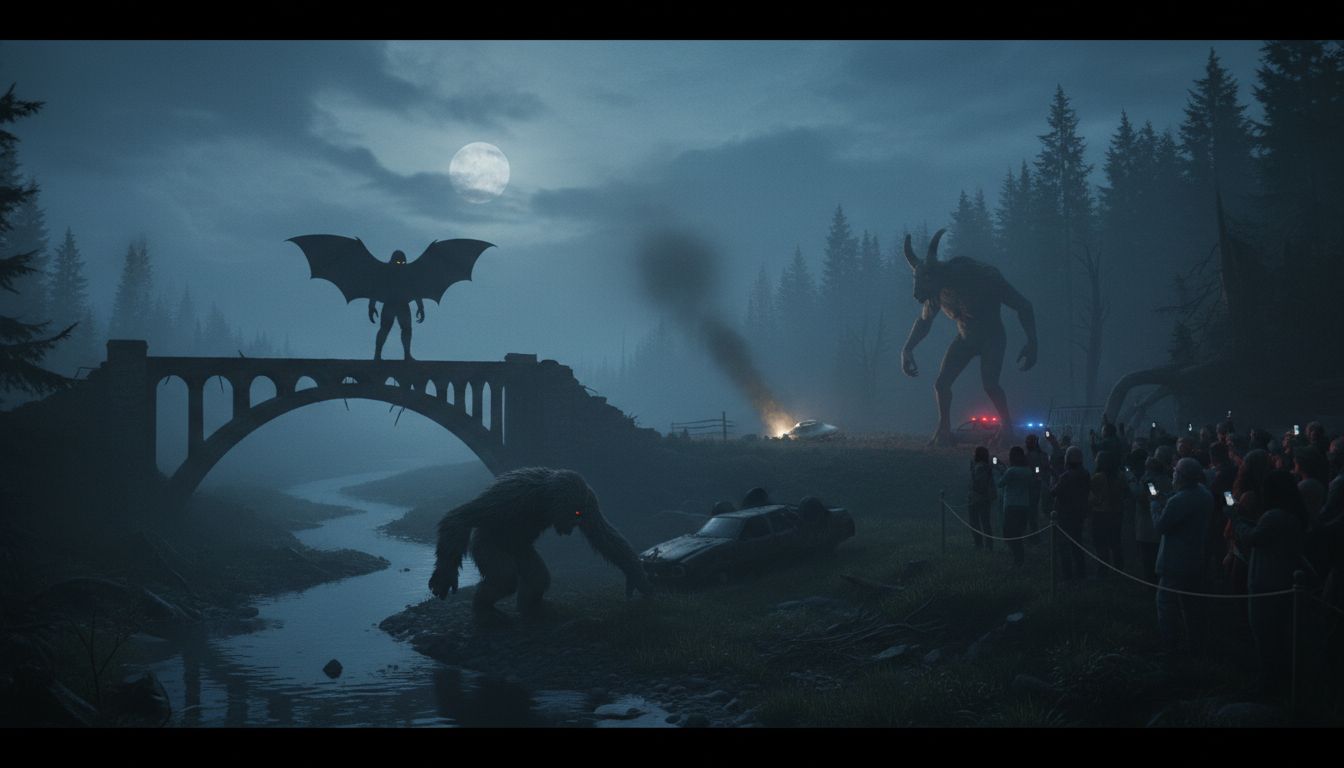
A growing body of folklore scholarship suggests that many cryptid legends—Mothman, Bigfoot, the Pope Lick Goatman—are repeatedly linked to local tragedies. Researchers argue that these creatures function less as literal threats and more as cultural symbols of collective fear, guilt, and unresolved loss. The pattern is evident in news cycles that connect unexplained deaths to cryptid sightings, and in the way towns transform sorrowful events into annual festivals that both memorialize and commercialize the myths.
Cryptids and Tragedy
The most cited example is the 1967 collapse of the Silver Bridge over the Ohio River, which claimed 46 lives. While the engineering failure was the official cause, the incident quickly became entwined with the Mothman legend, a winged humanoid reported near Point Pleasant, West Virginia. Local media and later documentaries framed the creature as a “harbinger of doom,” implying that its appearances were warnings rather than causes. Similarly, in December 2024, two Oregon men were found dead in Washington’s Gifford Pinchot Forest after a holiday hike that some outlets labeled a “Bigfoot‑seeking expedition.” Although investigators attributed their deaths to exposure, online commentary amplified the cryptid connection, with some commenters accusing authorities of a cover‑up. These narratives illustrate how cryptids are invoked to explain or dramatize misfortune, even when empirical evidence points elsewhere.
Notable Cases
Beyond Mothman, the Pope Lick Monster—often described as a goat‑like humanoid—has been linked to a series of accidents on a railroad trestle in Louisville, Kentucky. The legend grew after several hikers reported sightings, and the site later became a hotspot for thrill‑seekers, despite repeated warnings about dangerous tracks. In each case, the creature’s mythos is reinforced by repeated retellings of tragedy, creating a feedback loop where fear fuels folklore and folklore, in turn, fuels fear. Scholars such as Joseph Laycock, a religious‑studies professor, note that “the ritualization of disaster through legend allows communities to process loss while simultaneously attracting tourism.”
The Influence of Harvey Pratt
The death of 84‑year‑old Harvey Pratt on December 30, 2025, marks a pivotal moment for Bigfoot iconography. Pratt, a forensic artist who spent decades sketching alleged footprints and sightings, helped shape the modern visual language of Sasquatch—tall, shaggy, and human‑like. In a 2023 interview, Pratt explained that his goal was “to give a face to the unknown, not to prove its existence.” His meticulous drawings have been reproduced in documentaries, field guides, and merchandise, cementing a standardized image that persists across media. Pratt’s passing underscores how individual creators can embed personal artistic interpretations into the broader cultural memory of cryptids, reinforcing their symbolic power long after the creator’s death.
Tourism and Cultural Impact
Today, towns such as Point Pleasant host the Mothman Festival, drawing over 10,000 visitors each October. The event features costume contests, lectures, and a large statue of the winged figure, turning a historic disaster into a celebratory economic engine. Similar festivals for Bigfoot and Goatman have sprouted across the United States, often marketed as “cryptid tourism.” While these gatherings provide revenue and community cohesion, critics warn that commercialization can obscure the original tragedies, reducing complex historical grief to kitsch. As scholars continue to examine the interplay between folklore, trauma, and commerce, the pattern remains clear: cryptids serve as both mirrors of societal anxieties and catalysts for local economies—an uneasy partnership that persists long after the original tragedies fade from memory.


