Overview
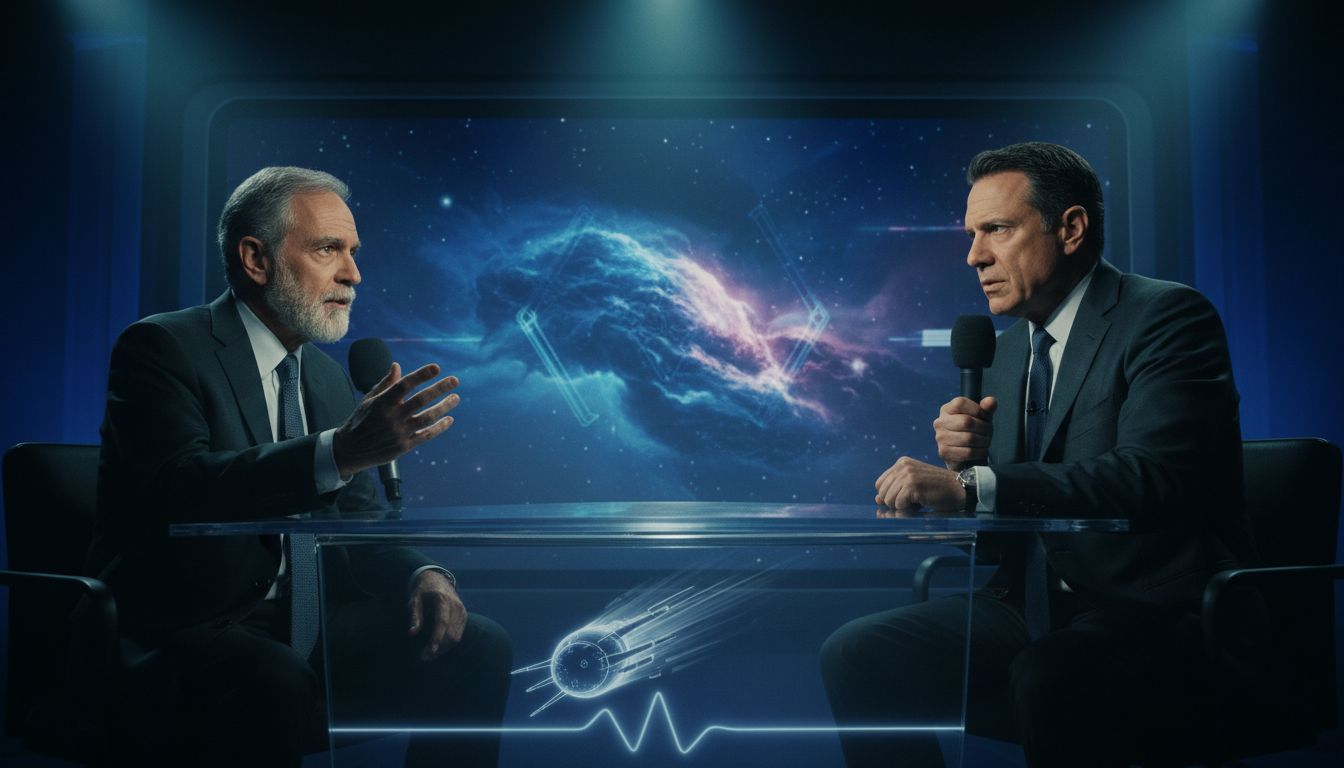
On a recent episode of "The Chris Cuomo Project," host Chris Cuomo sat down with Harvard astrophysicist Professor Avi Loeb to delve into the controversial question of whether some recent astronomical phenomena, particularly the so-called "3I Atlas" comet, could have technological origins. The conversation arrives amid a growing public fascination with Unidentified Aerial Phenomena (UAPs) and renewed scrutiny of the government's transparency on the issue. Loeb’s remarks challenge the prevailing scientific consensus, while additional reports from Cristina Gomez and Ross Coulthart highlight alleged government knowledge of underwater UFOs in regions such as the Baltic Sea and the waters off California.
The Mystery of 3I Atlas
At the heart of the discussion is the object known as "3I Atlas," the third interstellar visitor detected by earthbound telescopes. Discovered by the half-meter Atlas survey telescope in Chile, the object has sparked debate within the scientific community due to its size and trajectory. Loeb explains, "Its mass is at least a million times bigger than the first visitor we had," referring to 'Oumuamua, the first known interstellar object observed in 2017. This discrepancy raises questions: Why would such a large object arrive before seeing many smaller ones, as probability would suggest?
Loeb notes that the odds of such a massive object entering our solar system within a decade are extremely slim—about 0.1% by his calculations. Even more striking, the comet’s path aligns within five degrees of the ecliptic plane, the flat plane in which all the planets orbit the sun. "The chance of that happening at random is one in 500," Loeb asserts, suggesting that such alignment may not be coincidental.
Challenging the Scientific Status Quo
Loeb’s skepticism extends to the broader scientific community’s approach to anomalies like 3I Atlas. He criticizes what he sees as "the arrogance of expertise," arguing that specialists are sometimes too quick to categorize every unexplained object as a conventional comet or asteroid. "These experts were trained on data sets that include only comets. So for them, anything in the sky must be a comet—even if it’s a spacecraft," Loeb contends.
He points to the example of 'Oumuamua, which displayed none of the typical signatures of a comet—no gas, no dust, no tail—but was still explained away by many as a "dark comet." Loeb argues that true science is built on humility and the willingness to learn, not on rigid adherence to established frameworks. "The foundation of science is based on the humility to learn, not on the arrogance of expertise," he stresses.
Government Secrecy and Underwater UFOs
Parallel to the scientific debate, journalists Cristina Gomez and Ross Coulthart have raised concerns about alleged government knowledge of underwater UFOs or UAPs in areas such as the Baltic Sea, Catalina Island, and Santa Monica Bay. These reports suggest that significant information may be withheld from the public, fueling speculation about the administration’s commitment to transparency.
The convergence of new scientific mysteries and persistent governmental secrecy has only intensified public interest. As Cuomo summarized at the outset, "I want the answers to all these and so do you." The episode underscores the growing demand for openness—both from scientists willing to question orthodoxy and from officials who may know more than they’re letting on.
The Path Forward
As researchers like Loeb push for unbiased investigation and journalists continue to probe official silence, the debate over the origins and significance of objects like 3I Atlas is likely to intensify. Whether these anomalies are natural wonders or evidence of advanced technology, the call for humility, transparency, and rigorous inquiry is only growing louder. The conversation on "The Chris Cuomo Project" serves as a reminder: in the search for truth, asking uncomfortable questions may be just as important as finding answers.